

Much like its hordes of shambling infected, the zombie genre is one that never truly dies, and no other video game franchise is as synonymous with the undead as Capcom’s Resident Evil. Over the course of eight mainline titles and a plethora of spin-offs, the franchise has cemented itself as not just a staple of zombie games in general, but that of survival horror titles too.
After 30 years since its debut in 1996, one would think that Resident Evil has run out of ideas by this point, but that’s far from the case, as with Resident Evil Requiem, the team is attempting something they dabbled in previously, but are now looking to fully flesh out – having two playable protagonists with vastly different playstyles.
With newcomer Grace Ashcroft (daughter of Resident Evil Outbreak’s (2003) Alyssa Ashcroft) joined by series legend Leon Scott Kennedy, Resident Evil Requiem gives players the opportunity to experience both the atmospheric tension of later franchise titles like Resident Evil 7: Biohazard (2017) and the raw action of the Resident Evil 4 remake (2023). In addition, the title also marks a celebration of the franchise’s roots of sorts with a return to Raccoon City, ground zero of the viral outbreak and the origins of Leon’s journey.

Nostalgia can be a tough act to balance, especially when combined with such ambitious gameplay systems, but fortunately, Resident Evil Requiem largely succeeds in providing a nice throwback supplemented by some of the franchise’s most polished gameplay experiences yet. It’s too bad that some questionable design choices, a forgettable storyline, and a painfully short runtime hold it back from reaching the heights of its predecessors.
Resident Evil Requiem begins with a central mystery – a series of five dead bodies are found with strange black bruises covering their hands, and interestingly, all had been survivors of the Raccoon City incident. The FBI sends their most capable technical analyst, Grace Ashcroft, to the scene of the five bodies to investigate, which just so happens to be in the same place her mother Alyssa, was tragically murdered eight years ago.

Of course, this is Resident Evil we’re talking about, and there are no coincidences, as Grace soon finds herself stalked and captured by a mysterious hulking individual, Dr Victor Gideon. Enter Leon Kennedy, who’s on the same case as he is suffering from an infection with the same symptoms as those seen on the bodies of the deceased.
After learning Gideon has ties to Umbrella, the corporation responsible for the initial viral outbreak almost 30 years ago, Leon pursues the mysterious doctor, only for his and Grace’s paths to converge and send them both back to where it all began – the now destroyed Raccoon City, where they learn of a mysterious keyword: Elpis. A new strain of virus? Or some other form of superweapon? No one knows, but one thing’s for sure, Gideon believes it can change the course of history, and that Grace is key to unlocking it.

As Resident Evil storylines go, Requiem’s is servicable, but not particularly interesting. While later games in the franchise weren’t afraid to throw some curveballs in its narrative (like the big Ethan reveal near the end of 2021’s Resident Evil Village), Requiem plays it really safe in comparison, and while a safe story is still much better than a bad one, it does make its overall plot a little forgettable.
Instead, what Requiem excels in providing is a celebration of Raccoon City and, by extension, Leon himself. Almost every location players visit or character they meet has some ties to the initial outbreak Leon was a part of, making for many a “Oh, I remember that!” moment, such as Leon returning to a dilapidated Raccoon City Police Department (R.P.D.), which offers a better look at the true extent of the damage the outbreak caused alongside his growth as an individual.

Speaking of growth, the Leon we see here is far from the rookie cop seen in Resident Evil 2 (1998), as his many encounters with the undead since then have left him a hardened zombie-killing veteran. Leon’s back, and so are his iconic one-liners, although admittedly, Requiem does go a little overboard in this regard, with almost every line delivered being some sort of witty comeback. It’s fine for the first few dozen times, but after that, it just feels forced and out of place.
Grace, on the other hand, has the unique prospect of being a complete newcomer to the franchise, and Requiem takes advantage of this by making her the most vulnerable character seen in the franchise thus far. As an analyst with only the basic FBI training and little to no field experience, having the horrors unfold in front of her eyes with such fragility definitely adds to the overall tension of her gameplay segments, which is a nice change of pace and arguably a more realistic reaction to what the average person would feel when faced with a horde of flesh-hungry zombies.

Much like Leon’s one-liners, however, this same vulnerability does overstay its welcome, as unlike past Resident Evil characters with a similar lack of experience like Claire Redfield or Ethan Winters, Grace never really grows throughout her time in the game, largely remaining a damsel in distress even as the game comes to a close.
While its story banks heavily on nostalgia to carry it through, Requiem’s gameplay is nothing short of excellent. The game is essentially split into two portions, the stealth-heavy, resource management style of Grace that mirrors the classic survival horror experience of games like Resident Evil 2 and 7, and the action-focused portions with Leon, which play out like an amped up version of Resident Evil 4, and sometimes even to the extent of Resident Evil 6 (2012).

We’ve already gone into the finer details of general gameplay in a previous preview, something that remains largely unchanged in the full build. As Grace, players will still be sneaking around locations, solving overly complex puzzle locks in true Resident Evil fashion, all while managing limited resources and balancing whether to fight or flee to reserve precious ammo. In a complete one-eighty, Leon’s parts are all about stylish action, powering through foes with an abundance of supplies and powerful weapons.
Player progression also defers slightly between the two characters, with Grace having to either find antique coins, à la Resident Evil 7, to unlock permanent stat boosters which improve either health or gun damage and control, or make them herself with the title’s new crafting system, which sees players extracting the blood of fallen foes or set blood collection points.
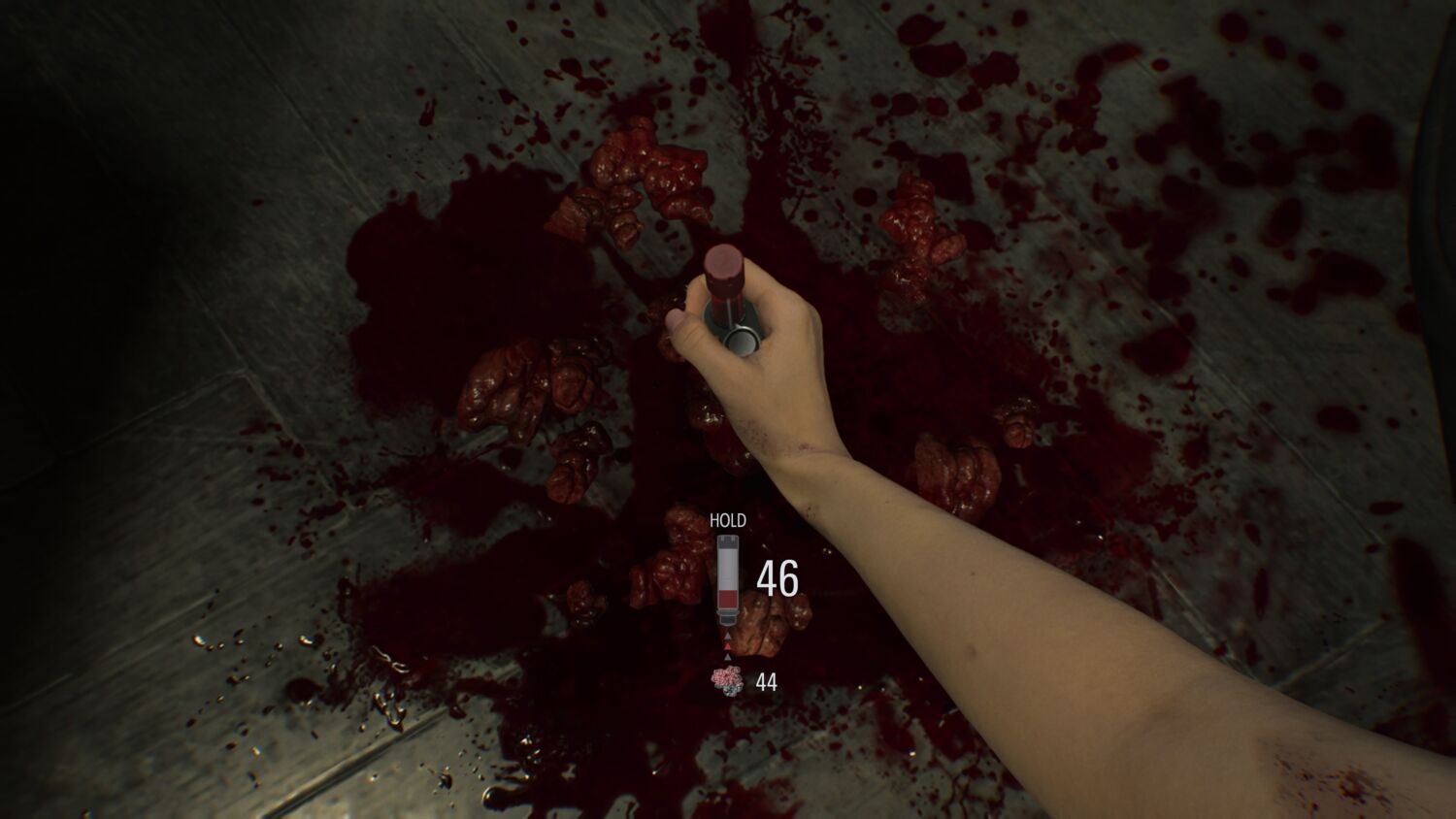
This way, the system also encourages open combat, and if players are able to pick their battles carefully and garner enough crafting components, it’s entirely possible to have a surplus of ammo early on, giving them the flexibility to choose between stealth and going guns-blazing as the situation calls for it, if they can reliably land hits, that is.
Continuing the tradition of Resident Evil’s “everyman” main character trope, Grace has very little firearms or field training as an analyst, something that’s presented extremely well in Requiem. Getting near hostiles leads to her increasingly unsteady breaths, which does wonders for immersion and makes it feel like the player is really in danger. When push comes to shove, Grace is able to hold her own, but, at least at the beginning, without upgrades, her gun handling is clearly not up to snuff, with tons of weapon sway and excessive recoil adding to the immersion of playing a character that’s clearly not in her element.

While Grace does get more “powerful” over time thanks to the aforementioned stat boosters, one thing that doesn’t change throughout is her melee “finisher” and her weapon. Unlike Leon’s iconic roundhouse kick, all Grace can muster is a quick shove that pushes foes to the ground, and apart from the powerful “Requiem” revolver given to her by Leon, Grace only has access to one type of firearm throughout the entire game, that being a basic pistol. These limitations make sense at the start since everything is still new to her, but by the end, it just feels like a wasted opportunity for character growth to not have her learn at least another new move or find a more powerful gun.
Leon, on the other hand, is the true definition of all guns blazing. He controls and plays almost exactly like how he did in the Resident Evil 4 remake, except with a few major improvements. His new combat axe, for example, can be sharpened on the fly without the need for finding resources, meaning players are free to parry and perform axe finishers on foes to their heart’s content. Leon is also able to perform flashy gun finishers by shooting low-health foes at close range, which admittedly serves no purpose other than making him look badass. In certain instances, he is also able to pick up and use dropped enemy weapons, such as throwing spears or axes to stagger foes for a quick kill, or even chainsaws to cause maximum carnage.

Unlike Grace, Leon doesn’t need to upgrade his stats at this point, with his progression instead similar to the system seen in the Mercenaries mode, a staple arcade mini-game seen throughout the franchise. Early on, Leon gets access to a special wrist band that rewards him with credits for every kill, which he can then exchange at supply boxes to purchase everything from ammo, armour, new guns, or even upgradable attachments for each weapon.
Among the two, Leon’s portions are by far the more interesting ones. While Grace’s slow-paced segments do provide the much-needed tension the franchise is known for, most of the excitement comes from Leon instead, and mowing down dozens of foes to unlock more powerful equipment to then mow down even more foes remained an interesting gameplay loop throughout.

Another area in which Resident Evil Requiem shines is in its zombie design and behaviour. As game director Nakanishi Koshi said in our previous interview, the goal was to make the most Resident Evil-like zombies possible, something the game has smashed out of the park. The game’s zombies might look like your standard franchise affair, but they act in a way that hasn’t been seen in the series thus far.
Zombies in Requiem aren’t just your mindless shamblers, as they retain the core memories of the person before their deaths. An undead custodian, for example, remains obsessed with switching off lights even after turning, meaning players can tactically lead him out of their way by turning on lights at strategic points. Some zombies were also patients that were ultra-sensitive to sound, meaning even the slightest movements can cause them to rush the player. The unique thing is that these “quirks” aren’t explicitly made known to the player, instead leaving it up to them to discover notes around the map that explain such unique behaviour.

Like most Resident Evil titles, zombies can also mutate, and here, they can morph into something known as Blister Heads, which can significantly up the difficulty if a player isn’t careful, as these mutants will rush players with immense ferocity and strength, and require quite a bit of ammo to take down, especially for Grace. The only way for her to prevent mutation is by crafting Hemolytic injectors, which takes up valuable resources, or by avoiding combat altogether, further amplifying the need for player choice. Leon, on the other hand, can mostly power through, as after all, this is just another day in the office for him.
It’s also to note that Resident Evil Requiem can be played in its entirety in either the first-person or third-person perspectives. The game does recommend the former for Grace as it ups the tension and the latter for Leon as it makes movements more fluid, although players are free to choose which perspective suits them best.

With these, Resident Evil Requiem marks an excellent culmination of the franchise’s gameplay systems over the years, but here’s the kicker – the game is also one of the shortest entries in franchise history. After experiencing the entire story at a leisurely pace and exploring every nook and cranny of each area to unlock nearly everything the game had to offer, our playthrough took slightly less than 10 hours.
This, by comparison, is even shorter than the already brief Resident Evil 7, which makes it a huge disappointment as for one, this is a fully priced AAA title, and for the other, Capcom had the opportunity to allow players to explore more never-before-seen areas in Raccoon City, but instead left us with an experience that ends just as its about to get good. This, coupled with the fact that Requiem’s ending was too “safe” and void of any mindblowing twists, means that it unfortunately closes on a low note.

As short as it is, Requiem does try its best to at least provide players with some interesting sights along the way. In the themes of celebrating the franchise’s past, players will get to explore a massive hospital early on, which gives off the same vibes as Castle Dimitrescu in Resident Evil Village, alongside parts of a destroyed Raccoon City and RPD itself, the latter two being the highlights.
There’s something inherently interesting about walking the streets of a location so integral to Resident Evil’s lore, against an almost hauntingly beautiful backdrop of destroyed buildings that still hold the ghosts of what was once a bustling town. The aforementioned R.P.D. is perhaps the best example of this, with those rooms that are still standing appearing almost exactly like Leon left them, albeit now caked in a layer of dust and debris.

Capcom’s proprietary RE Engine also shines here, just as it did with the Resident Evil 4 remake, offering high-resolution textures coupled with Path Tracing support on the PC, a first for the engine, with consoles receiving Ray Tracing support instead. Best of all, the game runs flawlessly on the PS5 Pro, with no noticeable drops even when the action ramps up.
As the ninth mainline entry of the franchise, Resident Evil Requiem manages to simultaneously provide some of the most thrilling sequences alongside some of the biggest letdowns in series history. Its dual gameplay styles of pure survival horror and intense action mean this is one title catered to both franchise veterans and newcomers alike, but one thing’s for certain, both are bound to be let down by its disappointing conclusion that arrives far too soon.
GEEK REVIEW SCORE
Summary
For all its gameplay evolutions and ambitions, Resident Evil Requiem’s disappointingly short run time and so-so narrative mean that this is one zombie-killing chapter that’s sure to leave players wishing for more.
Overall
8.5/10-
Story - 7.5/10
7.5/10
-
Gameplay - 9.5/10
9.5/10
-
Presentation - 9.5/10
9.5/10
-
Value - 7.5/10
7.5/10
-
Geek Satisfaction - 8.5/10
8.5/10

Kevin is a reformed PC Master Race gamer with a penchant for franchise “duds” like Darksiders III and Dead Space 3. He has made it his life-long mission to play every single major game release – lest his wallet dies trying.

 Joey Leong