This interview has been edited for clarity.
There is something poetic when a moment of destruction birthed something indestructible, but that’s the origin story of the now iconic Casio G-Shock wristwatch series. In 1981, engineer Kikuo Ibe was working at the Casio electronics company, then known for making scientific calculators and clocks, and accidentally bumped into a pedestrian on a Tokyo street, causing the mechanical watch his father gave him to pop off his wrist and shatter on the pavement.
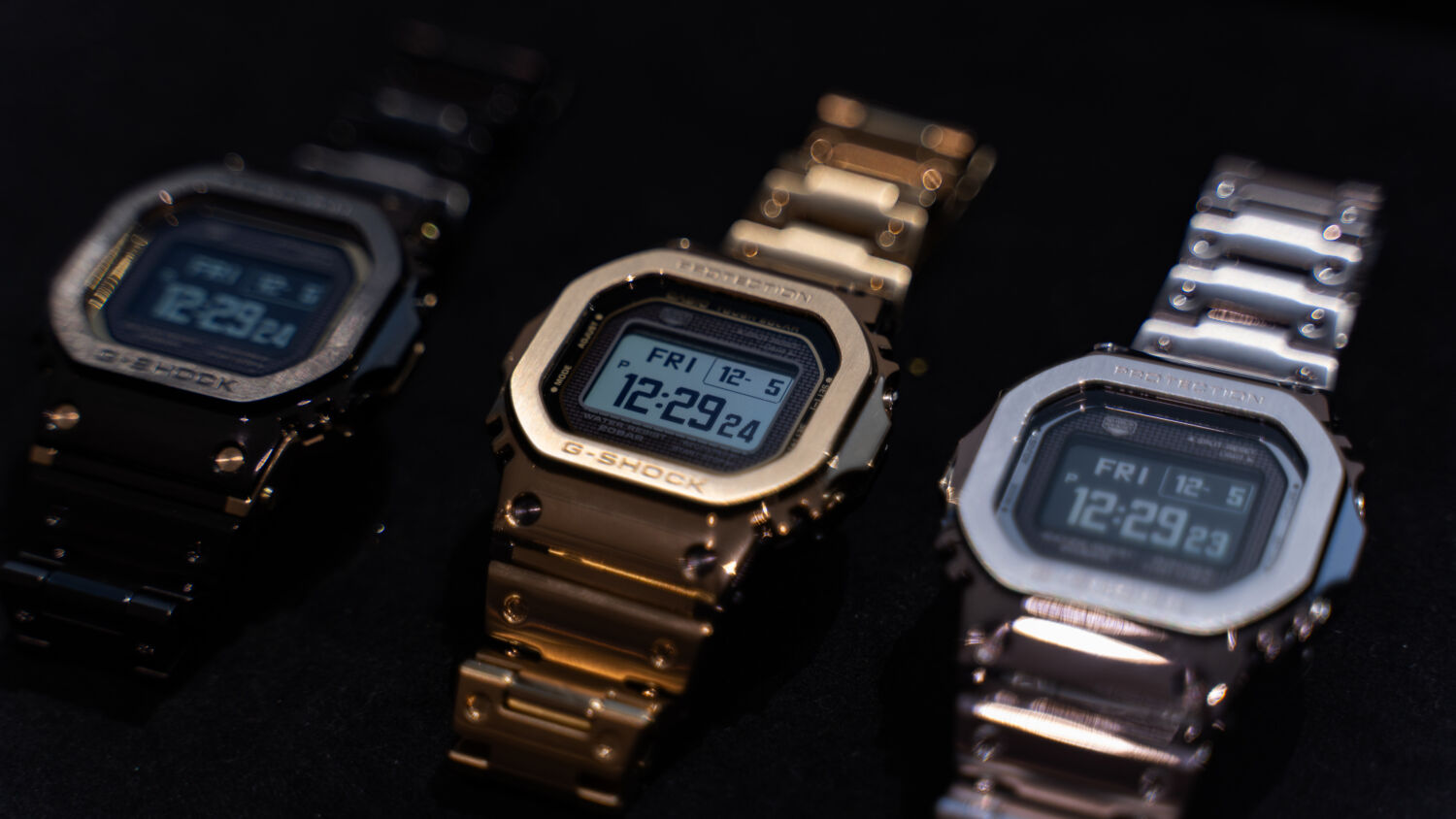
For most, the remnants of the irreparable device would simply become a painful memory and an expensive lesson. Ibe isn’t most, however, turning it into an obsession that took two years of tinkering, and while it’s been 42 years since his idea of toughness took shape, the iron-clad reputation of a G-Shock has hardly been dented. To pass the test, a G-Shock model must have “triple 10 resistance,” meaning it should last 10 years on battery, survive a fall from 10 metres, and boast water resistance of 10 bar, or the equivalent of 100 metres.
Over time, the technology introduced even sturdier features, including mud and magnetic field resistance, reinforcing the endurance of the iconic timepiece born at a time when dress watches were the norm. But just as time is fluid, the definition of ‘toughness’ can change, so G-Shock’s messaging has now gone beyond its original focus on physical form factor.
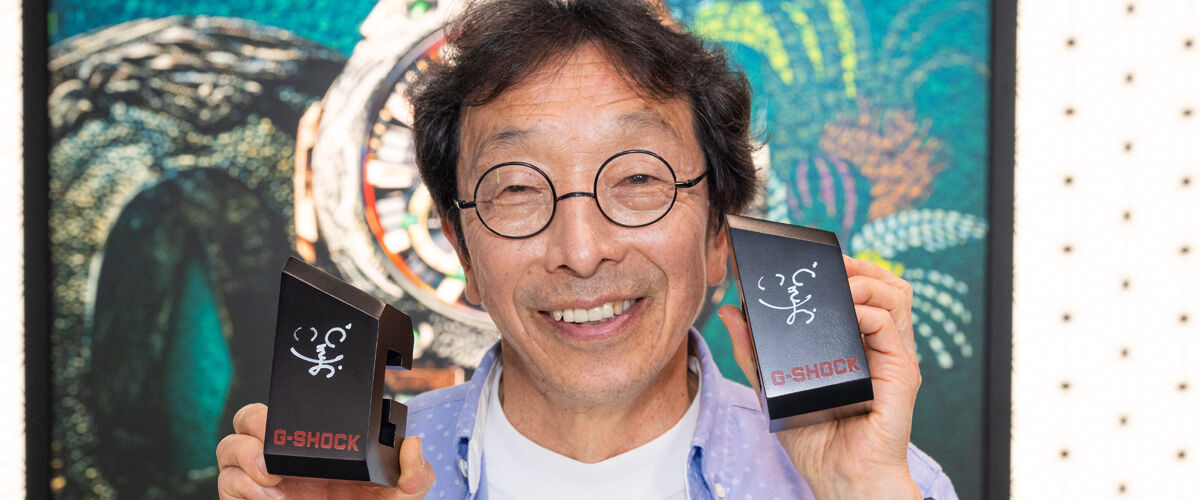
“When I developed the past G-Shocks, I considered ‘toughness’ to be a kind of durability, as in physical toughness,” says Ibe to Geek Culture in an exclusive interview held at the company’s office in Singapore. These days, he has included another aspect.
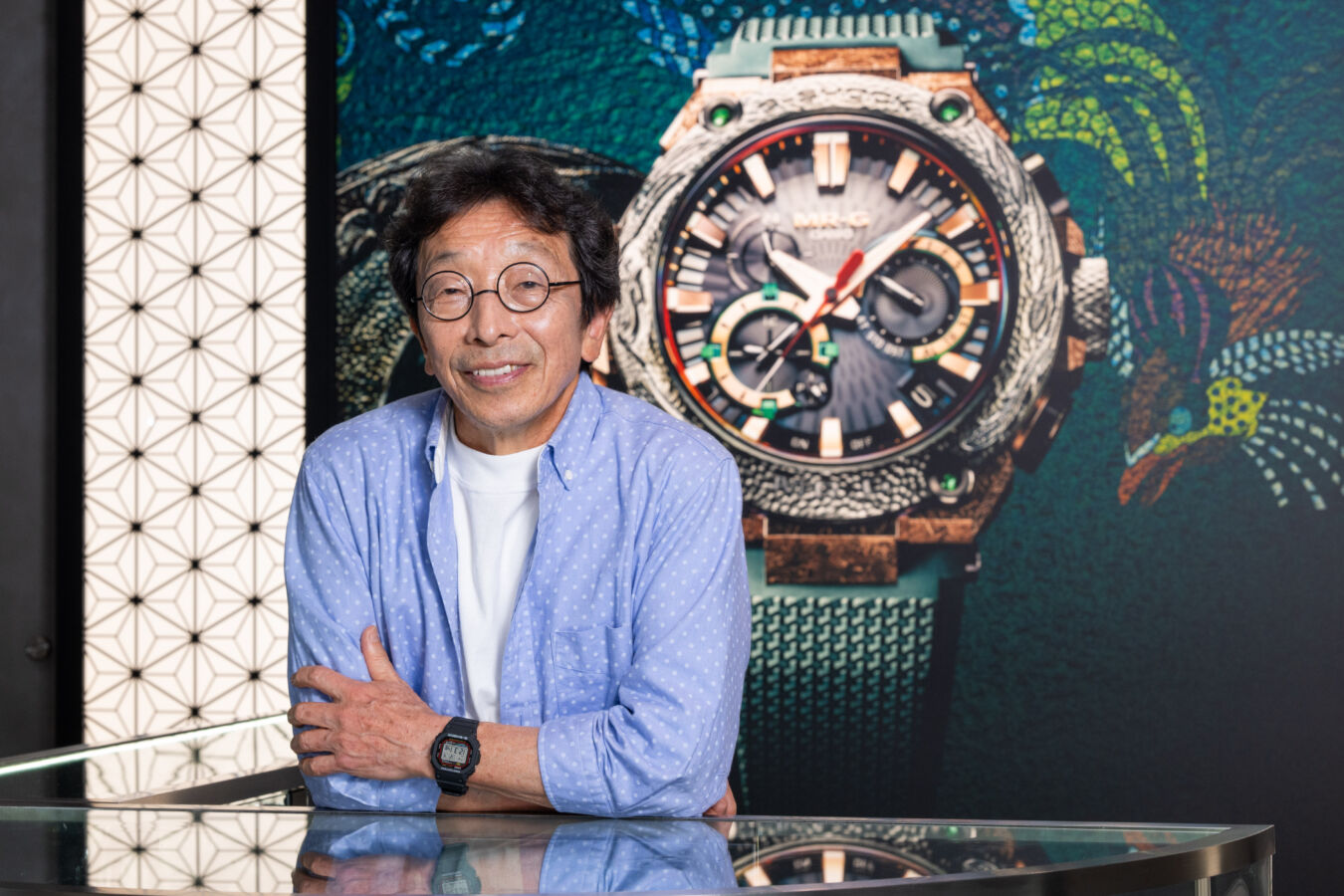
“Toughness comes in two forms: the first is physical, and the second is mental,” the 73-year-old continues.
“Today, through the initial development story, I convey a spirit of mental toughness, [of] never giving up, even when facing challenging situations; the G-Shock series tells the importance of challenging, to keep challenging to achieve the original ambition.”
The trajectory of G-Shock’s evolution may come across as unorthodox, but it’s certainly no surprise. When the original DW-5200 was released, the unconventional squared case, all-black aesthetic, and unapologetically utilitarian appearance was met with scepticism at home. In the US, though, Casio developed a bold marketing strategy involving using the watch as a hockey puck by a player, which drew criticisms for having overstated its toughness until independent verification validated the claims and earned the DW-5200C the nickname ‘Hero’, worn by athletes and the police.
And it was through this success story that circled back to Japan, via the Japanese youth culture’s fascination with American trends, that turned it into a domestic phenomenon.
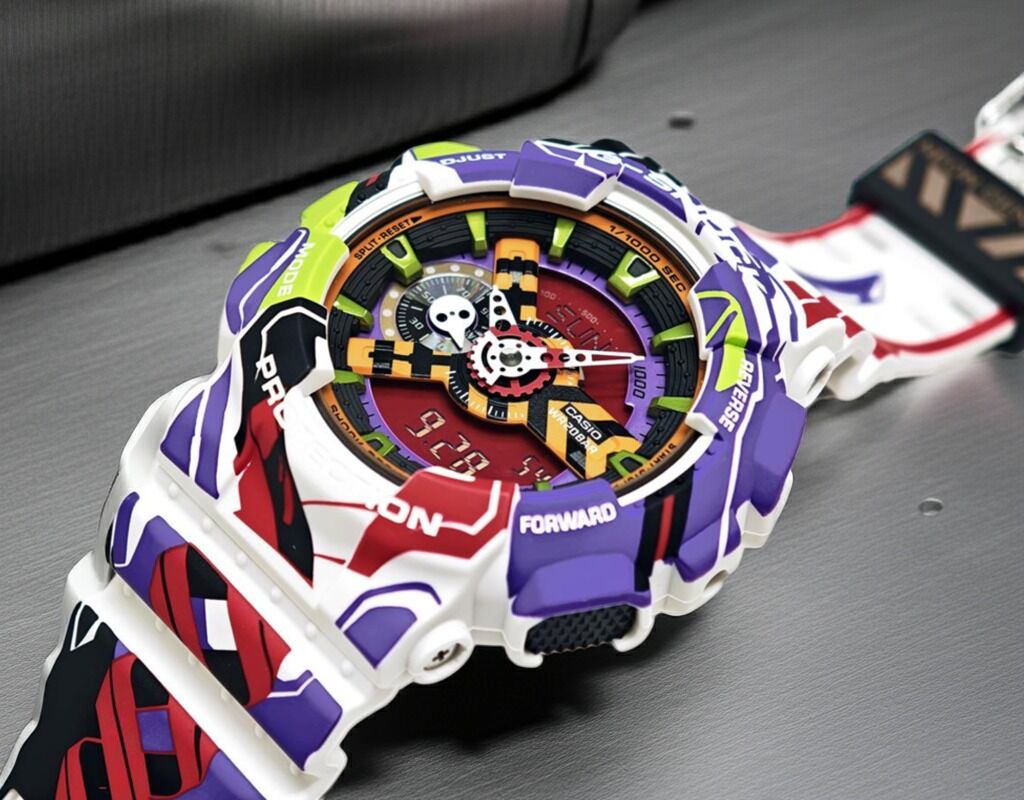
Over the decades, the brand has continued to defy the odds and become a household name by branching out into different line-ups. The pop culture collaborations, for instance, increase mass appeal through a combination of functionality and style, spanning anything from international music artists like Gorillaz, Japanese rock band ONE OK ROCK, and K-pop girl group ITZY, to anime (Neon Evangelion Genesis and Gundam) and video games (Super Mario and League of Legends), among others.
According to Ibe, the most important point – and the greatest challenge – lies in “incorporating the collaboration partner’s essence within G-Shock’s rugged design to convey the meaning” behind each crossover project. It’s this same attention to detail that drives the development of its MRG series, launched in 1996. The top-of-the-line premium range, characterised by a fusion of metal processing technology and traditional Japanese craftsmanship, marked another ambitious pivot as it proved that metal could be just as tough with the right engineering.
Finding the perfect fit isn’t always possible, however, and the industry veteran admits that many, many ideas didn’t get to see the light of day. Nonetheless, the brand has shipped over 100 million units globally, evolving from that first square model into a sprawling universe of designs. In 1989, Casio introduced its first analogue-digital G-Shock hybrid, the AW-500, signalling the brand’s willingness to expand beyond its digital roots. By 1993, the Frogman DW-6300 grew into a cult favourite among divers and collectors as the first ISO-certified 200-meter dive watch in the lineup.
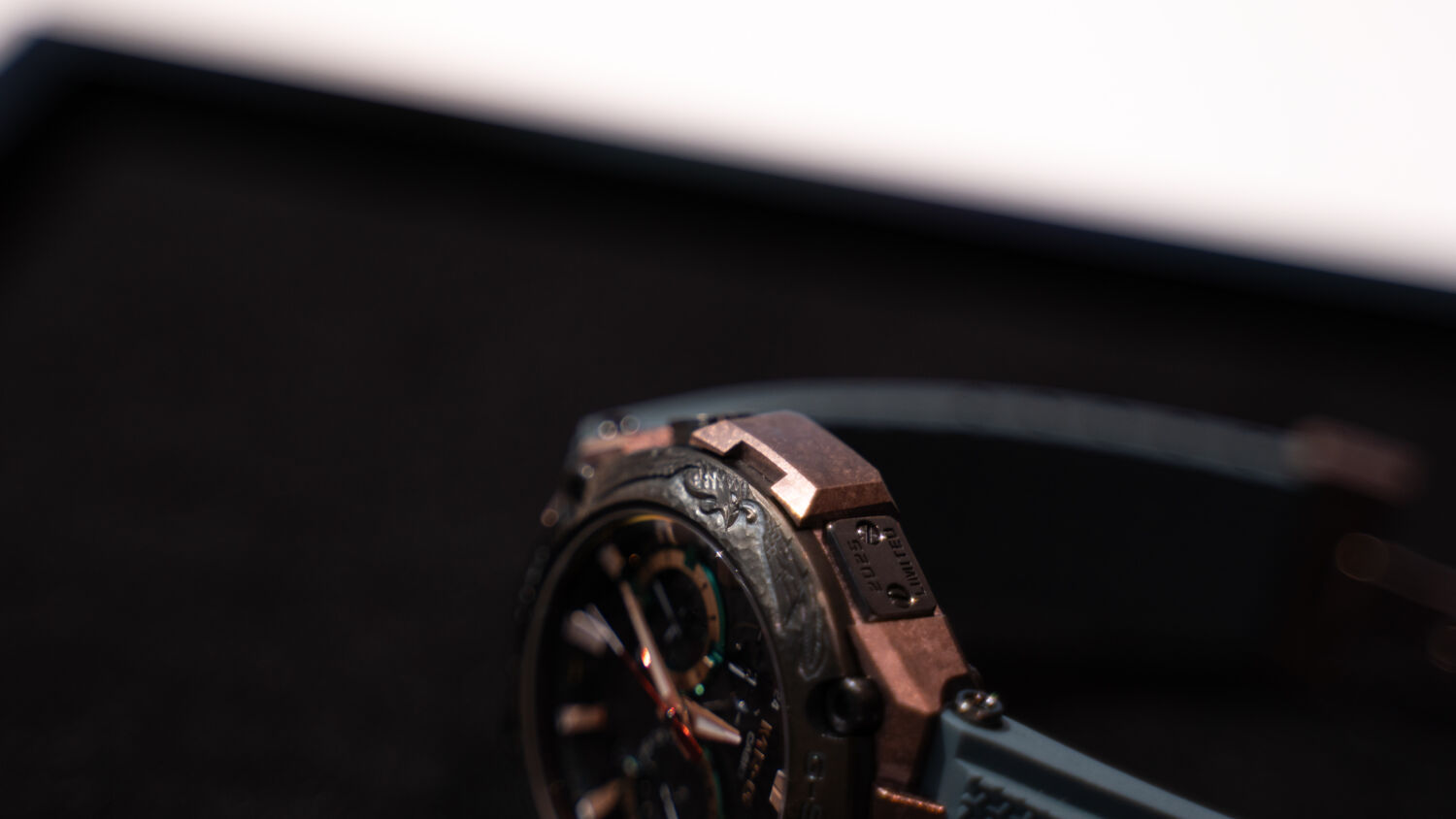
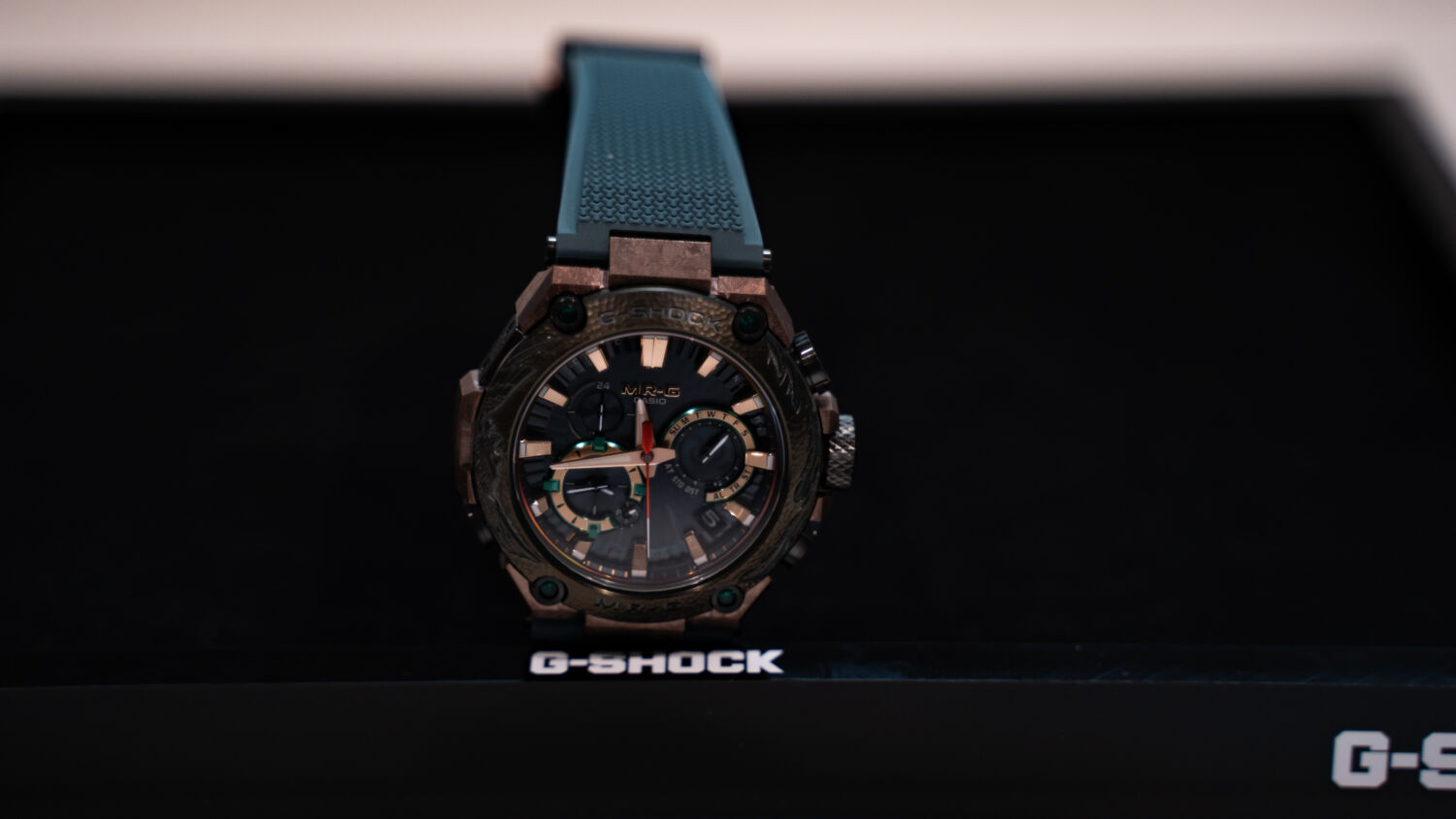
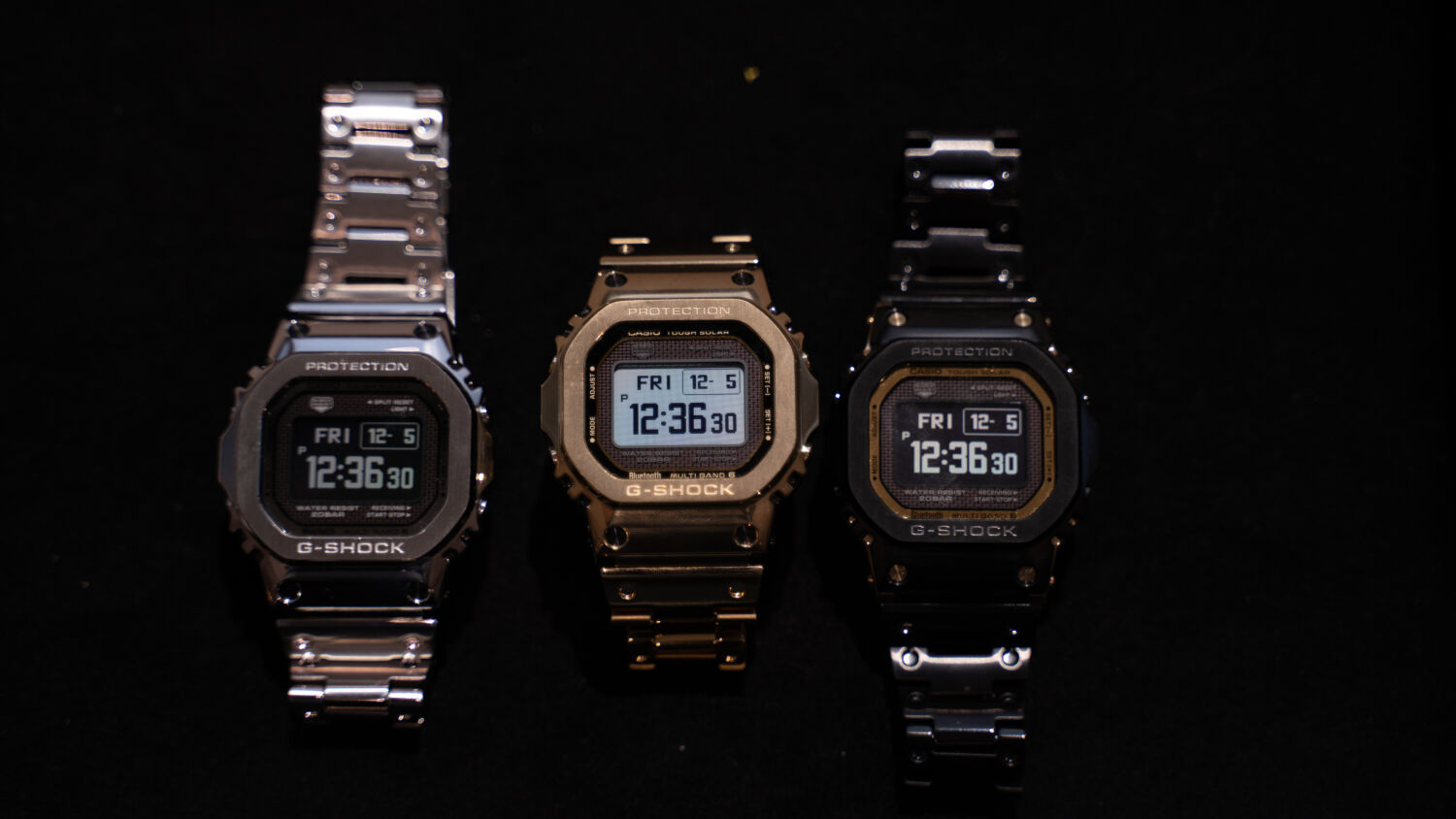
When the pieces do fall in place, the intricacies command attention. The latest limited-edition MRG B2000KT model pays homage to the fabled phoenix, revered in Japan as a symbol of good fortune, nobility, happiness, and longevity, through a fine engraving of the mythological creature, as well as a dial ring with colour gradation that expresses it in graceful flight. Adding to the personality is a titanium bezel with deep-layer hardening and a green diamond-like carbon (DLC) finish inspired by the kurogane-iro, a dark blue-green hue adorning the forged textures of traditional Japanese iron sword guards, or tsuba.
Like the rest of its family, the MRG 2000KT is in extremely short supply, limited to 800 pieces globally, of which 30 are reserved for Singapore, where it costs S$9,888. Alongside a unique serial number for each, no two pieces will be identical, as master metal engraver Masao Kobayashi has created a one-of-a-kind design for the engraved phoenix motif on the watch.
The seamless collision of different worlds, whether it’s pop culture or luxury, only serves to reinforce G-Shock’s standing as an unapologetic norm-breaker, especially with its steady following of female wearers from its S-Series, formerly known as Baby-G – a juxtaposition to the conventional association of “toughness” with masculinity. To Ibe, a self-proclaimed non-conformist, empowerment doesn’t discriminate.
“First of all, the G-Shock series shows support for those who want to overcome adversity,” he emphasises. “Regardless of whether the wearer is male or female, if they are able to draw just a bit of strength from wearing the G-Shock, I’d truly be happy.”
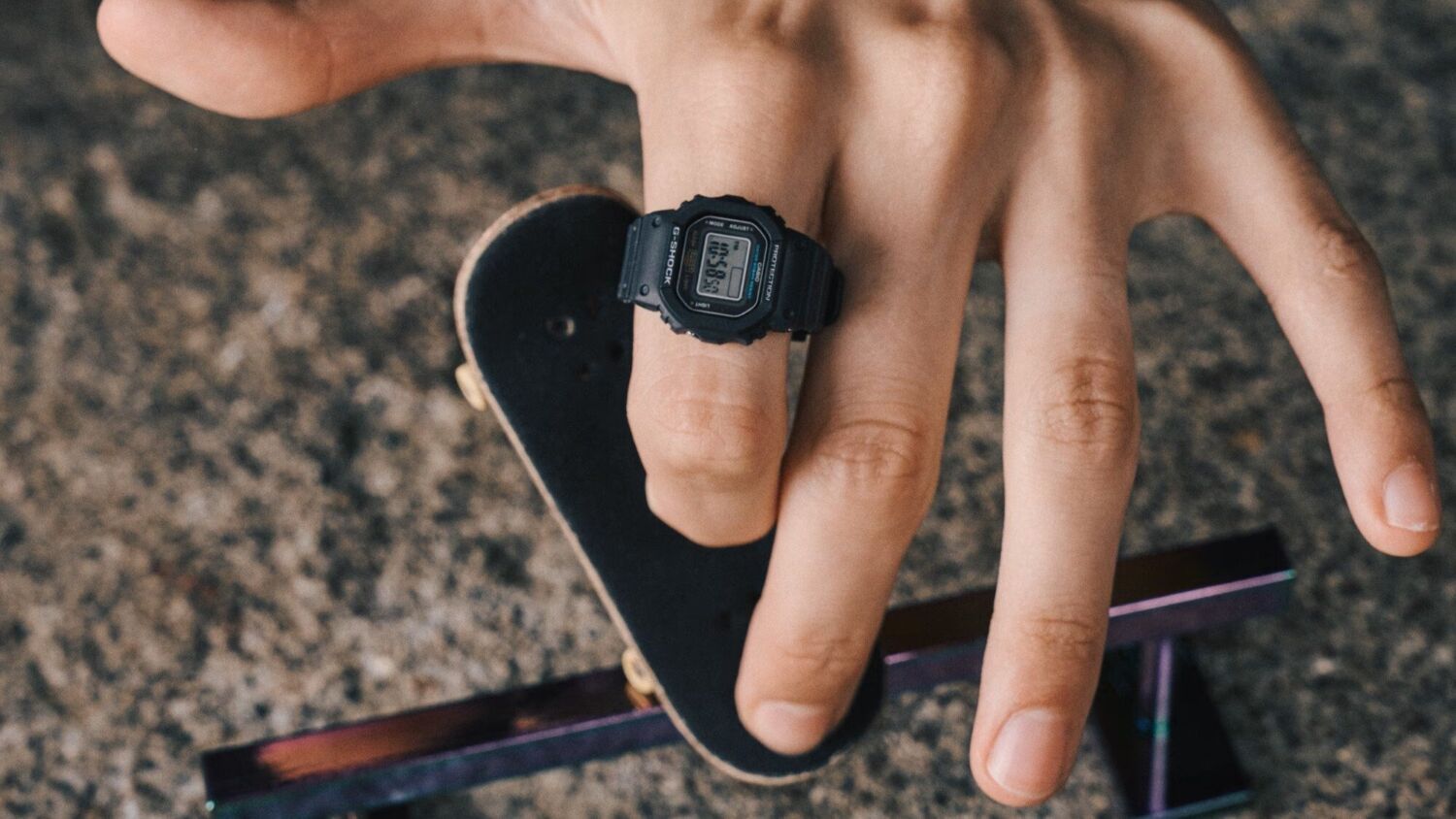
A long-standing legacy requires more than tradition alone to maintain and grow, though. In Casio’s case, the pursuit of innovation has brought it to repeated new heights and countless firsts, including last year’s G-Shock nano ring watch collection, which shrinks the original timepiece into 1/10 of its form factor without sacrificing signature elements like shock resistance, 20-bar water resistance, and a replaceable battery, as well as fully intact features ranging from a calendar and dual time to a stopwatch and more.
More recently, the brand onboarded the artificial intelligence (AI) movement with the MTG-B4000, which it describes as a co-creation between human developers and generative AI. It’s a bold move, particularly in the design space, where the term is shrouded in negativity – even if the use case here isn’t quite applicable to the typical output of text and images. Per Casio, the process involved debuting a new frame, initially developed through sketches by the G-Shock team, before generative AI was used to optimise them.
“It’s about how we use AI, [and] how we co-work with AI,” Ibe comments on reconciling this difference in viewpoint, highlighting that the tech is used for the most time-consuming task of evaluating the toughness and shock resistance structures to allow more time for creative tasks.
“We want to continue to co-work with AI and spend more human time on more creative fields,” affirms the industry veteran.
AI isn’t the only shift in recent years, with the smartwatch boom leading to declining demand for traditional watches. While Casio’s G-Square line of sport watches falls into this space, G-Shock models occupy more of a middle ground, making them susceptible to the potential threat. As it appears, there’s little cause for concern – Ibe confirms that the series hasn’t been significantly affected by smartwatches, while coolly acknowledging that the move towards health monitoring, fitness tracking, and other features like ECG is but a “very natural progression of technology evolution” that will continue to advance even further.
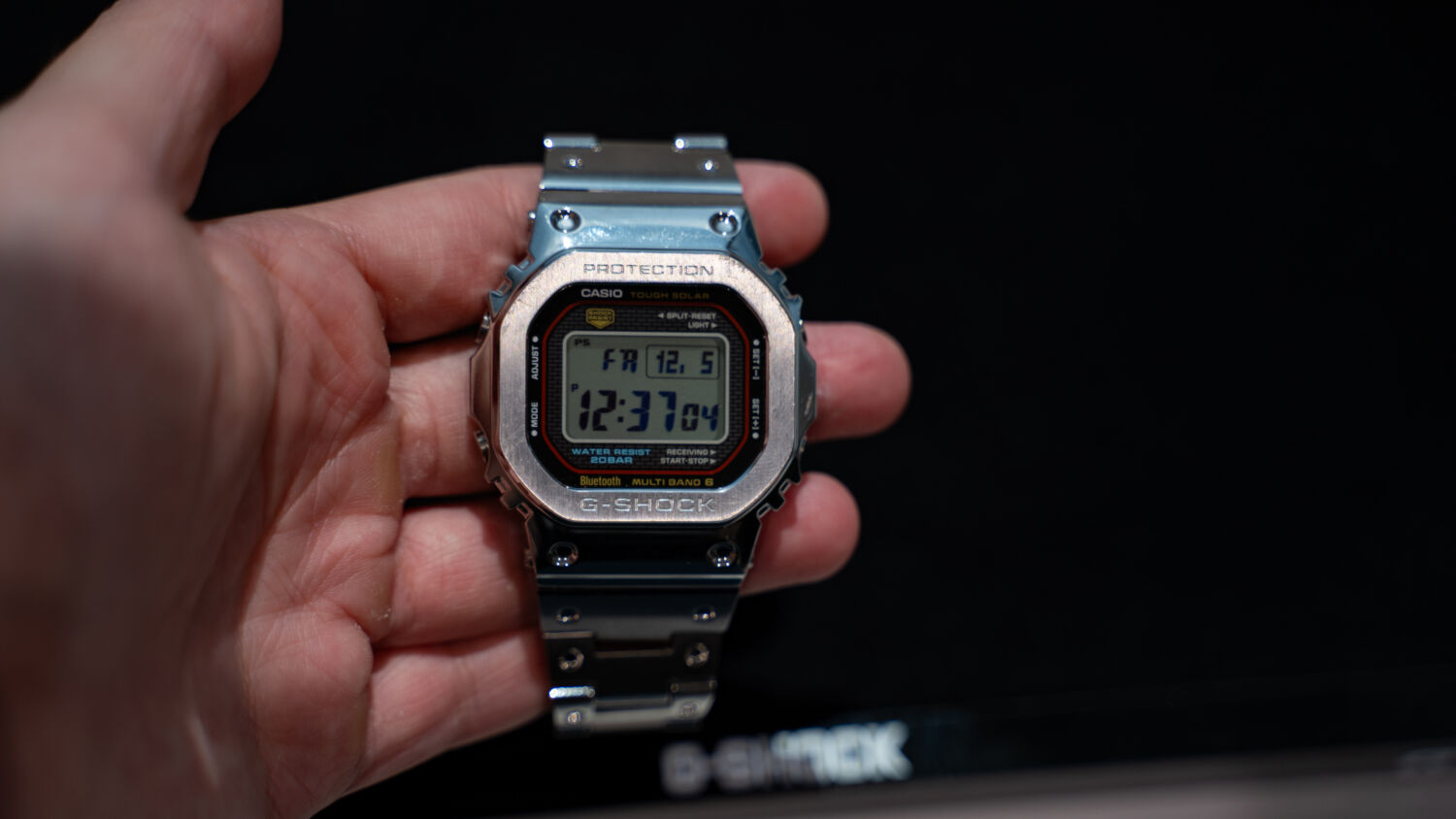
Instead of viewing smartwatches as existential threats, Casio’s G-Shock has selectively incorporated connectivity features, such as Bluetooth time adjustment, smartphone integration, and even GPS, while still maintaining the core identity that made the brand legendary. And in an era of planned obsolescence and disposable technology, there’s something deeply reassuring about a watch designed to outlast whatever punishment life can dish out.
He muses, “I believe that over the next 10 years, we will continue as before to take on the challenge and realise various techniques…The toughness of G-Shock should remain as new features are developed, becoming its core pillars alongside technology.”
As time continues to flow, Ibe hopes to turn his long-standing dream of developing a G-Shock for space into a reality someday. Of course, work is still underway, but there’s no harm in indulging fantasies every now and then, and the father of G-Shock played along when asked about potential naming options for the watch if it were currently available.
“Space-G!” Ibe enthuses, “Literally, to indicate that G-Shock can be used in space and withstand very harsh conditions.”
And wouldn’t that be another neat full-circle moment for a timepiece that uses the abbreviation of ‘Gravational Shock’, aka G-Shock, in its name?

Si Jia is a casual geek at heart – or as casual as someone with Sephiroth’s theme on her Spotify playlist can get. A fan of movies, games, and Japanese culture, Si Jia’s greatest weakness is the Steam Summer Sale. Or any Steam sale, really.

 Kevin Low