
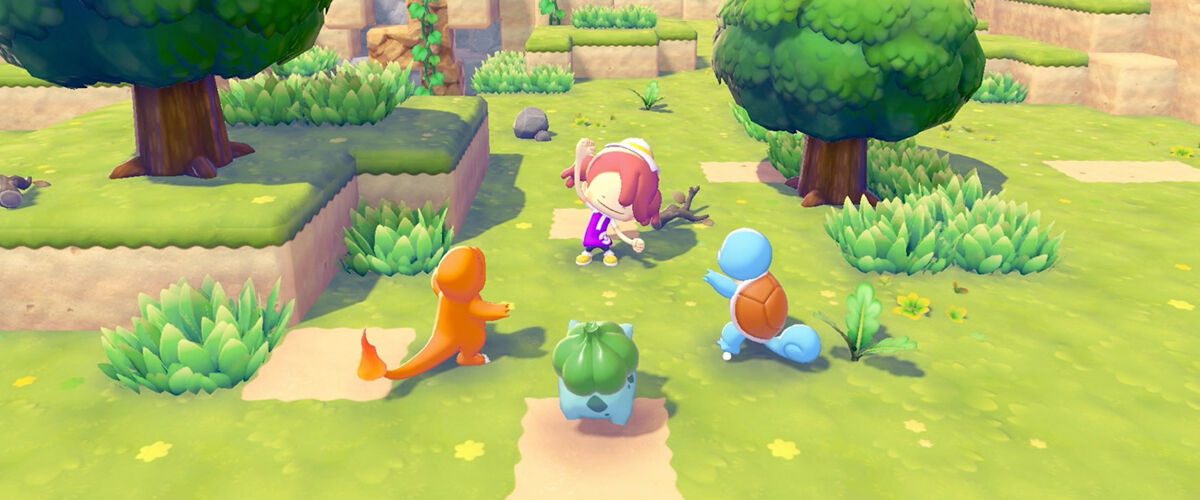
There’s a familiar rhythm to the mainline Pokémon games – embark on an adventure with a starter companion, encounter and catch more critters along the way, battle Trainers and the Elite Four, the toughest challengers in their regional Pokémon League, and defeat the Champion to become the best there is. While its 30-year history has seen various tweaks to the formula, the core elements remain unchanged to date, including Pokémon battles and a shared world in which humans co-exist with Pokémon.
Pokémon Pokopia bids both of these farewell in a bold move that has been a long time coming. The upcoming spin-off, planned and co-developed by The Pokémon Company, Game Freak Inc., and Koei Tecmo Games, presents a Ditto-shaped riff on the life-simulator flair, where players are tasked with rebuilding a desolate world alongside their Pokémon friends in a sandbox setting. Here’s the kicker: they play as a Ditto in human form, in place of the usual trainer role.
It’s a match in heaven, with the adorable critter designs lending themselves well to the domestic, cosy vibes of its genre brethren, and allowing for a welcome change in pace. Not everyone will appreciate this sense of lull, especially those who revel in the thrill of battle, but a 90-minute hands-on preview in Tokyo, Japan, rekindled the joy that comes with slowing down and going at one’s own pace, reminding players to take a breather when needed.

As human-form Ditto, the amorphous blob retains its signature beady eyes that, coupled with a soft-hued big head, exude an oddly charming (albeit slightly unnerving) look. Courtesy of a character creator, players can shape their own personality through basic customisation options, such as hairstyle, headwear, and gender, accessible via a full-length mirror in the game.
Taking them through the opening moments is Professor Tangrowth, the second and final Evolution of Tangela, who expresses surprise at Ditto’s shape-shifting capabilities and ability to communicate with other Pokémon. It then asks for help to clean up a mysterious region of the larger in-game universe and make it inhabitable once again, with the gameplay loop involving collecting materials for crafting, creating Pokémon-spawning habitats, and growing the population.
Like Ditto, Pokémon Pokopia adapts to its new thematic demands effortlessly without neglecting its roots. Where Pokémon moves are traditionally designed for combat, the title has reworked them into cultivation tools, starting with Bulbasaur’s Leafage to add greenery to the space. Grow enough grass patches to form a habitat, and new species will appear, unlocking more skills that can be used in tandem – for example, combining Leafage with Squirtle’s Water Gun, which hydrates dried plants, in the vicinity of a tree creates a different landscape that isn’t just tall grass. An intuitive grid layout offers visualisation of the reach of certain techniques, although it may take some time to nail down a precise execution without relying on the Nintendo Switch 2’s mouse functionality.
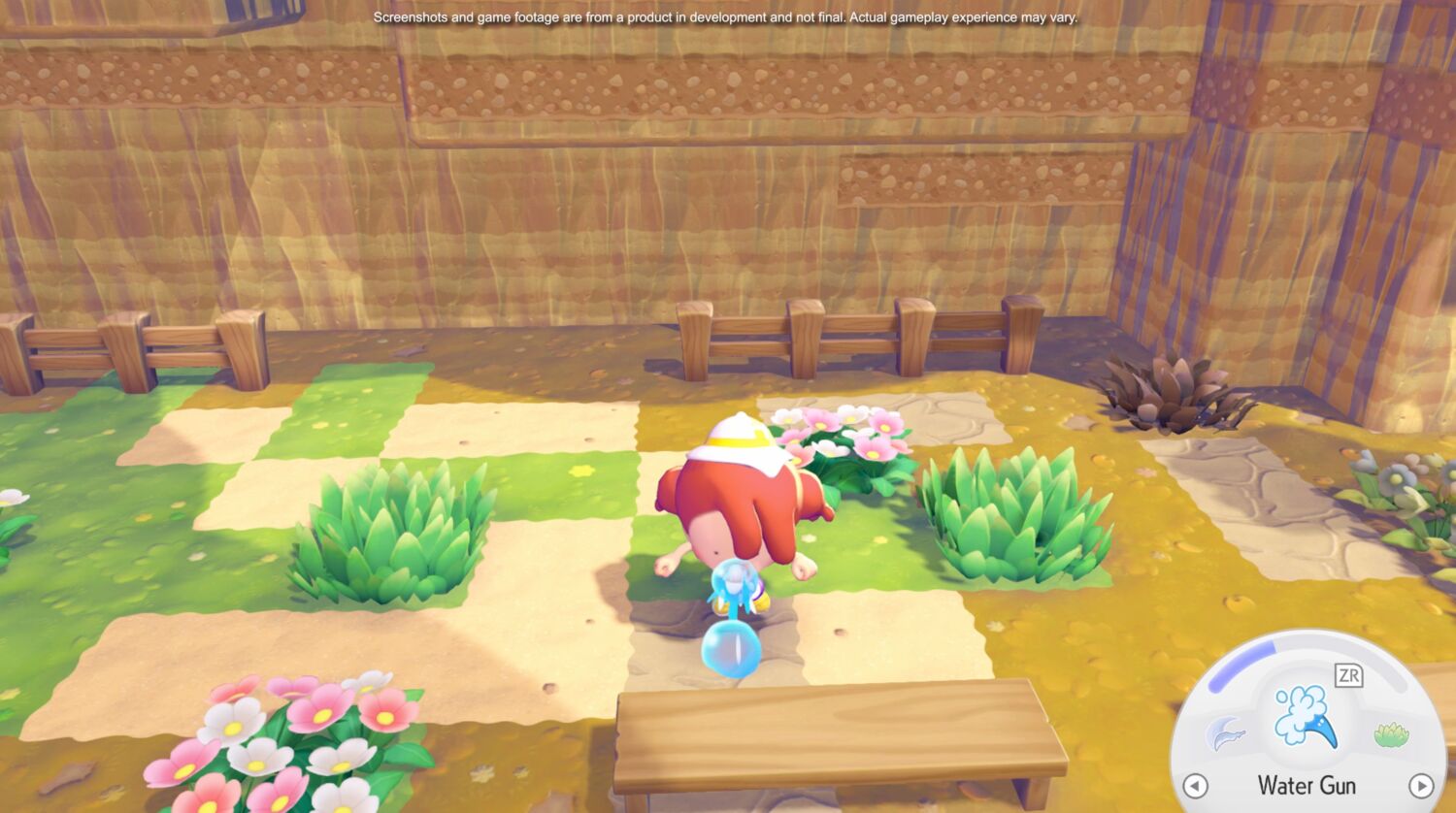
In true Pokémon fashion, the Pokédex returns with a stable of useful stats and information on Pokémon appearances, but players can also tap into a second database here. Similar to the Pokédex, the Habitat Dex keeps track of native critters for each after the discovery of sparkling traces, presented through familiar silhouettes that veterans will have no problem identifying. Other times, the moves prove necessary to remove obstacles in the way or gather crafting resources, including Cut for slicing through softer objects like lumber or bushes and Rock Smash to, well, pummel a stone or a wall into smaller bits.
Processing these materials at the crafting workbench transforms them into furniture, buildings, decorations, and the like, and while it always feels satisfying to spruce up a space, their functionality extends beyond aesthetic value. Placing a straw bed within the clearly demarcated boundaries of a habitat, for instance, increases the comfort level and happiness of Pokémon there, resulting in a stronger bond, improved living conditions, and one step closer to a cosy utopia.

Naturally, not all crafting recipes will be available from the get-go. More projects can be unlocked by progressing through the main story and spending coins at the store, earned by completing challenges – another way to upgrade living conditions. It’s common to incentivise effort with a list of tasks, but Pokémon Pokopia takes the pressure off having to tackle them by a certain timeframe, leaving it up to the player when they are ready to do so.
Not that they are tedious in the first place, despite the repetition. Between crafting, building new homes, and befriending more Pokémon, it’s easy to get caught up in the loop, and the spin-off makes sure to remind players about the existence of time. As with other life simulators, engaging in activities will drain Ditto’s energy levels (reflected as PP, or Power Points, from the games), which are restored by napping or eating. The day-night cycle will also be familiar to genre enthusiasts, with nocturnal Pokémon appearing only after the sun sets.

There’s one last element to the experience: exploration. The colourful world of Pokémon has always brimmed with life, and it’s no different here, as the mellow pastel tones and blocky, modular terrain are eye candy that holds attention well. Movement mechanics are straightforward, and habitat zones have their own distinctive traits corresponding to the type of Pokémon inhabitants housed within. To get around in Pokémon Pokopia, Ditto can transform fully into Lapras or Dragonite – its other forms use a partial transformation – to surf on water and fly, respectively, granting access to nooks and crannies around the island.
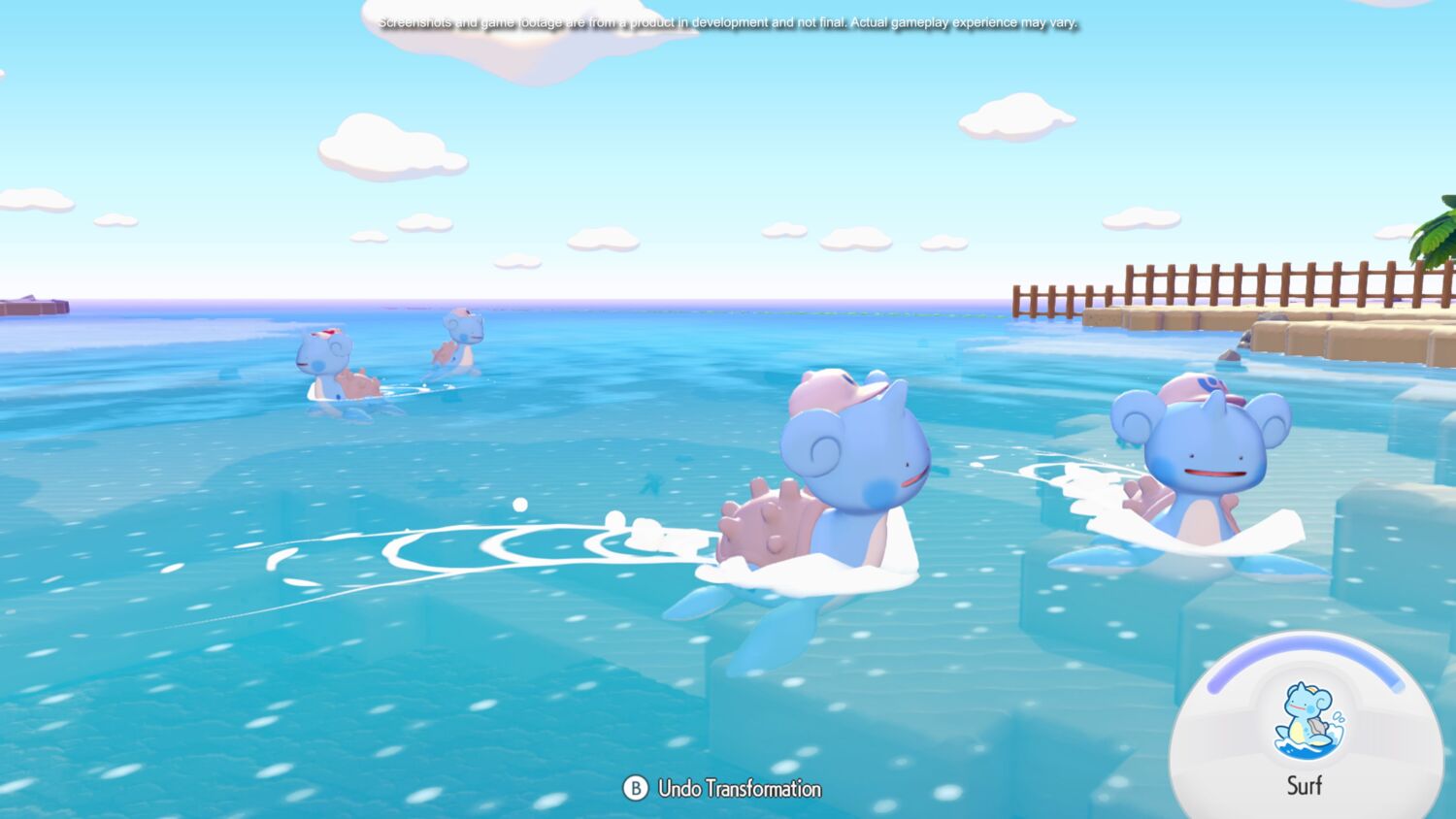
The layered design adds spatial depth to navigation, but there’s a slight catch. During the preview, there were times when straying too far off an objective would guide Ditto back to it, limiting the sense of individual agenda. However, it’s unlikely to continue past the first few hours, aligning more with the own-time-own-target freedom that teases a relaxing, invigorating affair.
The feel-good vibes are further elevated through the game’s sense of humour, with Professor Tangrowth taking offence if players use Water Gun on it, accidentally or otherwise, and telling them that it isn’t wilting like dry grass (or shall we say, vines?). Likewise, Ditto will get dizzy if you spin it around too much with the joystick, and it’s nice to see Pokémon Pokopia embracing the silly playfulness of it all. For longtime fans, another treat lies in wait – while the game features new music, some of its audio cues are remixes of the original soundtracks, and the familiar ditty that denotes a Pokémon Evolution now plays whenever Ditto learns a new move.
A 25-minute-or-so multiplayer session was included as part of the preview, and it didn’t feel too different from solo play. Even as certain tasks required all players to be present, everyone was free to contribute however they wanted (or not), be it crafting, completing challenges, or uncovering more secrets. It can be a double-edged sword, though, because the independent spirit feels removed from the sense of community that co-op experiences are meant to foster, and a well-developed world leaves guests with little else to do, as gleaned from the sneak-peek event.

The other barrier is the varying level of access for each participant. In a separate interview with the team, Takuto Edagawa, chief director of Pokémon Pokopia at Koei Tecmo, confirms that it “will depend on that specific individual, so there won’t be level matching or anything of that sort”. Essentially, whatever you can do or access in your own world remains unchanged as a visitor, but that shouldn’t matter if the main objective is simply to bask in each other’s company away from the bustle and hustle of real life. Both local wireless and online co-op support up to four players, with the GameShare functionality allowing friends without the game to join in the fun.
In any case, the forthcoming adventure is shaping up to be a soothing force of charm. The laid-back pace is a welcome respite from tradition, and the vibrant, cotton candy-styled aesthetic makes it difficult to look away. From creative minds who enjoy building and customising various elements to Pokémon completionists, the appeal of Pokémon Pokopia is far and wide, and hopefully, that will continue to ring true when the full game launches.
Pokémon Pokopia comes to the Nintendo Switch 2 on 5 March.
©2026 Pokémon. ©1995-2026 Nintendo/Creatures Inc./GAME FREAK inc. ©2026 KOEI TECO GAMES. Pokémon and Nintendo Switch are trademarks of Nintendo.

Si Jia is a casual geek at heart – or as casual as someone with Sephiroth’s theme on her Spotify playlist can get. A fan of movies, games, and Japanese culture, Si Jia’s greatest weakness is the Steam Summer Sale. Or any Steam sale, really.


 Kevin Low