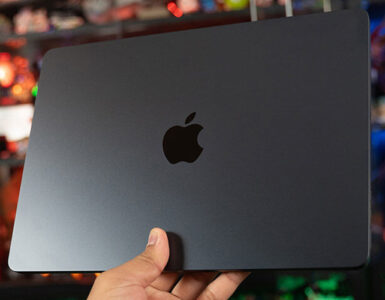

Hot on the heels of announcing the iPhone 17e and the iPad Air with an updated M4 processor, Apple has unveiled its latest M5 Pro and M5 Max chips, which will power the MacBook Pro lineup, alongside a new MacBook Air with M5, and updates to the Studio Display family.

Built using a new Apple-designed Fusion Architecture, the chips combine two dies into a single system on a chip (SoC), bringing together a new CPU, a faster 16-core Neural Engine, the latest Media Engine, a unified memory controller, and Thunderbolt 5 support. According to the company, the 18-core CPU and 12 performance cores increase performance by “up to 30 percent for pro workloads,” with the M5 Pro delivering 20 percent higher graphics performance than before and a 35 percent boost in graphics uplift in apps that support ray tracing.
The M5 Max, meanwhile, now boasts an up-to-40-core GPU (versus the M5 Pro’s maximum of 20 cores), offering over four times the peak GPU compute compared to the previous generation, as well as 20 percent faster graphics performance and a 30 percent uplift for apps using ray tracing.

In addition to the souped-up hardware, the refreshed 14 and 16-inch MacBook Pro models are kitted with more base storage: 1TB and 2TB, respectively, both double that of their predecessors, paired with 24GB and 36GB of RAM. Users can also expect twice the SSD performance, up to 24 hours of battery life, and Wi-Fi 7 and improved Bluetooth connectivity courtesy of the N1 wireless networking chip.
Elsewhere, the laptops remain largely unchanged. The displays feature Liquid Retina XDR tech and a 120Hz refresh rate, plus resolutions of 3,024 x 1,964 pixels (14-inch) and 3,456 x 2,234 pixels (16-inch), while the same Silver and Space Black colour options are available.
Here’s the catch — starting prices for both devices have gone up. The 14-inch MacBook Pro with M5 Pro starts at S$2,999, up S$250 previously, and its bigger sibling retails for S$3,649. The latest MacBook Air with the M5 chip isn’t spared from the price hike, either, costing at least S$1,599 — S$100 more than the M4-equipped model.

Like its higher-end counterpart, the machine is more of a spec-bump update. It still comes in Sky Blue, Silver, Starlight, and Midnight, and inherits the same Liquid Retina display, 12-megapixel (MP) Center Stage camera, and 18-hour battery life, but the M5 chipset’s 10 CPU cores and up to 10 GPU cores mean up to a fourfold increase in AI performance and up to 1.5 times faster 3D rendering. The MacBook Air also touts the N1 wireless chip and a base storage option of 512GB, which can be configured up to 4TB.
Pre-orders for all new MacBook models open on 4 March, with the full list of starting prices as follows:
- 13-inch MacBook Air with M5: S$1,599
- 15-inch MacBook Air with M5: S$1,899
- 14-inch MacBook Pro with M5 Pro: S$2,999
- 16-inch MacBook Pro with M5 Pro: S$3,649
- 14-inch MacBook Pro with M5 Max: S$5,009
- 16-inch MacBook Pro with M5 Max: S$5,449
Separately, Apple is bringing the 12MP Center Stage camera, a studio-quality three-microphone array, a six-speaker sound system with Spatial Audio, and Thunderbolt 5 connectivity to the Studio Display. The 26-inch 5K screen boasts 600 nits of brightness and comes with a tilt-adjustable stand, or can be configured with a tilt- and height-adjustable stand or a VESA mount adapter for custom desk setups, with users now able to daisy-chain up to four models.

As for the new 27-inch Studio Display XDR, it features 5K resolution, mini-LED backlight with over 2,000 local dimming zones, 2,000 nits of peak HDR brightness, and the same camera, audio, and ergonomic capabilities of the standard model. Unlike it, the Studio Display XDR also includes a 120Hz refresh rate and Adaptive Sync support, which dynamically adjusts frame rates for content such as video playback or graphically intense games. It starts at S$4,499, while the regular Studio Display is priced at S$2,199. Both models are available in standard or nano-texture glass options, and can be pre-ordered from 9 March.

Si Jia is a casual geek at heart – or as casual as someone with Sephiroth’s theme on her Spotify playlist can get. A fan of movies, games, and Japanese culture, Si Jia’s greatest weakness is the Steam Summer Sale. Or any Steam sale, really.
 Kevin Low