
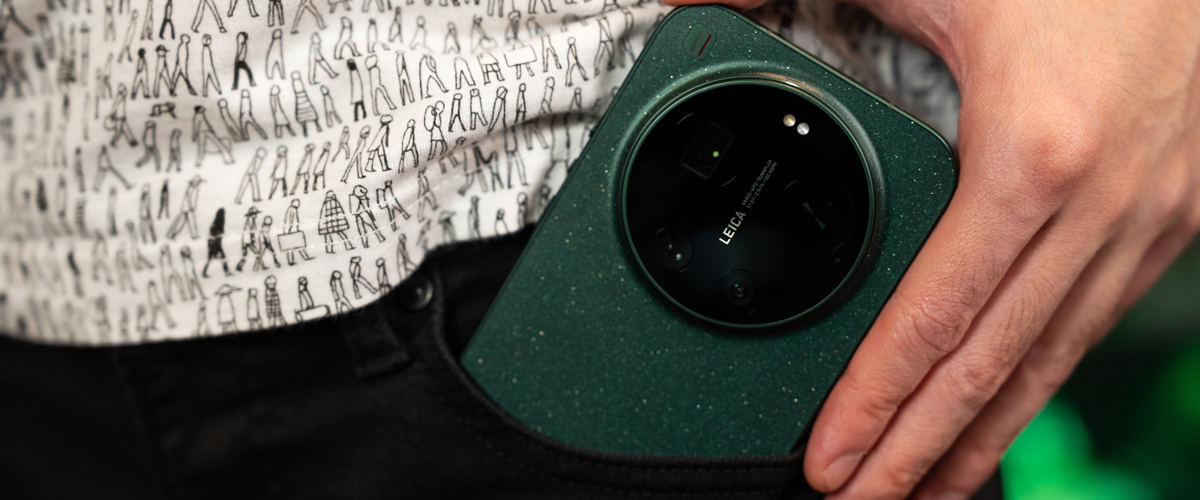
The tech race is all about numbers. Be it the camera, the chipset, or the price tag, the general impression is that a higher count leads to better performance, but with flagship devices already offering cutting-edge features, design identity is now a key differentiating factor between them.

In the case of China’s Xiaomi, a circular camera cutout has found a permanent home on its Ultra series, alongside the Leica branding that honours its longstanding partnership with the renowned imaging company. The Xiaomi 17 Ultra, which skipped one generation and serves as the successor to the 15 Ultra, retains both elements and tweaks others – most notably, the vegan leather and two-toned look on the rear. It also sports three cameras instead of four and has a new, higher-end sibling, the Leica Leitzphone powered by Xiaomi, that includes a mechanically rotating Control Ring.
Don’t mistake that for a downgrade, however. The mantle of a camera powerhouse still holds, and day-to-day performance is no less powerful than what longtime users would expect. This time, all the beefiness is packed into a slimmer, lighter build, coming in at 8.4mm and 218 grams, respectively (versus 9.35 mm and 226 grams previously), and donning three colour options: Black, White, and Starlit Green.
While the former two cater to classic preferences, the Starlit Green iteration brings a charming pop of green to the review unit. The glittery look is easy on the eyes, and the composite fibreglass offers a nice and comfortable grip, even if the camera bump contributes to its familiar top-heavy build. The flat-edge frame aligns more with the traditional slab aesthetic, and despite the subtle rounding along the edges, it seems to accentuate the rear protrusion.


It takes some time getting used to, but the volume buttons are now separate and have a round, tactile profile, making on-the-fly adjustments without looking directly at the phone more intuitive. There aren’t any additional quick-access buttons to the camera and other settings, either, so those used to shortcuts will have to settle for the compromise.
Gone too is the previous-generation quad-curve display. The Xiaomi 17 Ultra boasts a fully flat 6.9-inch OLED screen, one of the largest in the Ultra lineup to date, complete with the expected bells and whistles: a 120Hz refresh rate, support for both HDR10+ and Dolby Vision, a peak brightness of 3,500 nits, and an upgrade to the Xiaomi Shield Glass 3.0 that claims to be 30 per cent more drop-resistant. Though largely negligible to the average user, resolution is slightly lower at 2,608 x 1,200, down from WQHD+ (3,200 x 1,440).
There’s no particularly notable new tech comparable to the Privacy Display on the Samsung S26 series, but bright, punchy colours, sharp detail, and rich contrast still make up the viewing experience. Keener eyes may notice a slightly cooler tone to the visuals, which can be adjusted manually in the display menu, and an additional anti-glare functionality would be welcome, especially in tropical, sunny Singapore.

As with most top-end models worth their salt, the handset is powered by the Snapdragon 8 Elite Gen 5 chip, and paired with an Adreno 840 CPU and 16GB of RAM under the hood. Handling day-to-day tasks is a breezy affair, be it scrolling through social media platforms or editing short videos on CapCut, extending to gaming performance in GPU-intensive titles such as Wuthering Waves, Zenless Zone Zero, and Genshin Impact. During our in-house test, frame rates rarely dipped even in particle-heavy cutscenes – an impressive feat without the assistance of Game Boost – and the improved vapour chamber kept temperatures within reasonable limits, proving effective at dissipating heat.
Photography, however, remains its biggest asset. While the three-camera setup may seem like a downgrade from its predecessor’s quad design, the difference isn’t as straightforward in practice. The 50-megapixel (MP) main and 50MP ultrawide rear shooters are unchanged, with the previous two telephoto cameras combined into a single 200MP periscope telephoto camera that covers the 75mm to 100mm focal range, courtesy of a new mechanical zoom system. Sitting on the front is a 50MP lens, a step up from 32MP.
In true Xiaomi-Leica fashion, there’s plenty to like about the imaging performance here. Choosing between the Leica Vibrant and Leica Authentic profiles is a matter of personal preference, but the main camera delivers accurate, lively colours (more striking in the former mode, of course), great dynamic range, and clear detail either way. Firing up portrait mode also yielded stellar depth separation and natural, crisp bokeh, except the minimum focus distance is now farther.


Noise isn’t a concern for the most part, picking up only in low light or past 5X zoom, where photos start to lose their sharpness. Long-distance zoom to 20X and beyond is offered as an option, albeit not recommended, that leverages AI upscaling and produces a heavily edited look. The overall versatility is easy and pleasant to work with, although users may want to be careful about resting their finger against the large camera bump for extra support, as it can accidentally get into the shot at times.


For the more enthusiastic shutterbugs, the separately sold Photography Kit offers additional creative freedom. A staple of the Ultra series, this year’s iteration includes a standard and a pro model, with the latter retailing for S$199. Both feature a two-stage shutter and a video button, but the customisable dial, zoom lever, and thumb support are only available on the pro option. There’s a difference in battery capacity as well, coming in at 270mAh and 2,000mAh, respectively.
At a very AI time in everyone’s lives, it’s refreshing that Xiaomi doesn’t lean aggressively into its AI-powered software for marketing. Alongside HyperOS 3 atop Android 16, the 17 Ultra touts familiar HyperAI tools – such as AI Search, which can find documents, files, and pictures using natural language; AI Interpreter for real-time translation; and AI Speech Recognition that transcribes recordings in real time and provides automatic summaries – on top of image editing tools in the Gallery app. It’s nothing new, with AI Erase Pro removing unwanted objects and elements from photos, AI Image Reflection Removal eliminating glare or reflective surfaces, and more.

Among the more prominent additions is HyperIsland. Taking inspiration from a certain fruit, the Dynamic Island-like feature displays timers, music playback, and other active tasks in a notch at the top of the screen, serving as a shortcut to open their respective apps. In fact, the design cues are similar enough that those making the switch from Apple won’t take long to get familiar with navigation. Cross-platform sharing is hardly an issue, either, as HyperConnect enables wireless file sharing between the Xiaomi 17 Ultra and iOS, iPadOS, and macOS devices.
Elsewhere, MIUI (the company’s own custom mobile operating system) veterans will find that bloatware and customisation have been improved, even if much of the latter is deeply nested in the settings. The hidden access isn’t ideal, especially for users coming from other more accessible Android platforms, and the built-in Google Gemini suite comes in handy during such situations.
Boasting a 6,000mAh battery, the handset packs in longer-lasting stamina than its predecessor. It’s a respectable figure that lags behind the higher capacity of its Chinese counterparts, but the Xiaomi 17 Ultra can still power through eight hours, or a typical workday, of heavy use. On a lighter workload, it may last a little under two days, though mileage will naturally vary across individuals. Wired charging clocks in at a fast 90W, taking about 35 minutes to hit 75 percent with a compatible charger. Wireless charging takes a slight hit from before, dropping to 50W (versus 80W).

After keeping to the same price point with its previous generational leap, the Xiaomi 17 Ultra now sees a S$100 markup to S$1,799 for 16GB of RAM and 512GB of storage – not too far off the standard for flagship offerings. While its flat-edged look is a change, the best parts of its essence remain true to form: snappy performance, excellent imaging, and an attractive display. The vast market competition will be its greatest deterrent, however, especially with alternatives that compensate for its downsides. Still, the investment won’t disappoint those willing to look past all of that.
Product images were shot using a Sony α7 IV Full-Frame Hybrid Camera equipped with a 28-70mm F2 GM lens.
GEEK REVIEW SCORE
Summary
In the face of stiff competition, the Xiaomi 17 Ultra refines its photography edge and tops it off with day-to-day competence.
Overall
8.8/10-
Aesthetics - 9/10
9/10
-
Build Quality - 8.5/10
8.5/10
-
Performance - 9/10
9/10
-
Value - 8.5/10
8.5/10
-
Geek Satisfaction - 9/10
9/10

Si Jia is a casual geek at heart – or as casual as someone with Sephiroth’s theme on her Spotify playlist can get. A fan of movies, games, and Japanese culture, Si Jia’s greatest weakness is the Steam Summer Sale. Or any Steam sale, really.
 Kevin Low
 HSALS
HSALS