“You had a temper like my jealousy / Too hot, too greedy / How could you leave me / When I needed to possess you? / I hated you, I loved you, too.”
Kate Bush sang it like a warning, her voice climbing into the gothic stratosphere to haunt the airwaves in 1978 with a song as unhinged and obsessive as the doomed couple it was inspired by. You didn’t need to know who Cathy or Heathcliff were to feel it – that feral ache of love curdled into something ruinous. Emily Brontë’s timeless 1847 literary classic Wuthering Heights has endured for that very reason – it is a story of passion poisoned by possession, of generational cruelty, of people so emotionally stunted they become monstrous.

And yet over the years, the novel has been repeatedly misremembered as a tragic love story repackaged for palatability, defanged for audiences too squeamish to sit with its mess. Emerald Fennell’s “Wuthering Heights” (stylised with quotation marks, as if to pre-emptively absolve itself of fidelity) is the latest to join that trend. She positions the film as an “interpretation,” rooted in how the novel made her feel at 14.
Much has been said about adaptations only covering the novel’s first half, a convention stretching back to William Wyler’s (Ben-Hur, Roman Holiday) 1939 film, and continued by Andrea Arnold’s (American Honey) 2011 version. But where Arnold’s take felt elemental, muddy and alive with mood, Fennell’s retelling is curiously bloodless, as gone is the chaos of Catherine’s emotional self-destruction and the desperation that drives Heathcliff’s revenge. Ironically, Fennell’s earlier work, Promising Young Woman (2020) and Saltburn (2023), captures far more of Brontë’s unhinged spirit than anything on display here. Stripped of nearly all supporting characters and restructured into a coming-of-age melodrama, it feels like a Brontë-esque aesthetic draped over a script that seems uninterested in Brontë herself.
There is just Cathy and Heathcliff here, entangled in a doomed romance that’s been drained of its social context and moral rot. Fennell’s focus lies squarely on the erotic pull between two beautiful people, discarding the novel’s concern with class oppression, colonialism, or the brutality of inheritance. It’s telling that the film makes no attempt to address Heathcliff’s outsider status (neither in race nor in origin) nor does it concern itself with the way the moors, in Brontë’s hands, reflect the wildness and volatility of human nature.

Cathy, played by Margot Robbie (Barbie, The Wolf of Wall Street), is miscast in both age and temperament. Her performance though visually poised, lacks the untamed spite and spine that animates Cathy in the text. What Brontë gave us was a wild, volatile woman raging against the confines of femininity and class. Fennell gives us a wistful, well-groomed heroine whose defiance has been sanded down into petulance.
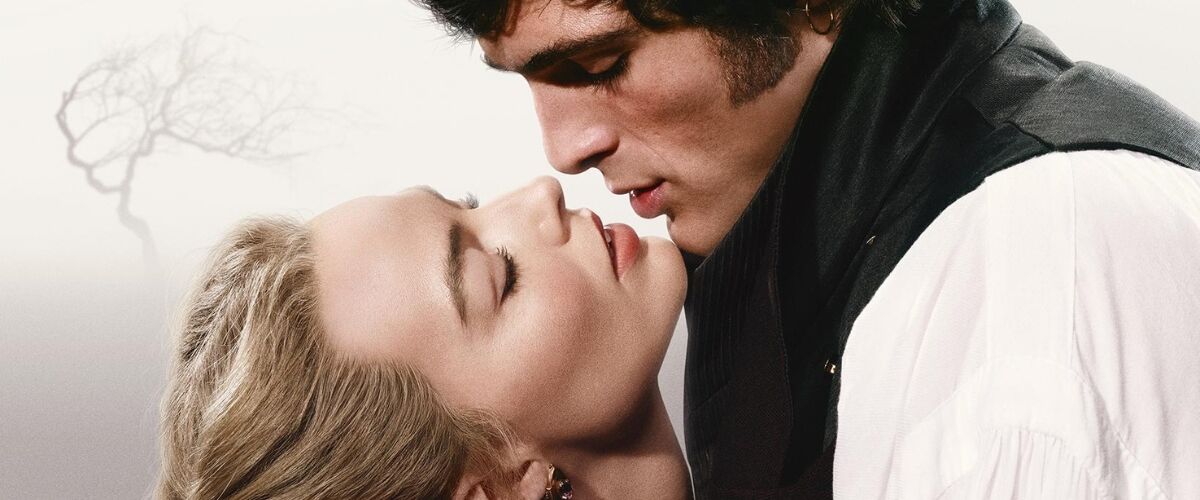
And Heathcliff fares no better in this vision. Played by Jacob Elordi (fresh off Frankenstein), his take on the character has been drained of his racial ambiguity and transformed into a perfectly sculpted avatar of male longing. Elordi’s presence is imposing, his frame towering over windswept moors and candlelit corridors alike, but his Heathcliff is less a child of violence than a wounded dreamboat – any edge is dulled by the film’s desire to romanticise him. Instead of a vengeful survivor weaponising the tools of his oppressors, he becomes a wet-eyed protector who seems to exist purely to cradle Cathy against the rain. His socioeconomic status is referenced in passing (“lower class,” the film insists) but it never shows us the stakes of that status, nor the societal machinery that makes it matter. His transformation from feral boy to refined gentleman carries no consequence, no bite… just better tailoring.
Elordi, to his credit, tries to claw at something more beneath the surface. There are fleeting but charged moments where his Heathcliff hints at a capacity for cruelty, flickers of danger beneath the devotion. It recalls his darker turns in Priscilla (2023) and Euphoria (2019-present) where beauty became a weapon rather than a virtue, but those flashes are quickly buried beneath a script that neuters his capacity for destruction and his hunger for retribution. The towering menace of the novel’s antihero becomes a gentle monolith here, robbed of his most frightening and compelling edges.

That reorientation stretches into Cathy and Heathcliff’s dynamic – what Brontë wrote as toxic obsession and spiritual ruin is reframed as teenage miscommunication. Elordi and Robbie, both magnetic performers, feel oddly restrained. Their intimacy plays like stylised foreplay – fingers in mouths, breathy declarations, moody silhouettes. But very little burns beneath it – basically a watered-down Bridgerton (2020-present) without the wit.
Much of that dilution stems from a critical rewrite. In Fennell’s adaptation, Hindley Earnshaw, the keystone antagonist in Brontë’s novel, is entirely excised. Gone is the sibling rivalry that drives Heathcliff to vengeance – his cruelty is reassigned to Mr. Earnshaw, Cathy’s father, played with sour drunkenness by Martin Clunes (Doc Martin). That shift rewires the entire premise, Heathcliff, no longer an abused boy usurped by a jealous brother, is now a joint victim alongside Cathy. Both are trapped under the thumb of the same patriarch, stripped of the class and status conflicts that originally separated them. Fennell’s choice to erase Hindley also dissolves Heathcliff’s raison d’être. The grand arc of a man bent on revenge becomes a rom-com glow-up, complete with slow-motion Pride and Prejudice entrances and yearning glances. Brontë’s Heathcliff amassed his fortune to ruin lives but in this adaptation, it’s just to impress Cathy, flattening the feud into a romance and the pain into longing. Without Hindley, there is no true vendetta, no years-long rot of resentment spilling into the next generation.
To make things worse, characters who once anchored Brontë’s world are distorted beyond recognition. Nelly Dean, the original novel’s moral compass and quiet chronicler, becomes a bastard daughter of aristocracy played by Hong Chau (The Whale) with icy disdain and simmering resentment for Cathy. Joseph (Ewan Mitchell, House of the Dragon), traditionally a fire-and-brimstone religious zealot, is now a leering footman with a taste for the whip, more Fifty Shades of Wuthering Heights than Brontë’s puritan terror. But it’s Isabella Linton, the ward of Edgar Linton (Shazad Latif, Star Trek: Discovery) whom Cathy marries, who suffers the greatest disservice.

Brontë’s Isabella is among the novel’s most tragic figures: an innocent woman seduced, abused, and discarded. Fennell’s Isabella, played by Alison Oliver (Conversations with Friends), is none of those things. She’s sharp-tongued, sexually forward, and fully complicit. When Heathcliff declares his intent to destroy Cathy and warns Isabella of the pain to come, she gleefully consents. Their marriage is reimagined as a consensual power game complete with collars, crawling, and breathy pleas to “be nice later.” What was once a cautionary subplot becomes a fantasy of mutual depravity. Even Heathcliff’s sadism feels sanitised by the fact that Isabella apparently wants it. When he confesses his true motives (to harm Cathy, and only Cathy) it lands mostly as a degradation kink-coded agreement. By reframing Isabella’s torment as desire, Fennell strips the story of one of its most searing tragedies – there is no innocence here to be corrupted, just performance, all agreed upon. In attempting to modernise Brontë’s brutality into something palatable, even titillating, the film loses sight of what made these relationships so destructive in the first place.
Visually, though, it’s hard to look away. Linus Sandgren’s (La La Land, No Time to Die) cinematography drenches the moors in romance, turning Yorkshire’s desolation into something painterly. Interiors swing from Gothic opulence to candy-coloured absurdity, and Thrushcross Grange looks like it was designed by someone who binged Sofia Coppola’s Marie Antoinette (2006) and asked, “but what if we add skin-coloured walls, freckles, moles and all?” Costuming flits between regency corsets and Forever 21 lace, while Anthony Willis’ (M3GAN) sweeping score, with contributions from pop star Charli XCX, adds a pop sheen to the brooding gloom. At times, it all works. A sudden wide shot of the moors, a moment of silence between screams, and you remember the source material’s raw emotional core, though those moments are fleeting.
Tone becomes the film’s biggest hurdle – Fennell sprinkles in self-aware camp, then turns on a dime into melodrama. One scene might echo 1939’s Gone with the Wind, while the next feels lifted from an Evanescence music video. It’s a tightrope between surreal and sincere, but the film never quite finds its balance. Plenty of filmmakers have bent classic texts to fit contemporary visions (Coppola’s Marie Antoinette, Baz Luhrmann’s Romeo + Juliet, Greta Gerwig’s Little Women) but here, the dissonance doesn’t serve a greater whole. Fennell collects bold ideas – kink, camp, couture – and places them on display like trophies. Without emotional continuity or thematic bite, “Wuthering Heights” feels a lot like a stylish dare: provocative, expensive, and hollow.

What made the OG Wuthering Heights endure was that it dared to question if love could survive after being mangled by class, grief, and pride. Brontë didn’t ask us to root for Heathcliff and Cathy – these are characters who spit, haunt, and hurt, and yet Brontë imbues them with such thorny charisma that we ache to know their full, miserable histories. Fennell, however, sands down the jagged edges and reduces them to beautiful star-crossed lovers who want to kiss in a lot of fog, coasting on visual lushness and aesthetic mood, all while insisting it’s telling a tragic love story. But tragedy without consequence is just melodrama, and for all its erotic posturing, “Wuthering Heights” is strangely chaste, seemingly afraid to let its characters rot from the inside. It’s not the worst sin in adaptation, but it reads like AO3 fanfiction by someone who skimmed half the book, found the idea of “forbidden love” sexy, slapped in some BDSM, and tossed out the rest.
A faithful Wuthering Heights wouldn’t be digestible and wouldn’t slot neatly into Valentine’s Day campaigns. It would seethe, fester, and make audiences uncomfortable, and that’s the point. So if Fennell’s film feels like a loss, maybe it’s only proof that Brontë can’t be tamed. Her story remains, as ever, too hot, too greedy… and utterly her own.
GEEK REVIEW SCORE
Summary
For all its polish and provocation, Emerald Fennell’s Wuthering Heights drains Brontë’s savage, obsessive romance of its rage, race politics, and brutal class tensions, providing instead nothing more than glossy melodrama that mistakes aesthetic excess for passion.
Overall
6/10-
Story - 5.5/10
5.5/10
-
Direction - 6/10
6/10
-
Characterisation - 6/10
6/10
-
Geek Satisfaction - 6.5/10
6.5/10

Natalie is a big fan of anything related to movies, TV shows, and anime — you name it. When she’s not reading or being a dedicated cinephile, she’s probably playing gacha and tabletop games, or daydreaming of Caleb from Love and Deepspace.
 HSALS
HSALS