
It’s a usual school day in Kuala Lumpur, Malaysia, and lessons are underway in different classrooms. In one, hand-drawn illustrations with katakana adorn the noticeboard at the back, while in another, terms such as “radius”, “circumference” and “circles” are often repeated.

But it doesn’t take long to notice the differences from a standard classroom setting. There are no worksheets or textbooks on the table in front of students, only iPads, and displaying content on a screen doesn’t require a projector. Instead, classes are powered by the Apple ecosystem, in which both students and teachers, armed with hardware, use a mix of software for presentations, collaboration, and communication.
This sight is a daily affair at Sekolah Berasama Penuh Integrasi Gombak (INTEGOMB), a fully residential co-ed boarding school for 13- to 17-year-olds, serving as part of its Apple Tech Leaders programme. Established in 2018 to bridge technology knowledge gaps and accelerate digital transformation through peer-to-peer teaching and learning, it tasks the current 100-strong student population with coaching peers on device and app usage on a day-to-day basis, as well as running special workshops for them, including iOS app development with Swift and a digital animation bootcamp.
Offering mentoring assistance are 48 educators (accurate as of the time of writing), who have received the Apple Teacher certification – recognised by the Ministry of Education Malaysia for teacher professional development – while the 1:1 iPad setup in every classroom unlocks access to educational materials that aren’t available for traditional systems. Here, math lessons involve taking a photograph of a real-world circular object like a bottle cap, and using the Freeform app to draw and measure the radius from the centre to the point of tangency to deduce the angle formed.
Then comes the true test of understanding. After creating their own 3D shape in Reality Composer, students have to present their learnings in class, and it’s an interactive experience that also extends to other syllabi, such as Japanese Language and Physical Education. The former, for instance, sees students drawing a simple illustration of transport and vehicles, identifying various Japanese words with the Translate app, recording their pronunciation, and adding all these elements to their Keynote presentations.

As for the latter, the focus is on learning about sports technology and the role of motion capture in physical activity. With an iPad in hand, students can capture baseline lower body movement, including squats and horizontal jumps, using My Jump 2, FormCheck, and other apps. The data is subsequently collected and recorded over time to measure performance, improve athletic technique, and facilitate injury recovery.
The device integration isn’t for show, either, with tangible results in its wake. Two projects by INTEGOMB students have gained acclaim nationally and around the world: iMarine, an app prototype designed to inspire greater participation in marine conservation, and PhytoTech, an all-in-one robot that seeks to accelerate reforestation by automating sapling planting.
The winner at the global stage of Tun Fatimah Ideas Challenges 2026, iMarine combines real-time pollution tracking and gamified challenges, where users can earn redeemable real-world rewards and connect with others to organise community initiatives. Alongside Keynote on iPad, Swift Playgrounds, a programming language created by Apple, is also being used to bring the team’s idea closer to becoming a reality.
PhytoTech, meanwhile, brought home the Platinum award at the national-level Selangor Education Summit competition with its objective of restoring forests more efficiently and at scale. Conceptualised on Freeform and Notes, the prototype was built via the Reality Composer app, following the visualisation, testing, and refinement process.
INTEGOMB is hardly the first success story for Apple, and it certainly won’t be the last. The Cupertino giant has long cemented a strong presence in the education scene, driven by its commitment to empower every kind of learner, both in and out of Malaysia. As key players in cultivating such dynamic learning environments, educators can look to various professional programmes to build their skills in iPad and Mac – in addition to the previously mentioned Apple Teacher, Apple Learning Coach offers a free package of self-paced lessons, virtual workshop sessions, and personal creative projects.
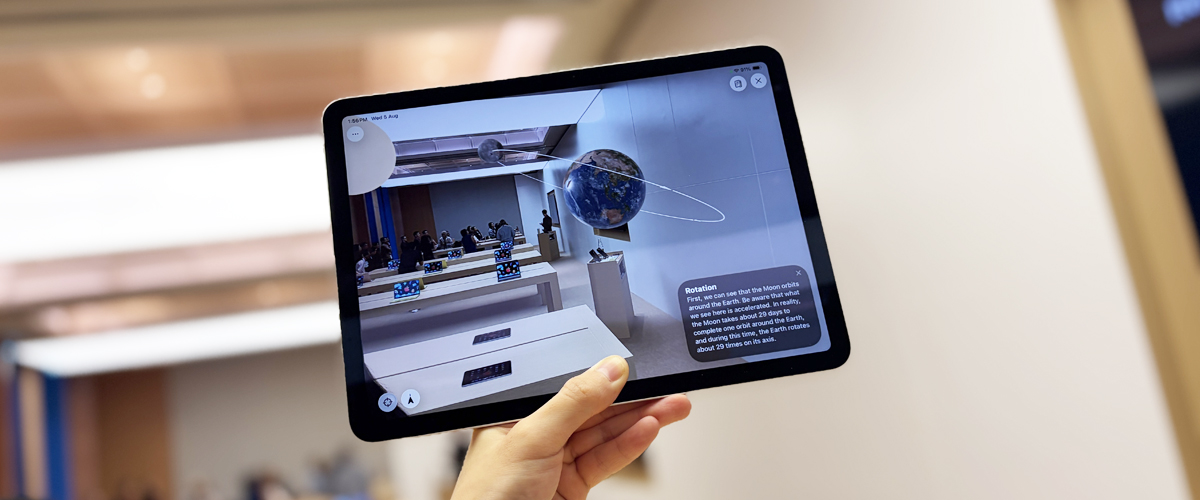
Dating back to 1995, Apple Distinguished Educators continues to recognise the efforts of K-12 and higher education professionals who have transformed teaching and learning, made possible by a cohesive ecosystem. Compatible software, whether first- or third-party, is designed to complement its family of devices, starting with Foxar, which uses 3D models and augmented reality (AR) to help students visualise school subjects, such as phases of the moon. Apple Classroom, in contrast, is tailored for educators, allowing them to lock screens, forcefully launch specific apps or websites, view displays, and share documents via AirDrop.
The Apple badge of honour applies to institutions around the world, too. Apple Distinguished Schools are defined as “centres of leadership and education excellence that demonstrate Apple’s vision for learning with technology,” with 17 in Malaysia to date. Sharpening that technology from a simple tool to a weapon is no easy feat, though, requiring the right guiding force, and Nur Safiqa Binti Sapar – one of the 400,000 Apple Teachers worldwide – from Sekolah Tun Fatimah in Johor Bahru, shares how it can work alongside the human touch.
“Students don’t always need an answer. Sometimes, they simply need the opportunity to imagine,” expresses the English teacher during an Apple Education keynote held in Kuala Lumpur. “Technology gave them the canvas, but it was imagination that brought the learning to life.”
“Technology may continue to evolve, but our purpose as educators never changes: to help every learner discover that their ideas matter, and that they have the power to change the world,” she adds, noting that innovation begins when “students believe their ideas have value.”

First, there needs to be room for self-discovery. For the tech giant, individual agency is integral to unlocking this experience, with Dominic Leichti, senior director of Worldwide Education Product Marketing, stressing the significance of “ cultivating a culture of student autonomy that lets learners take chances to try new things”.
The former educator continues in his opening speech, “It’s more important than ever to focus on agency, [and] to cut through that ambiguity, because when you build a culture of agency, you can bring the focus to what matters most – helping each group develop a deeper connection with their own learning, in a way that fits them best.”
Coupled with the core values of accessibility, environment, and privacy and security, Apple’s education approach has generated an iron-clad track record over the years. According to the team’s latest K-12 impact report, 70 per cent of students on Mac take ownership of their learning, compared to 59 per cent on competitor devices, and teacher preference also skewed toward the Apple ecosystem (34 per cent versus nine per cent).
In Singapore, the impact of Mac is no less encouraging. Figures sit at 80 per cent across the board, with 89 per cent of users demonstrating responsibility, 87 per cent becoming more motivated to learn, and 84 per cent using critical thinking and communication skills. Artificial intelligence (AI) development, which the country has a vested interest in, scores an 85 per cent, and it’s no wonder – ‘AI and Big Data’ tops the list of rising skills by 2030 on the World Economic Forum’s 2025 Future of Jobs report.

It’s an interesting paradigm shift, as the ease that AI introduces clashes with several fundamentals of learning, including building problem-solving skills, since answers are readily available and remain susceptible to hallucination (when the information provided by artificial intelligence software is false, misleading or completely fabricated), discerning existing biases, and developing original ideas. To tackle them, AI literacy and critical thinking prove indispensable.
“It’s not just about the technology, but about what we can build with technology,” emphasises OECD analyst Luis Francisco Vargas-Madriz in a panel discussion about the role of AI in education. “In this case, it’s important to build critical thinking skills around it, and the research shows us that how we engage with technology is very important and really meaningful.”
Nick Chan, principal of the School of Science and Technology, Singapore, also an Apple Distinguished School, shares a similar sentiment. Citing the ability to think for themselves and to innovate, he elaborates, “It couldn’t be more important to have your own viewpoint from a critical lens on what you’re hearing [and] being told, with all the noise that we’re seeing today.
“I’m thinking particularly about the kind of new technologies that are being introduced. How can we leverage them effectively?”
Back on home soil, this practice is already underway. At the National University of Singapore (NUS), for instance, the 75-student pioneer batch of a spatial computing module – the first of its kind at a local institution – brought their projects to life with visionOS, the operating system that runs the Apple Vision Pro. Spanning the healthcare, humanities, and STEM (Science, Technology, Engineering, and Mathematics) disciplines, these innovations range from MediView, focusing on anterior cruciate ligament (ACL) recovery, to Weave, which seeks to preserve disappearing heritage crafts like rattan weaving.
And while technology has certainly made things easier and more convenient, it doesn’t mean the journey will always be smooth-sailing. Setbacks, both small and big, are still part of the process, and Gabriel Lipkowitz, assistant professor at NUS, College of Design and Engineering, believes that embracing failure is essential to grow as a person.
“Failure actually helps you to grow and become more resilient, [as well as] understand that it’s constructed. Sometimes, when you feel like you’re failing the most, that’s when you are actually growing the most.”
With over 40 years of expertise under its belt, Apple has seen its fair share of ups and downs in its education outreach efforts, but its commitment remains unchanged. As learning and teaching become increasingly digital, the blend of guidance and resources bridges the leap to a brighter future – one that transforms the traditional classroom experience.

Si Jia is a casual geek at heart – or as casual as someone with Sephiroth’s theme on her Spotify playlist can get. A fan of movies, games, and Japanese culture, Si Jia’s greatest weakness is the Steam Summer Sale. Or any Steam sale, really.

 HSALS
HSALS
 Kevin Low