
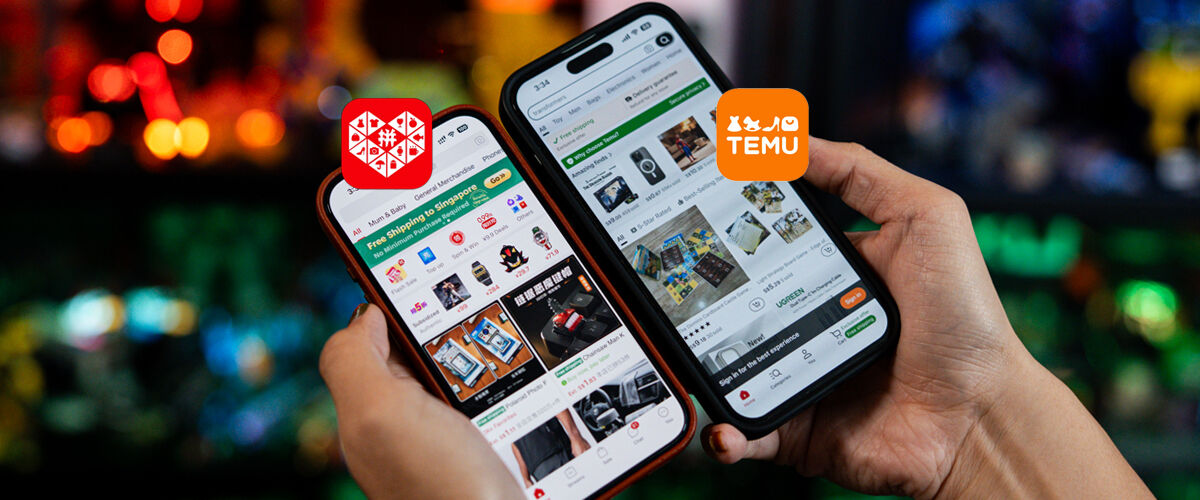
Despite rising rents and retail prices, with stores closing as quickly as they open, and despite layoffs and consolidation of services gutting e-Commerce, two new online retailers have taken the opportunity to enter the already crowded retail scene, as China’s Pinduoduo (拼多多) and Temu have started offering cross-border shopping services to Singapore shoppers.
This is despite major China players like Shopee and Lazada recently laying off a percentage of their workforce, while America’s Amazon not only cut Singapore jobs, it also shut down its Fresh grocery delivery service. Despite that, Singapore’s total retail sales, based on data from the Singapore Department of Statistics (SingStat), were estimated to hit SGD$4.7 billion in March, with online transactions amounting to a healthy 15.7 per cent of that figure.
Which means there’s money to be made, especially for two retailers who found success with low prices.
Founded in 2015 and initially focused on the agriculture industry, Pinduoduo is renowned for its extremely competitive prices (it was initially targeted at rural areas and lower-tier cities in China) and its social “group buying” model, where users can gain massive discounts by sharing product links with friends and family. In the last 11 years, the platform has grown into one of the biggest global e-commerce platforms of the modern generation, even beating the original incumbent Alibaba on its home turf.
Temu (originally short for “Team Up, Price Down”), on the other hand, was founded in 2022 as the sister company of Pinduoduo, to appeal to more Western markets. Like Pinduoduo, the platform keeps prices down with its heavy reliance on viral social sharing, alongside its factory-to-consumer business model.
Both platforms started launching in select Asia markets as early as 2024, with Singapore serving as one of the last few markets where the platforms were available to shoppers. Pinduoduo started running social media ads in late 2025, while Temu started its rollout in the second quarter of 2026.
Already, both apps have climbed the Apple App Store Shopping chart, where Pinduoduo had been the number one most downloaded shopping app for the last few weeks, while Temu is currently at third position, just behind Shopee. Alibaba’s AliExpress and Amazon round up the top five, while Lazada is not even in the top 10.
While both belong to the same parent company, PDD Holdings, there are differences in terms of product offerings, pricing, product assortment and user accessibility between the two, especially when it comes to Pinduoduo. Naturally, the lower prices on both platforms can give rise to suspicion that some of the items are not authentic or are knock-offs, so shoppers should be discerning and read up on the product reviews, especially those with photos and videos, to see if the product is what they want to get, at the price it’s being offered at.
In terms of shipping, Pinduoduo offers free shipping, but it’s by boat, so it takes about three weeks, which means you can’t use it to buy stuff you need immediately, or even within the next week, so there needs to be proper planning before a purchase. The app does offer a rather interesting feature where it tracks the ship’s exact location on the map, helping to give a better sense of when orders might arrive.
Temu, on the other hand, offers a shipping experience similar to that of Lazada or Shopee, with standard shipping taking about five to ten business days, and an express shipping option at an extra cost, which cuts the waiting time by about two days. Before they ship, however, purchased products usually enter a processing period, which takes an additional one to three days. Free shipping is provided once buyers hit a minimum spend or during special offer periods, with Temu also providing additional delivery guarantees, such as offering S$5 credit if orders arrive late.
Pinduoduo is also unique in that, unlike the others, where you add things to cart, here you make a purchase of one item from one seller, or multiples of the same item, from one seller. You cannot add more than one thing to a cart (other than buying multiples), so you buy one item, pay for it and then buy the next item. To this end, there’s no need to consolidate orders to hit a minimum spend to get free shipping, as it’s provided regardless of whether a user buys a S$1 or S$100 product.
Unlike Temu, which features an English interface, Pinduoduo is available in Mandarin only, although machine translation is available though at times, some listings are not translated as efficiently. Additionally, while Temu is available on both the local Apple App Store and Google Play Store, Pinduoduo is only available on the former, and Android users have to download its APK file directly from its website or via third-party providers.
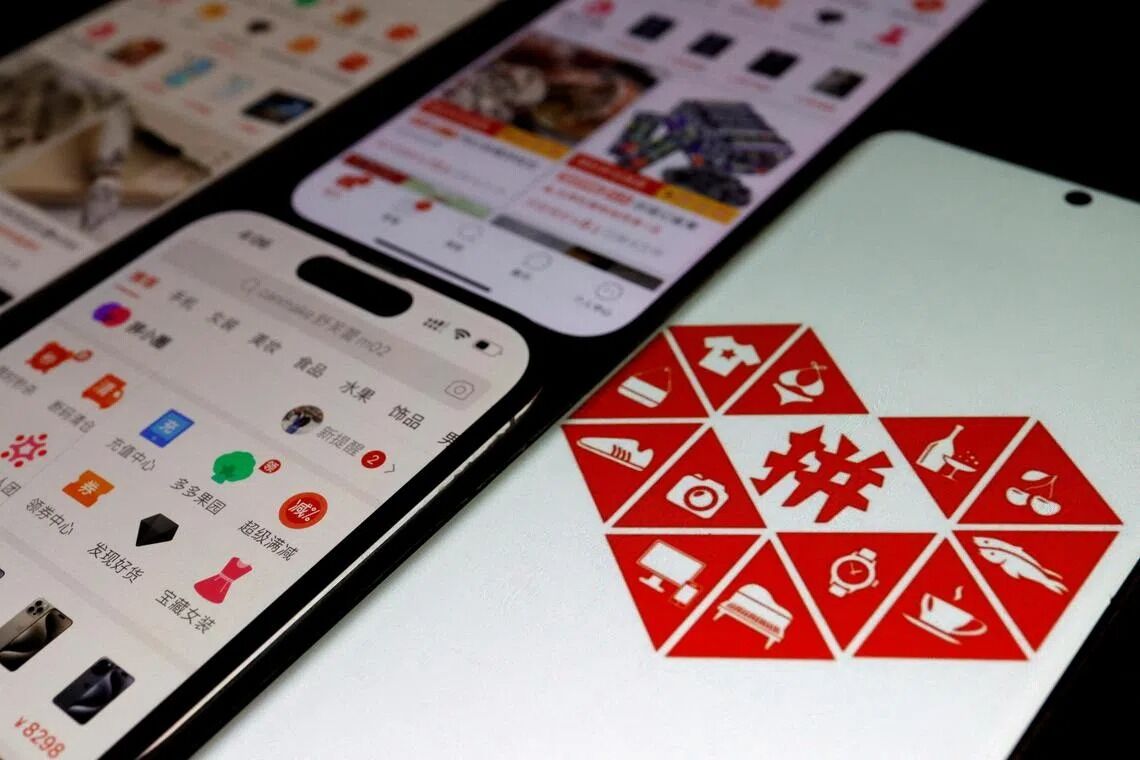
More importantly, though, both platforms support the use of local credit cards to make purchases, and at the end of the day, online shopping boils down to prices and product availability, and so for those who have yet to jump on the latest Chinese e-Commerce bandwagon, here’s a rundown of the two newest players and how they stack up against each other.
We rated their assortment and prices when shopping across four different product categories.
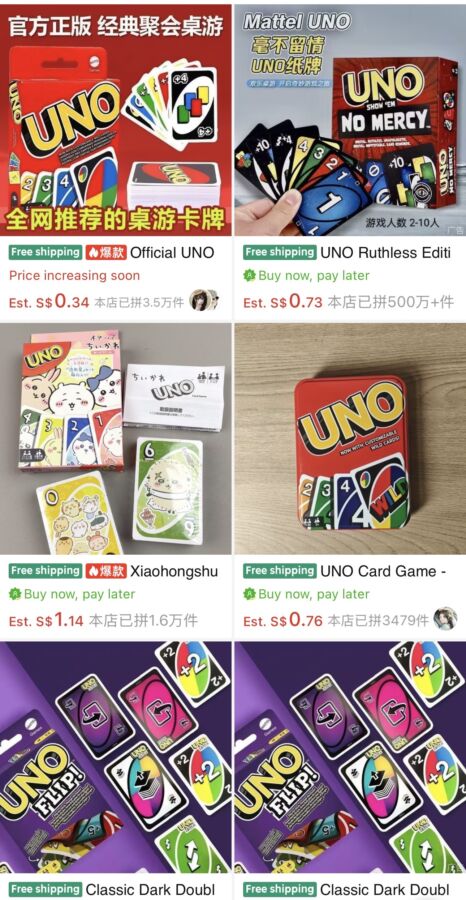
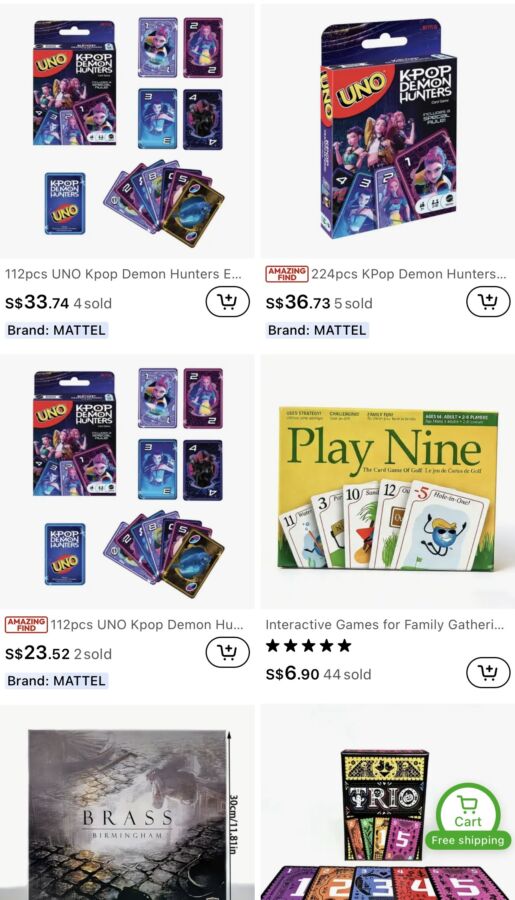
The first was for board games, and we searched for Catan (Settlers of Catan), RISK, and UNO and here’s what we found.
| Pinduoduo | Temu | |
| Catan (Settlers of Catan) | – Many variations of the game, including English and Chinese versions – Some listings sold different versions as bundles – Prices range from S$3 – S$5, and up to S$45 for more complex versions/bundles | – Only two options (5-6 player extension version (S$31.82) and 25th anniversary edition (S$62.69)) |
| RISK | – Multiple options, including special editions like Game of Thrones and Star Wars – Individual game pieces are also sold – Prices range from S$6 to S$20, depending on edition | – Three listings – Prices range from S$14 to S$23 |
| UNO | – Many options spanning different editions, like UNO Flip – Prices range from less than S$1 to S$16 | – Fewer options, results also feature other card games – Prices range from S$10 to $20 |
At first glance, Pinduoduo seems to be the obvious winner here, but the key point here is that items sold on the platform seem to be mostly knock-offs of the real deal, which can potentially explain the low prices. Low prices and knock-offs were also found on Temu but since the number of listings available is much lower, it’s easier to check product reviews to discern the quality of the product.
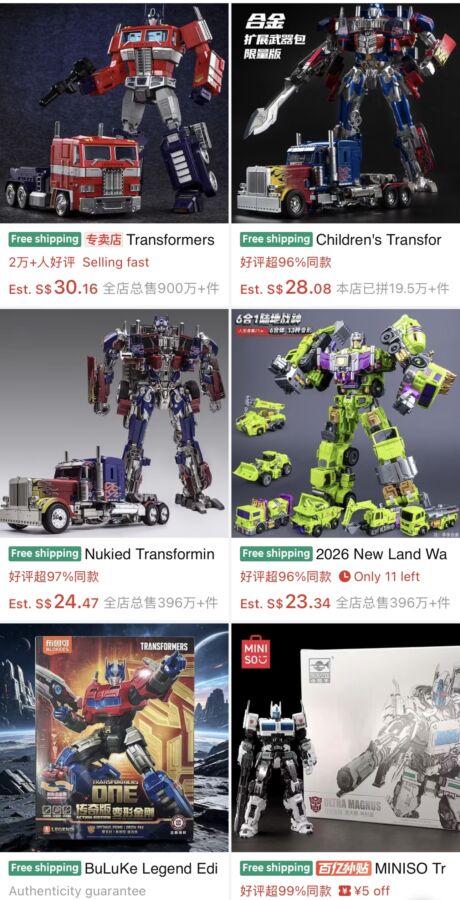
Next, we searched for toys, namely Transformers, Blokees, and Barbie.
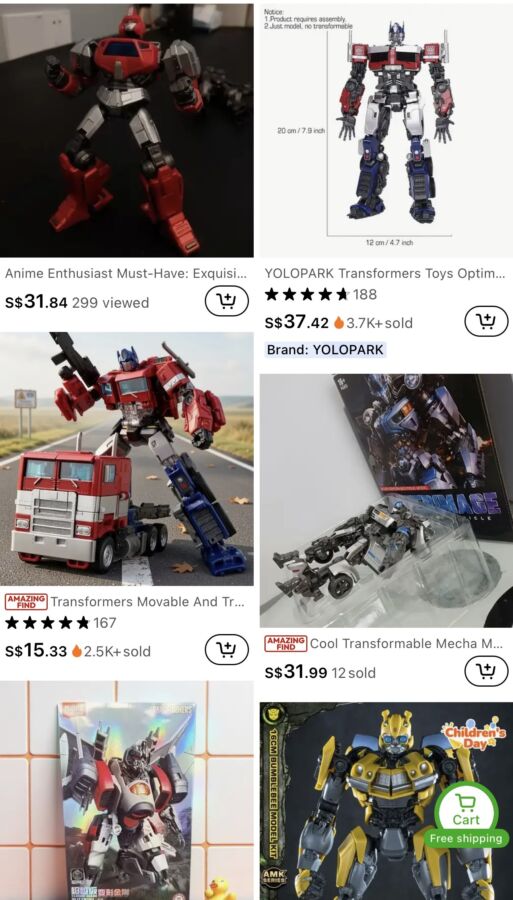
| Pinduoduo | Temu | |
| Transformers | – Many listings available, from official Hasbro products, to third-party releases and knock-offs – Listings include some rare finds, such as toys from the Transformers Prime and live-action movies – Prices vary wildly, from as low as S$5 to over S$300 for rare items and third-party releases | – Multiple listings, with several knock-off items – Harder to find as entering “Transformers” keyword results in mostly Gundam results – Prices range from S$10 to S$150 |
| Blokees | – Many options ranging across the different classes of model kits (Blind Boxes, Action Edition, Champion Class) – Prices range from S$1 for a single blind box to S$60 for limited editions | – Entering the keyword doesn’t work, though the actual sets are available. Users must key in the specific terms like ‘Transformers’ or ‘model kit’ – Limited selection available – Price ranges from S$30 to S$35 |
| Barbie | – Many options, ranging from dolls, apparel, and jewellery – Toy prices range from S$3 to S$20 | – Many options, ranging from dolls, apparel, and jewellery – Toy prices range from S$20 to S$60 |
On Temu, it’s harder to search for products using their official brand name. Instead, users are required to input related and relevant keywords linked to the product and try their luck. Hopefully, the platform will improve its search functions to cater to local search terms.
Moving on, we moved to apparel to search for simple items – sunglasses and a backpack.
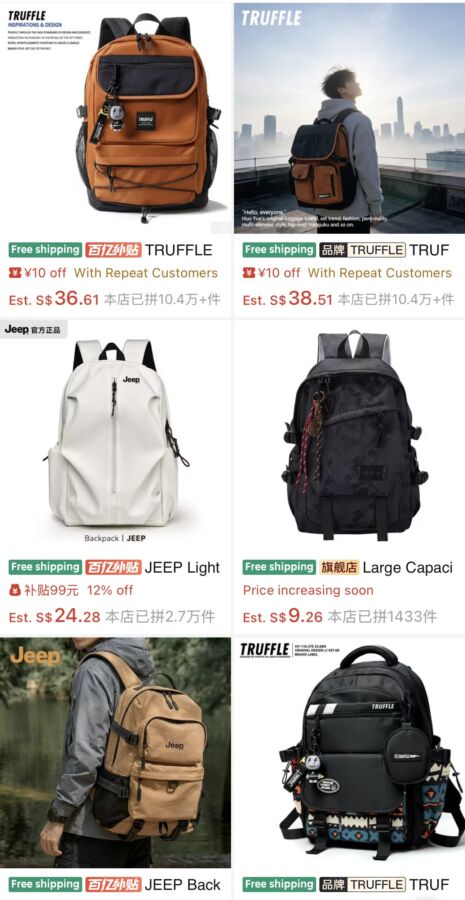
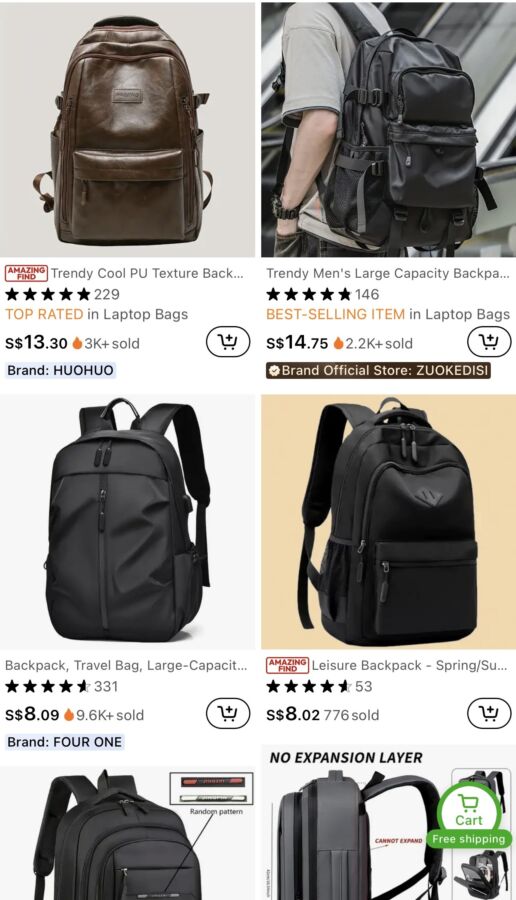
| Pinduoduo | Temu | |
| Sunglasses | – Wide range of products for men and women – Mostly cheaper variants of famous brands like Oakley – Prices range from S$0.30 to S$30 | – Wide range of products for men and women – Mostly cheaper variants of famous brands like Oakley – Some listings offer products in bulk – Prices range from S$2 to S$200 |
| Backpack | – A combination of regular, unbranded backpacks as well as an assortment from actual international brands, with matching prices. – Prices range from S$5 to S$80 | – A combination of regular, unbranded backpacks and officially branded products – Offers a wide selection of vintage leather bags – Price ranges from S$1 to S$300 |
This is where you decide if you want an unbranded bag or want to pick up an item that looks similar to a branded item, but at a fraction of the price. Temu offers products at a much wider price range thanks to bulk listings and items made of expensive materials. Officially licensed products on offer are usually from Chinese brands instead of international ones.
Lastly, we searched for accessories, and we had to be a bit more specific here, as we shopped for a Casetify iPhone 17 Pro Max case, a 100W Anker PD Charger, and a 100W USB-C cable
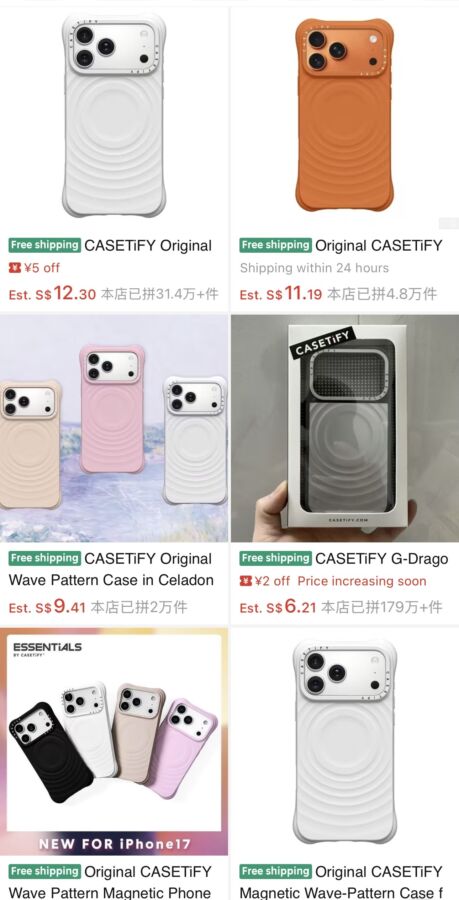
| Pinduoduo | Temu | |
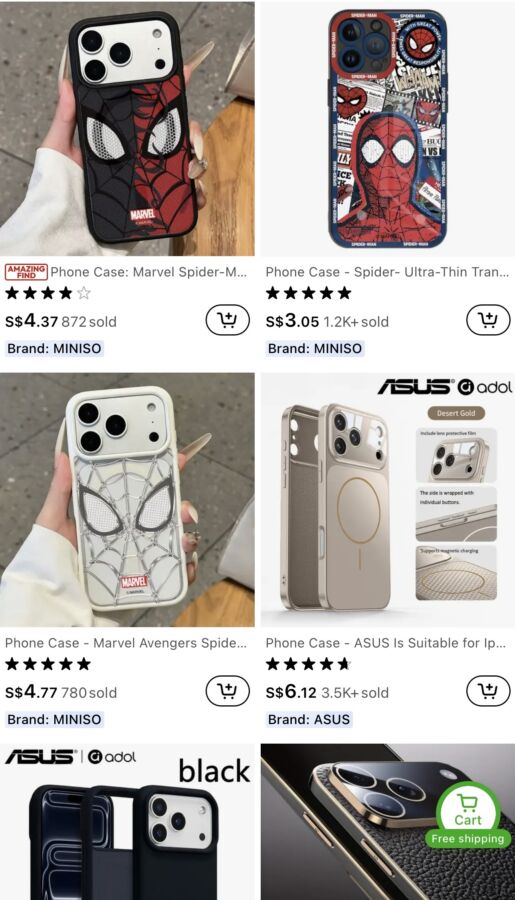
| Casetify iPhone 17 Pro Max case | – Several listings from Casetify and from other brands – Prices range from S$5 to S$14 | – Many options, but none from Casetify – Other brands on offer include MINISO and ASUS – Prices range from S$2.50 to S$16 |
| 100W Anker PD Charger | – Offers an official Anker store – Prices range from S$28 to S$85 | – Entering the keyword produces many unrelated results, like USB hubs and car chargers – Only features car chargers from Anker |
| 100W USB-C cable | – Many options from a variety of brands – USB C-to-C and A-to-C variations – Different cable lengths on offer – Prices range from S$0.20 to S$11 | – Many options from a variety of brands – USB C-to-C and A-to-C variations – Different cable lengths on offer – Prices range from S$2 to S$4 |
Once again, prices on Pinduoduo are generally lower, but the difference here lies in ease of use, as Pinduoduo generally offers more relevant search results compared to Temu, which often lists different product types than the one searched for.
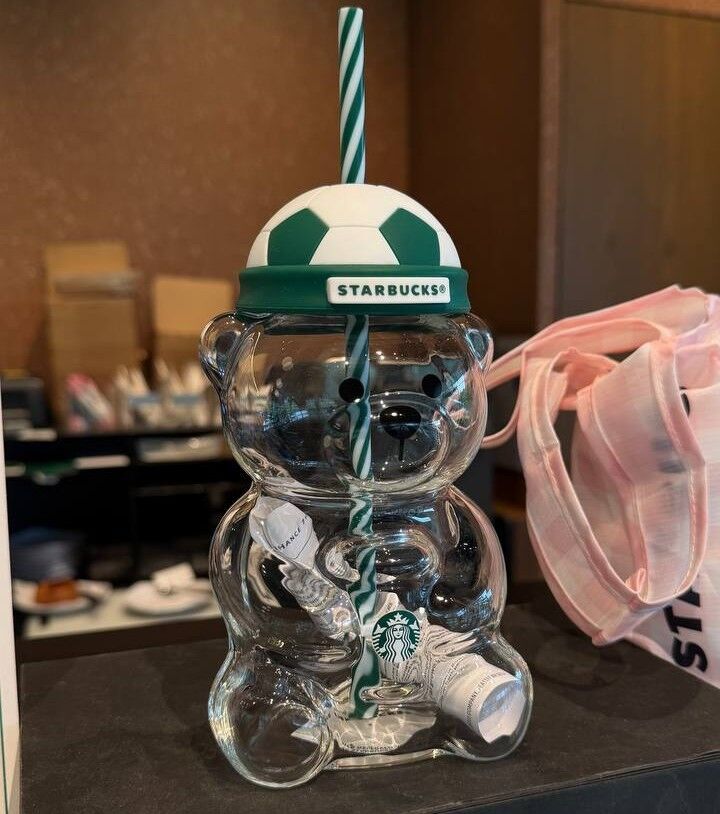
So what happens when you can’t search using the traditional method? This is where image search comes in. One of the driving forces of Chinese e-commerce platforms is the ability to upload an image of a product and then search for similar ones. This eliminates the need for consumers to perform manual searches, effectively getting past language barriers. For this test, we uploaded the following image of a Starbucks beverage bottle in the shape of a bear wearing a cap with a football design to see which platform offered the more relevant results.
| Pinduoduo | Temu |
| – Able to identify the exact item, down to the brand – Offers not just the product shown, but also the other variations in its lineup, including the same bear-shaped bottle, but wearing a green beanie instead. – When using the search function, the English machine translation doesn’t work, so the results are in Mandarin, and for some reason, prices are not listed in SGD. – Prices range from S$1 to S$25 for the entire set | – Less accurate, shows products that follow the same theme, but may not even look like the actual photo, such as showing results of normal glass cups with animal prints – Prices range from S$1.50 to S$16 |
The search function on Pinduoduo is much more accurate compared to Temu, with recommended items either being official or similar-looking items with the same bear shape design. The issue here is that machine translation doesn’t work while using this mode, so buyers might need to get around the language barrier with apps like Google Lens.
In all, Pinduoduo has consistently offered more relevant options with much lower prices compared to Temu, though you have to factor in up to three weeks or more for delivery. There is a suspicion that with prices so low, not everything is authentic, so it’s recommended that shoppers read the user reviews carefully to identify any complaints before making a purchase.

Kevin is a reformed PC Master Race gamer with a penchant for franchise “duds” like Darksiders III and Dead Space 3. He has made it his life-long mission to play every single major game release – lest his wallet dies trying.
 Si Jia
 Brandon Toh