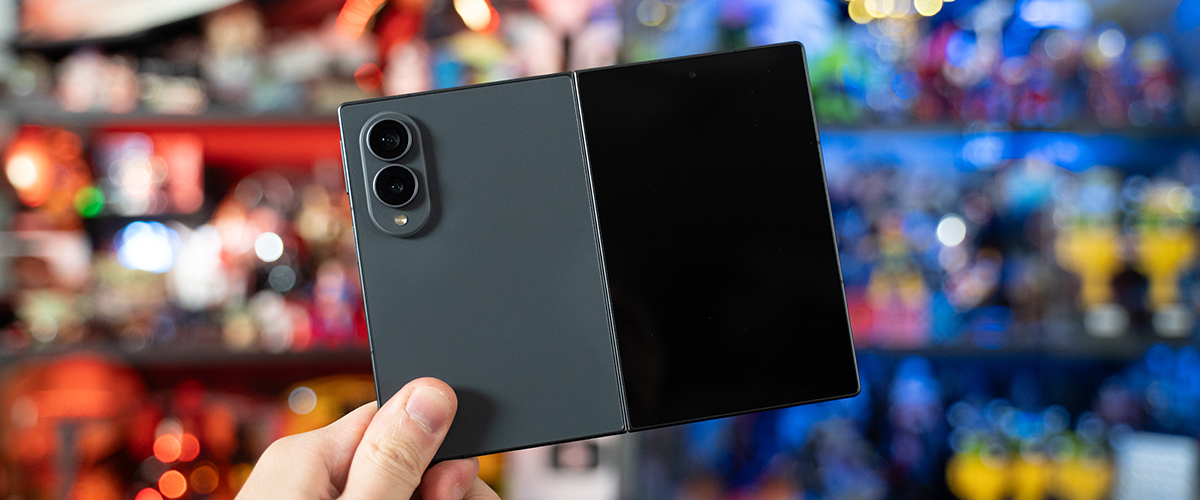
After seven generations of foldable smartphones with Samsung’s Galaxy Z Fold series, where a display can be unfolded like a book to reveal an even bigger screen, one would think that the Korean chaebol is ready to write a new chapter in mobile hardware technology and it has, with the Samsung Galaxy Z Fold 8 and a small tweak – with the industry’s first wide foldable Android device with a 4:3 aspect ratio.

Ditching the candy bar-esque design of conventional foldables, the Galaxy Z Fold 8 features a shorter but wider form factor when folded, measuring 81.9 x 123.9 x 9.7 mm compared to 158.4 x 72.8 x 8.9 mm on last year’s Fold 7, which now effectively makes it roughly the same size as a passport. Thanks to its more compact size, it’s also much lighter at just 201g (versus 215g on the Fold 7), making it more comfortable to use in one hand compared to other foldable devices.
While its 5.5-inch (1,248 x 1,972 resolution) AMOLED cover display might feel a little awkward to use at first, it’s no different from the squarish design of the 6-inch Kobo Clara e-book reader, which makes for far easier one-hand use compared to traditional rectangle-styled phones. The average user should have no problem accessing almost all areas of the screen with their thumb, including the volume rocker and power switch/fingerprint reader situated on the device’s right side. Their higher positioning along the device’s edge might take a bit of getting used to, but with no established design standards across companies, it looks like Samsung isn’t against going back to the drawing board to come up with something new and different.


On the other hand, the true advantage of using a more square-shaped display cannot be denied, as things aren’t squished up on the folded display and the wider nature allows for a more natural interface even when used with two hands in its folded state. Typing is more accurate as the on-screen keyboard is spaced out more than normal, and you can read more from left to right on the compact 10:16 aspect ratio, even as you scroll more along webpages and apps compared to taller phones.
Of course, the true magic is unveiled when the device is unfolded, which now boasts a 7.6-inch (1,828 x 2,448 resolution) AMOLED 2X inner screen that supports up to a 120Hz refresh rate. While conventional foldable devices can feel a bit too squarish, the Galaxy Z Fold 8 offers an experience that feels closer to using an actual tablet, which shouldn’t be too surprising considering its unfolded dimensions, of 123.9 x 161.4 x 4.5 mm, are similar to those on the Apple iPad Mini 7th generation, at 195.4 x 134.8 x 6.3 mm deep, though this does include a slightly larger bezel around the display.

With its wider form factor, watching videos and gaming on the device while unfolded is a much better experience, presenting minimal letterboxing and a more natural grip style, especially when gaming. For the older generation who grew up with standard television displays, you can catch older content like classic movies or anime built around the 4:3 aspect ratio that fills up the entire screen completely, removing those unsightly black bars on the sides.
The downside to this new design is that the phone no longer has a “Flex Mode”, a feature on previous devices and still available on the Galaxy Z Fold 8 Pro, that allows the screen’s layout to be split into two when folding the phone halfway like a mini laptop. Even trying to prop up the phone in this manner to watch hands-free videos is tricky to pull off, as the device has a tendency to automatically “snap” into its unfolded form, but users can still get around this issue by flipping the phone and using it in its “tent” mode with its cover screen.

One of the main selling points of a wider display is multitasking, and the device allows for up to three apps running in split-screen layouts, either with all three side-by-side, or having one occupying half of the screen, with the other two stacked on top of each other on the other half. This feature has to be manually activated by dragging and dropping the app screen, but users can also swipe two fingers from the side to automatically create a split-screen view with an app of their choice.
Once in split-screen mode, finer adjustments to each individual screen size can be made by dragging the corner of the screen, or pressing and holding a small blue line icon at the top of each screen to change its layout. Having this freedom to choose where each app appears on-screen can be pretty handy, allowing users to take notes while watching presentations, or have a frame-rate counter app open while playing games.

Here’s where another advantage of its 4:3 layout comes in, as compared to past foldables, which force split-screen apps into cramped, vertical columns, the Galaxy Z Fold 8’s wider aspect ratio offers more natural-looking tabs that can display more on-screen at once, which improves the viability of multitasking as more information can be presented per screen.
And for those who aren’t leaning towards foldable devices due to the perceived crease that accompanies any and all folded devices, the Galaxy Z Fold 8’s Flex Titanium technology has improved on this such that the Fold 8 features one of the least visible crease seen across any company’s foldable device line-up to date, and is barely noticeable in use unless you’re looking for it, and it can only be seen from certain angles.

Under the hood, the Galaxy Z Fold 8 is powered by a Snapdragon 8 Elite Gen 5 CPU and an Adreno 840 GPU, meaning it handles day-to-day use, even while running three different apps on the device at once, without displaying any noticeable software slowdown. This can be playing a mobile game on one side, watching a streaming service on the top half on the other side, and chatting with friends on the bottom half. The device offers a base configuration of 12GB of RAM and 256GB of storage, expandable to 512GB and 1TB, and presents smooth performance while gaming with titles like Delta Force and Genshin Impact, with performance taking a hit only on more graphically intensive games like Zenless Zone Zero. Its biggest boon to gaming, however, lies once again with its unique 4:3 aspect ratio, allowing it to deliver full-screen immersion without the black borders present on previous Fold models.
The biggest downside, however, lies in its unreliable thermals even when not operating in split-screen. The phone tends to heat up even while not using any power-intensive apps, such as simply scrolling through the web, which seems to be a downside of having such a slim chassis, since this doesn’t leave much room for proper thermal management systems, such as the vapour chamber seen on other Samsung devices, such as the Galaxy S26 Ultra. The phone also has the tendency to leave more fingerprint residue on its surface compared to a standard glass panel, which is a longstanding issue the company has yet to overcome.

Don’t expect too much from its camera setup either, as the Galaxy Z Fold 8 drops the 200MP wide main shooter of the Fold 7 for a 50MP main camera, even as the 50MP ultrawide lens is an upgrade from the 12MP one on the predecessor. Rounding off its camera capabilities are two sets of 10MP selfie shooters in wide and ultrawide configurations.
Even with its humble lineup of cameras, photos still come out looking more than decent, with reliable colour accuracy and clarity for the regular user, though visual performance does take a hit under low-light conditions. Perhaps the biggest missing feature here is the lack of a dedicated telephoto lens, and although the average user can still get by with its 10x maximum digital zoom, those who are heavily dependent on proper zoom photography might need to consider looking elsewhere.


Despite its limitations, the foldable nature of the phone means that it offers room for some fun photography gimmicks, such as the ability to use the device’s superior rear cameras for selfies while displaying a preview image using its cover screen. While not a new feature to the Galaxy Z Fold 8, it’s still a handy tool to get the most detail out of portraits or group shots. Meanwhile, other returning features, such as the ability to record vlog-style videos using both front and rear cameras, provide added flexibility when creating content.

Camera fidelity might have taken a step back in some regards, but battery capacity, perhaps the more important aspect of any device for your average user, has seen a much-needed boost. The device’s hefty 4,800mAh Si-C battery marks an upgrade over the 4,400mAh one seen on its predecessors, and packs more than enough juice to easily last through a typical workday.
Even when the battery runs dry, powering back up is also much faster as the device now supports 45 watts of wired charging, allowing it to be fully charged up from zero per cent in less than an hour. However, even though the device is capable of wireless charging at 20 watts, it still doesn’t feature built-in magnetic charging rings, so users will still need to buy external phone cases with magnetic attachments if they want to use wireless Qi2 chargers.

Even with its novel aspect ratio, dependable battery and reliable performance, its premium cost still remains the biggest hurdle to entry. Despite being priced at S$200 cheaper than its predecessor, the Samsung Galaxy Z Fold 8’s S$2,498 starting price point is still rather eye-catching for any smartphone, especially since it does fall short in a few areas like its less-than-stellar camera setup and tendency to run hot. Still, this is perhaps the most refined implementation of the phone-tablet hybrid form factor yet, so those who wish to benefit from its unique layout alone might find it worth taking the plunge for.
Product images were shot using a Sony α7 IV Full-Frame Hybrid Camera equipped with the following lenses: Sony FE 50mm F1.4 GM and 28-70mm F2 GM.
GEEK REVIEW SCORE
Summary
The Samsung Galaxy Z Fold 8’s unique 4:3 ratio sets the standard for multitasking and providing an immersive content-viewing experience, although its weak camera setup and hefty price tag make it a harder sell for anyone but the most dedicated foldable fan.
Overall
8.5/10-
Aesthetics - 9/10
9/10
-
Build Quality - 9/10
9/10
-
Performance - 9/10
9/10
-
Value - 7/10
7/10
-
Geek Satisfaction - 8.5/10
8.5/10

Kevin is a reformed PC Master Race gamer with a penchant for franchise “duds” like Darksiders III and Dead Space 3. He has made it his life-long mission to play every single major game release – lest his wallet dies trying.
 HSALS
HSALS