
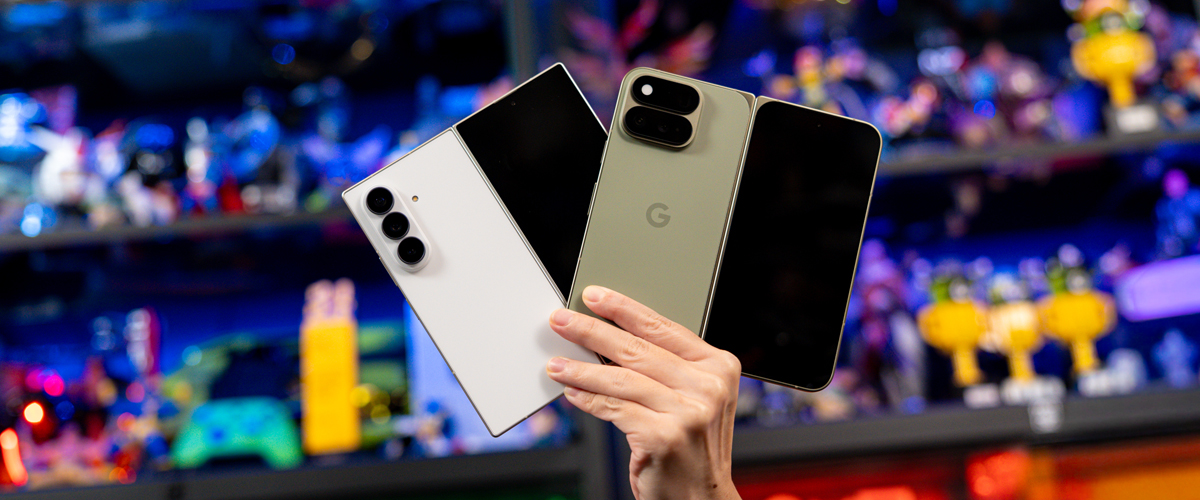
Once considered a niche offering, foldable smartphones have become increasingly popular in recent years, with more options now available on the market. This year, Samsung debuted the Galaxy Z Fold 8, its first model in the 4:3 form factor that challenges the Huawei Pura X head-on, but the base iteration — now renamed the Galaxy Z Fold 8 Ultra — has also been upgraded, keeping in line with yearly tradition. It’s the slimmest in the family to date, measuring 4.1mm thin when unfolded (versus 5.6mm on its predecessor) and weighing 215 grams.
Likewise, some heft has been trimmed off the Google Pixel 11 Pro Fold, which tips the scales at 239 grams, down from 258 grams previously. The handset expands from 76 x 10.1 x 155.2mm to 150.4 x 5 x 155.2mm when fully open, revealing an 8-inch Super Actua OLED inner display with a resolution of 2,152 x 2,076 pixels, up to 3,600-nit brightness, and a 120Hz refresh rate. In comparison, its Samsung counterpart boasts an 8-inch QXGA+ main screen (2,504 x 2,256), a 120Hz refresh rate, and a 3,000-nit peak brightness.
Hardware isn’t quite the same, too. While the Pixel 11 Pro Fold is powered by the company’s proprietary Tensor G6 chipset, the latter opts for the more standard Snapdragon 8 Elite Gen 5. Sitting at the rear of both devices is a three-camera setup, albeit with different configurations: a 48-megapixel (MP) main shooter, a 10.5MP ultra-wide camera, and a 10.8MP telephoto lens, versus 200MP, 50MP, and 10MP, respectively.
Rounding out the user experience is their own suite of new tools and artificial intelligence (AI) capabilities, including My FanCam for the Samsung Galaxy Z Fold 8 Ultra, as well as Make You Look and HiLight for the Pixel 11 Pro Fold. As impressive as the optics may look on paper, nothing matters more than real-world performance, which can only mean one thing — putting the two phones through a side-by-side comparison spanning gaming, overall features, and photography.
Check out how they stack up against each other in the video above.

Si Jia is a casual geek at heart – or as casual as someone with Sephiroth’s theme on her Spotify playlist can get. A fan of movies, games, and Japanese culture, Si Jia’s greatest weakness is the Steam Summer Sale. Or any Steam sale, really.
 Kevin Low