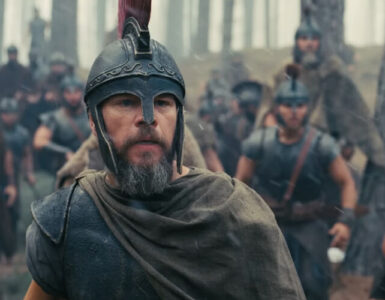
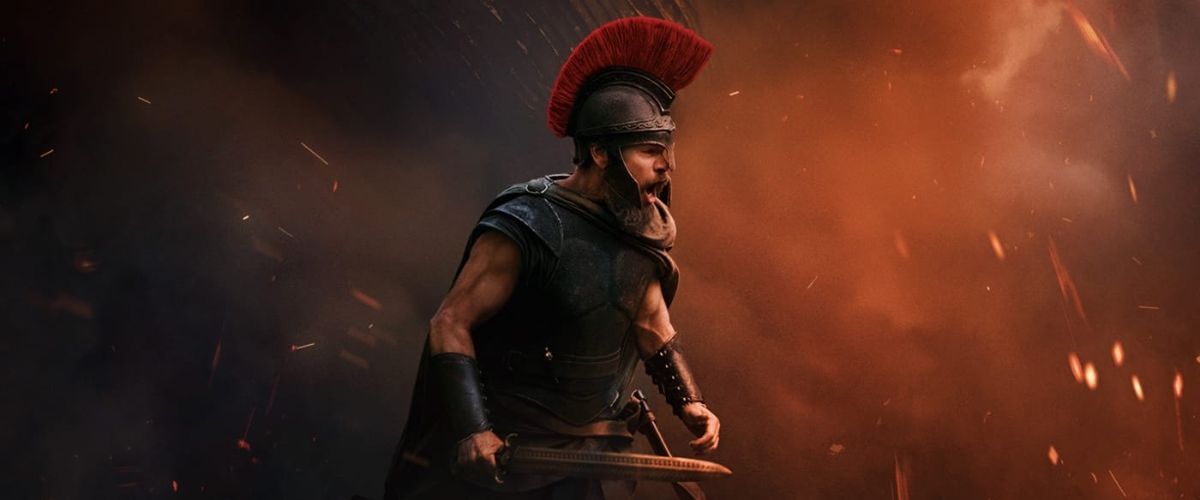
More than seventy years have passed since Hollywood last attempted a faithful adaptation of Homer’s epic The Odyssey, a surprising gap considering the industry’s endless appetite for revisiting familiar stories. Then again, The Odyssey has never been an easy mountain to climb as it is the original blueprint from which countless adventures have borrowed, and the foundation beneath the Hero’s Journey itself. Yet, its sprawling structure, shifting timelines and episodic encounters have often proved resistant to cinema.
Director Christopher Nolan (Interstellar, Inception), adapting the poem himself, approaches that challenge with obvious reverence, drawing from Homer’s original text while embracing the emotional immediacy found in modern interpretations like Emily Wilson’s celebrated translation (2017) and Jorge Rivera-Herrans’ musical interpretation Epic: The Musical (with an animated feature now in development from producer Jerry Bruckheimer). His film understands that Odysseus (Matt Damon, The Bourne Identity) survives because he remains brilliantly, frustratingly human – clever enough to outwit monsters, foolish enough to provoke gods, and stubborn enough to keep rowing towards home when every divine force seems determined to push him somewhere else. No contemporary filmmaker feels better suited to that ambition and fresh from the success of Oppenheimer (2023) and already renowned for pushing theatrical filmmaking toward ever grander horizons, Nolan reaches another technical milestone by becoming the first filmmaker to shoot an entire feature on IMAX film cameras – a decision that transforms Homer’s sprawling odyssey into an experience of almost overwhelming physical scale. Watching it projected on 35mm only reinforces the sensation that this is cinema built to honour both ancient storytelling and the tactile grandeur of the medium itself.
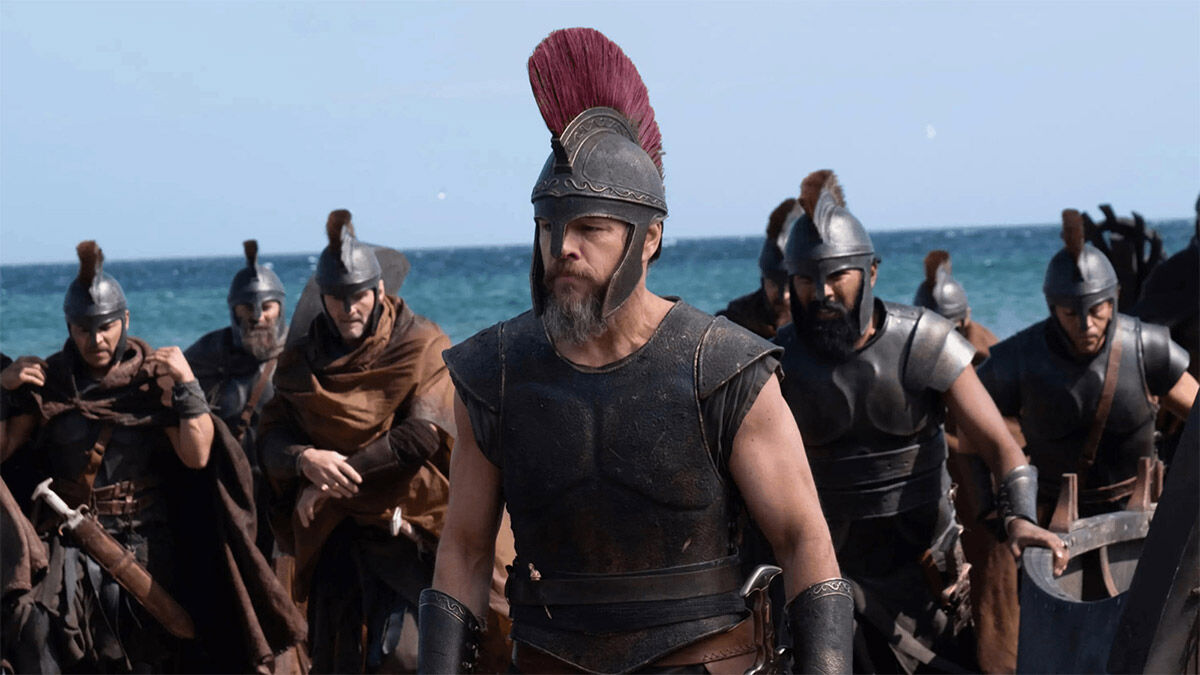
Ambition alone, however, has never been enough to tame Homer’s poem. Beginning in medias res, folding memory into the present and allowing entire adventures to unfold almost as standalone tales across a decade-long voyage, The Odyssey possesses a structure that has challenged storytellers for centuries but thankfully Nolan is known for and wisely embraces that design, weaving together Odysseus’ long passage home following ten brutal years fighting in the Trojan War under King Agamemnon of Mycenae (Benny Safdie, The Smashing Machine), as the weary king sails across the Mediterranean toward Ithaca, full speed ahead.
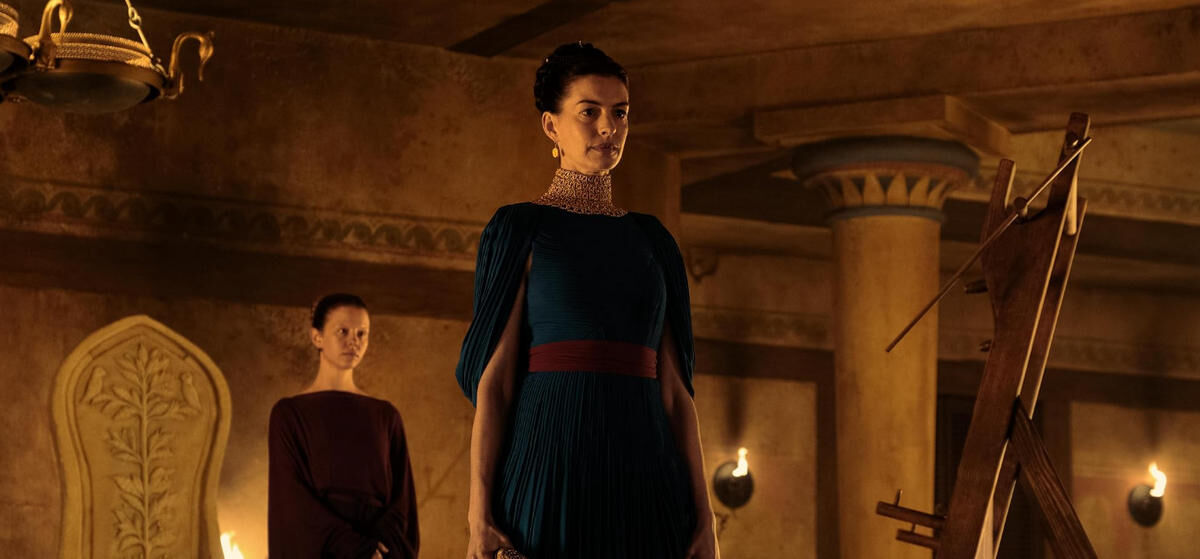
Rather than opening upon storm-tossed seas or mythical beasts, Nolan first turns his gaze toward an Ithaca slowly collapsing beneath the weight of twenty unanswered years. Queen Penelope (Anne Hathaway, The Devil Wears Prada) finds herself trapped inside a different kind of siege, forced to entertain a growing crowd of opportunistic suitors who feast upon her kingdom’s dwindling resources while waiting for grief to become surrender. Among those circling the throne, Robert Pattinson’s (The Batman) Antinous emerges as one of the film’s most delightfully contemptible creations. Smug, manipulative and perpetually convinced history is on his side, Antinous cloaks ruthless ambition beneath polished manners, delivering every line with the sort of theatrical arrogance that makes audiences relish every moment he occupies the screen – his cutting dismissal of Odysseus’ son Telemachus (Tom Holland, Spider-Man: No Way Home) as “pining for a daddy you didn’t even know, like some snivelling bastard”, lands with exactly the sort of calculated cruelty Homer’s most loathsome suitor deserves.
Holland rises to that challenge as Telemachus occupies an uncomfortable space between childhood and kingship, old enough to recognise the danger surrounding his family but still lacking the authority to stop it. Antinous promises Penelope that her son’s claim will be respected should she agree to marry him, though everyone in the room, especially Telemachus, understands how hollow that assurance truly is. Holland brings quiet resolve to a character defined by uncertainty, allowing compassion and courage to coexist without ever slipping into naïveté; audiences familiar with his instinctive optimism as Spider-Man may recognise echoes of that earnestness here, but there is a striking maturity underpinning the performance.
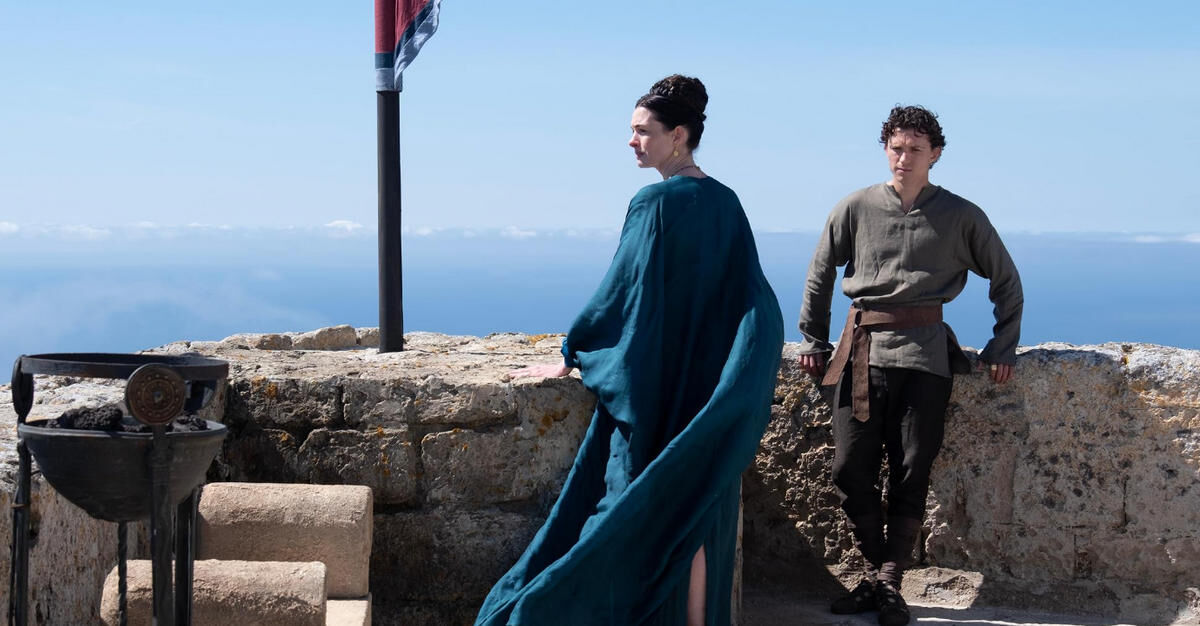
Much of that emotional weight ultimately rests with Hathaway, whose Penelope becomes the steady heartbeat of the entire film. Nolan understands that The Odyssey belongs as much to those left waiting as it does to the man undertaking the voyage, allowing Hathaway to portray years of grief, resilience and political calculation without ever reducing her to a passive figure. Flashbacks to the days before Troy reveal two young parents dreaming about a future together, aware that duty demands sacrifices neither truly wishes to make. Their conversations carry a bittersweet tenderness precisely because both already understand what answering Agamemnon’s call could cost. Damon and Hathaway share an effortless chemistry that quietly anchors Homer’s sweeping mythology, making it entirely believable that while kingdoms fracture, one promise continues refusing to yield. Twenty years reshape almost everything but love, against every imaginable odds, proves stubborn enough to survive them all.
Waiting becomes its own form of heroism throughout Ithaca and faithful swineherd Eumaeus, played with understated warmth by John Leguizamo (John Wick), also survives the suitors’ occupation as another relic of Odysseus’ forgotten household, quietly pushed to the margins alongside Argos, the king’s once-playful hunting dog. Homer devoted only a handful of heartbreaking lines to Argos’ reunion with his master, yet those verses have endured for centuries. Eumaeus also becomes the closest thing Telemachus has to the father who never came home and training beneath the old servant’s guidance gradually replaces youthful hope with quiet determination, convincing the young prince that inherited stories are no longer enough. Answers lie beyond Ithaca, prompting Telemachus to begin a journey of his own in search of men who actually fought beside his father rather than merely singing about him.
That search eventually leads to Sparta, where King Menelaus (Jon Bernthal, The Punisher) and his wife Helen (Lupita Nyong’o, Black Panther) welcome the young prince into his court. Victory at Troy may have secured everlasting glory, but Bernthal allows exhaustion and lingering bitterness to seep through every recollection. Around a shared meal, Menelaus recounts the deception that finally ended the war – Odysseus’ audacious plan to conceal Greek soldiers inside a colossal wooden horse presented as an offering to the gods before unleashing devastation from within Troy’s walls. Originally unveiled as an extended IMAX preview months before release, the fall of Troy fully justifies every ounce of anticipation surrounding it as Nolan transforms that familiar legend into one of the film’s most astonishing spectacles. Cinematographer Hoyte van Hoytema’s (Dunkirk) cameras begin inside the suffocating darkness of the horse itself, trapping audiences alongside nervous Greek soldiers listening for the moment history changes, before gradually revealing the overwhelming scale of a city they invaded.
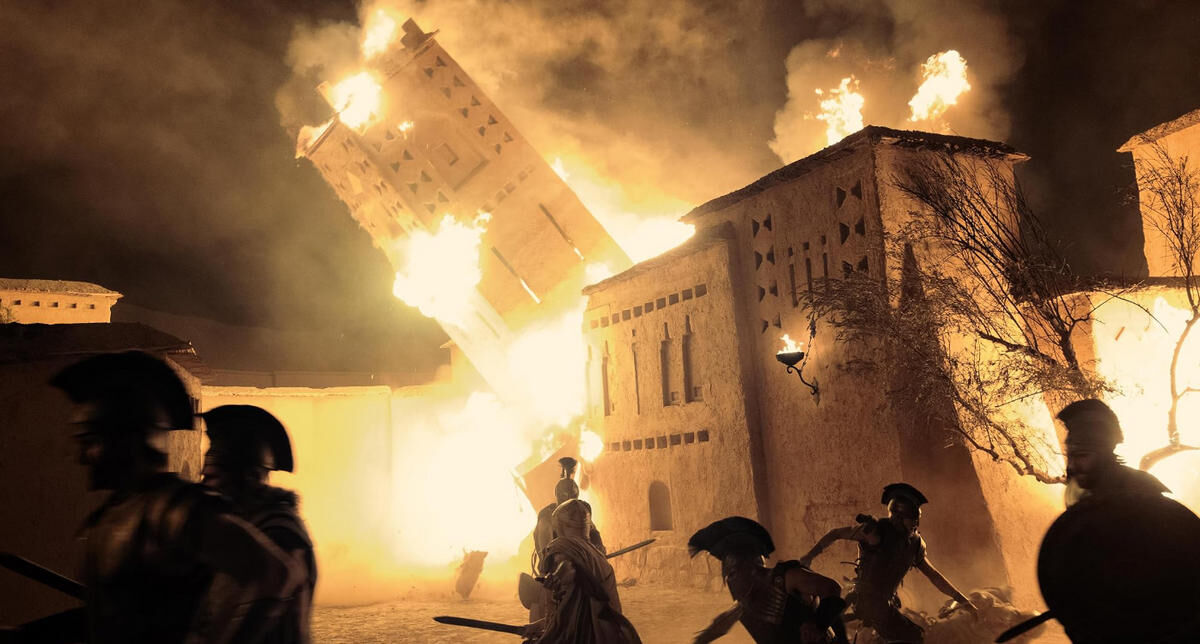
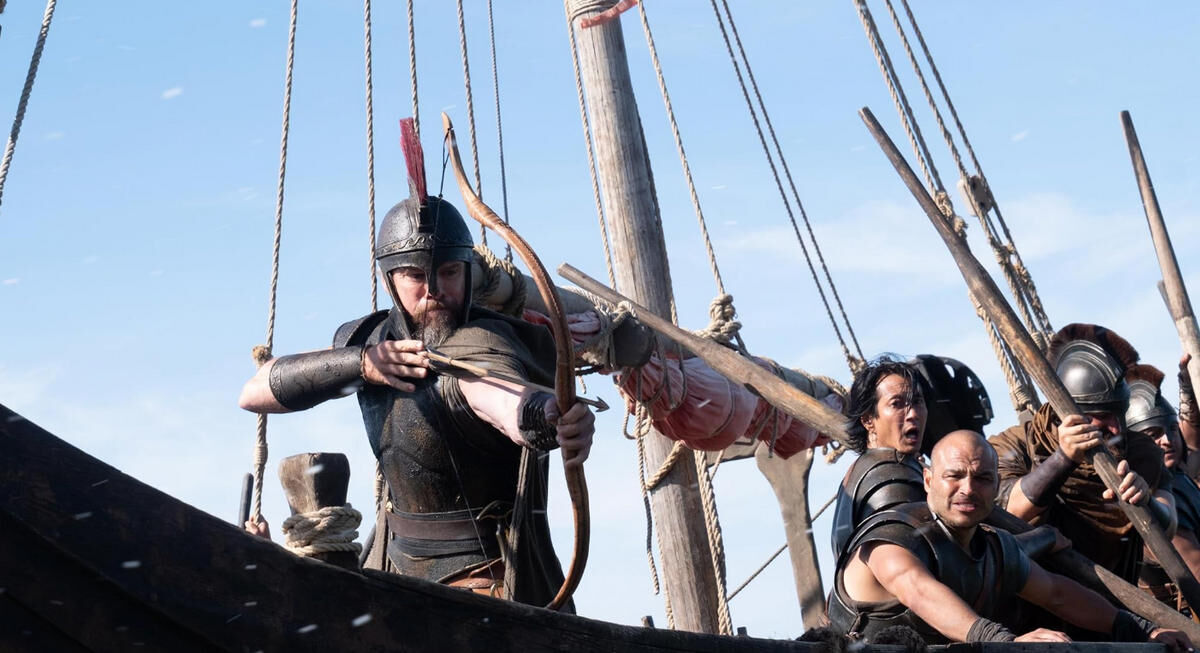
Similar ingenuity carries through every major mythological encounter that follows, whether Odysseus confronts the towering cyclops Polyphemus (Bill Irwin, Interstellar), battles the fearsome Laestrygonians or simply struggles against a sea that seems determined never to release him. Remarkably, Nolan achieves much of that illusion without leaning on overt digital spectacle, instead manipulating perspective, camera placement and enormous practical environments to convince audiences that gods and monsters truly occupy the same physical space as the cast.
Craftsmanship of that calibre extends across every department – Jennifer Lame’s (Tenet) editing maintains momentum across Homer’s episodic structure without sacrificing clarity, while Ruth De Jong’s (Oppenheimer) extraordinary production design transforms ancient Greece into somewhere tangible enough to smell the smoke and sea salt. Troy itself stands as an astonishing feat of construction, matched by Ellen Mirojnick’s (Bridgerton) costumes that gracefully bridge archaeological authenticity with mythical grandeur. Meanwhile, Ludwig Göransson’s (Sinners) masterful score shifts effortlessly between intimate melancholy and thunderous warfare, driven by pounding percussion that echoes like distant war drums across centuries. Keen ears may even catch subtle musical phrases recalling Rivera-Herrans’ ‘Just A Man’, a quietly affectionate nod that feels entirely appropriate for a story now embraced by multiple generations through different artistic voices.
Among the voyage’s many encounters, Samantha Morton’s (The Serpent Queen) Circe provides perhaps its most unforgettable detour. Hunger lures Odysseus’ exhausted crew into accepting her hospitality, only for an innocent meal to descend into grotesque body horror as men collapse and transform into squealing livestock through an extraordinary combination of prosthetics, practical effects and old-fashioned cinematic trickery. Rather than relying on flashy visual effects, Nolan stages the metamorphosis with disturbing physicality, making every twisted limb and distorted face feel alarmingly real. Odysseus’ eventual confrontation with Circe becomes a contest of intelligence rather than brute force, reminding audiences why cunning, not strength, has always been his defining weapon.
Irwin’s Polyphemus leaves an equally powerful impression despite limited screen time. Nolan stages the encounter with genuine horror, allowing silence and uncertainty to build before revealing the Cyclops in all his terrifying scale. Consequences ripple far beyond the cave itself, as the blinding of Poseidon’s son places an unforgiving god directly in Odysseus’ path for the remainder of his journey. Purists, however, may leave with understandable reservations – Homer’s poem devotes considerable attention to the wit that defines Odysseus, and several celebrated episodes receive surprisingly brisk treatment here. His elaborate deception of Polyphemus is condensed dramatically, omitting the famous “Nobody” ruse, the wine that lowers the Cyclops’ guard and, perhaps most puzzlingly, the proud declaration of his own name that originally earned Poseidon’s eternal wrath. Without those beats, newcomers may reasonably wonder how the sea god identifies the mortal responsible for blinding his son. Elsewhere, Scylla flashes past so quickly she risks becoming little more than a visual footnote, while Nolan’s heavily reimagined armoured Laestrygonians bear only a passing resemblance to Homer’s savage giants.
Every trial, every storm and every impossible encounter eventually leads back to the place where the story truly began. Returning to Ithaca in the guise of a beggar, Odysseus conceals his identity both to test Penelope’s enduring faith and to move unnoticed among the suitors who have spent two decades carving up his kingdom. Penelope, refusing to surrender her intelligence even after twenty years of waiting, devises one final challenge that only her husband could overcome, setting into motion the film’s exhilarating final act. Confined hallways, narrow chambers and crowded banquet rooms become Nolan’s battlefield of choice, allowing van Hoytema’s cameras to weave effortlessly between combatants as father and son fight side by side. Practical stunt work and in-camera spectacle give every arrow, sword strike and shattered table startling immediacy, culminating in exactly the sort of meticulously choreographed large-scale action sequence Nolan has spent a career perfecting.
Only after reaching home does The Odyssey fully reveal what has been weighing on its hero all along. Triumph arrives hand in hand with grief as Odysseus measures every hard-earned victory against the lives sacrificed to achieve it. Dead crewmen lost to storms and monsters haunt his conscience alongside the countless Trojans deceived by the wooden horse, a gift offered in the gods’ name before becoming an instrument of annihilation. One face returns more persistently than any other – Sinon (Elliot Page, The Umbrella Academy), borrowed from Virgil’s Aeneid, whose doomed role in convincing Troy to accept the horse transforms him into a symbol of the countless individuals crushed beneath the ambitions of kings.
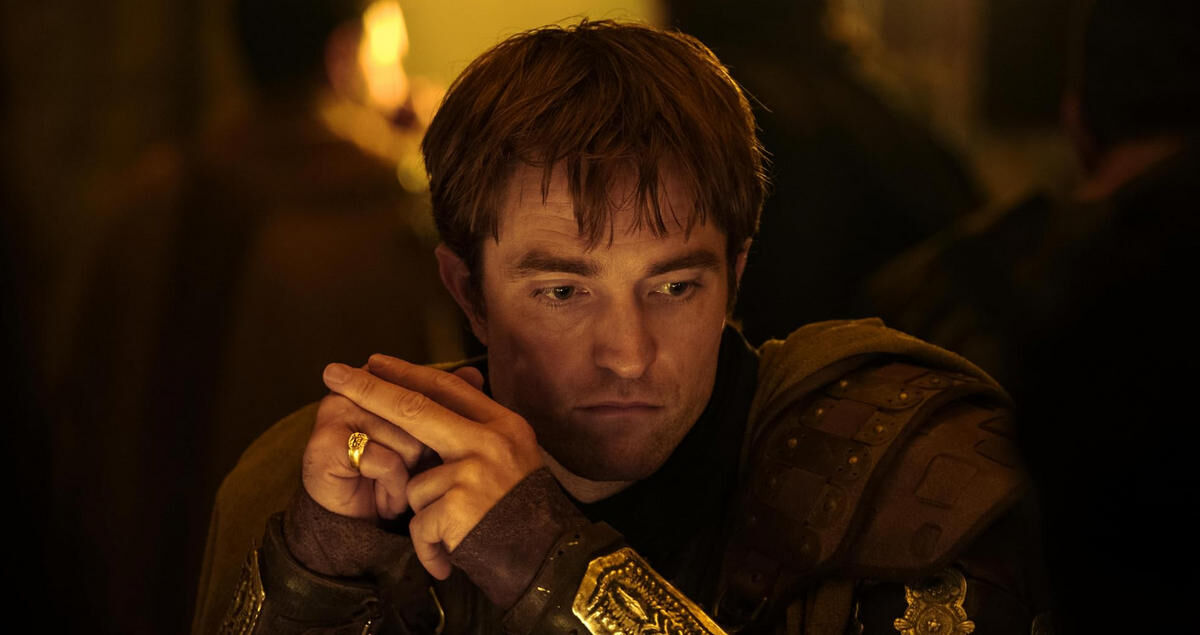
Repeated returns to the siege of Troy reinforce that emotional journey, although they occasionally threaten to overwhelm the voyage home itself. Nolan cleverly reframes those memories across the film, shifting them from exhilarating military spectacle to something closer to horror as audiences witness the invasion through increasingly uncomfortable perspectives – an effective reminder that every legendary victory belongs to someone else’s tragedy. Even so, the prominence of the Trojan Horse and repeated revisiting of the city’s fall sometimes makes The Odyssey feel as though it has drifted toward Homer’s other epic, The Iliad. Nolan’s fascination with the war certainly produces unforgettable cinema, but there are moments when the film seems almost as interested in the road Odysseus has already travelled as the one still stretching between him and home.
That said, the film sings the best when Nolan forces both Odysseus and the audience to reckon with what that deception ultimately unleashed. Interesting echoes emerge between Odysseus and Nolan’s previous protagonist, J. Robert Oppenheimer as both men alter history through extraordinary intellect, both believe their actions serve a greater purpose, and both spend the remainder of their lives wrestling with consequences far beyond their control. Nolan never forces that comparison, but it quietly colours Damon’s portrayal of a king who increasingly understands that brilliance offers no protection from conscience. Deaths of loyal companions such as his second-in-command Eurylochus (Himesh Patel, Yesterday), haunting encounters with the fallen Sinon and recurring conversations with Athena (Zendaya, the Dune franchise) steadily reshape Odysseus into someone far removed from the triumphant strategist who first sailed for Troy.
From his first appearance, marooned beneath Calypso’s (Charlize Theron, The Old Guard) enchantment and desperately grasping at fading memories of Ithaca, through brutal campaigns at Troy, impossible confrontations with gods and monsters, and finally his reckoning back home, Damon gradually charts Odysseus’ transformation through war, grief, triumph and crushing remorse with remarkable restraint. There is something quietly amusing about seeing an actor who has already spent much of his career trying to find his way home (see: The Martian) inherit literature’s most famous homecoming yet Damon never leans on familiarity – his Odysseus commands loyalty because intelligence, conviction and compassion coexist naturally within him, making it entirely believable that warriors would entrust him with their lives. It ranks comfortably among the strongest performances of his career and gives Nolan’s interpretation a deeply human centre.
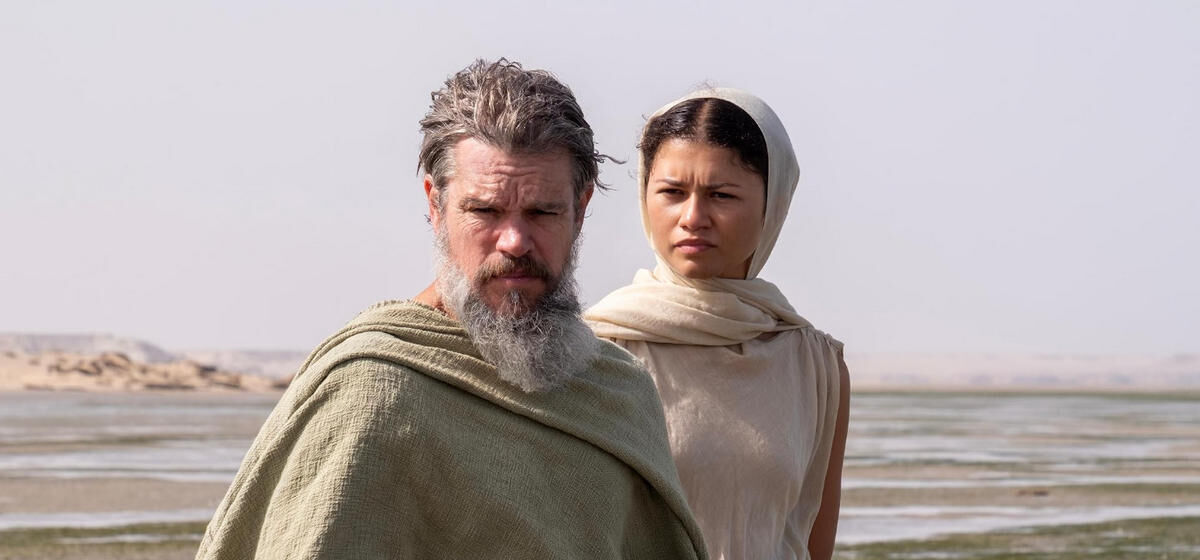
That humanity, however, arrives at the expense of something many lifelong admirers of Greek mythology may find difficult to overlook. Nolan consistently steers Homer’s world toward a more grounded interpretation, treating divine intervention as something intangible – Gods become distant influences instead of active participants, their presence felt through coincidence, conscience or the moral consequences of human action rather than direct appearances. It is an intellectually coherent choice especially within Nolan’s body of work, but one that fundamentally changes the texture of The Odyssey. Homer’s poem never presents Olympus as symbolic as Athena, Poseidon, Zeus and Hermes constantly shape mortal lives, arguing, interfering, rescuing and punishing with startling regularity. Removing much of that divine conversation inevitably strips away one of the epic’s defining qualities.
Athena perhaps suffers most from that approach – Zendaya brings warmth and quiet wisdom to her brief appearances but Homer’s great protector of Odysseus is reduced to little more than an occasional guide. Her relationship with Telemachus, so central to the poem’s opening chapters and ultimately crucial in orchestrating father and son’s reunion, receives only passing attention here. As a result, one of mythology’s richest partnerships loses much of its emotional and dramatic significance. Calypso encounters a similar problem as well – Theron is magnetic whenever she appears, effortlessly conveying the lonely immortality of a goddess unwilling to surrender the man she loves, though Nolan reimagines her imprisonment of Odysseus as something resembling a psychological lesson, eventually revealing that her purpose was to force him to remember who he truly was and where his heart belonged. Compared with Homer’s version, where Zeus commands her to release Odysseus after the gods determine his punishment has lasted long enough, the change feels surprisingly underpowered.
Whether those omissions reflect scenes left behind in the editing room or deliberate creative decisions remains impossible to know, particularly given Nolan’s well-known tendency to ground even his grandest ideas in emotional and physical reality, famously stripping much of the heightened comic-book fantasy from The Dark Knight trilogy (2005-2012) in favour of something recognisably modern. Here however, it occasionally feels like self-imposed limitation as Homer’s poem thrives because mortals and immortals constantly collide, where every triumph, disaster and detour is shaped by gods as emotional, vindictive and flawed as the humans beneath them. Choosing to keep much of that celestial drama at arm’s length leaves the film feeling curiously cautious whenever it should be embracing the very mythology that has kept this story alive for nearly three thousand years.
Even so, dismissing what Nolan achieves here would be profoundly unfair. The Odyssey may well be the most daunting undertaking of his career, and the result contains some of the most breathtaking filmmaking he has ever committed to celluloid alongside one of his most divisive screenplays. Entire sequences leave audiences wondering how they were physically achieved, particularly knowing they were captured almost entirely through practical craftsmanship using IMAX film cameras rather than computer-generated spectacle. Whatever reservations one may have about its interpretation of Homer, its technical ambition is nothing short of staggering.
Perhaps asking for the definitive adaptation of The Odyssey was always an impossible expectation. Homer’s poem has survived because every generation reshapes it according to its own fears, values and questions, with Nolan’s version joining that conversation. Some viewers will wish for more gods, others for more monsters, others still for a reunion between Odysseus and Penelope that shows the olive tree bed and lingers just a little longer after twenty years apart. All are fair criticisms but they also exist because the film inspires audiences to return to Homer, to Wilson, to Robert Fagles, to Rivera-Herrans, and to countless other retellings in search of the versions that speak most clearly to them. After all, there are worse legacies for an adaptation to leave behind.
GEEK REVIEW SCORE
Summary
Emily Wilson’s translation famously began Homer’s The Odyssey with a request – “Tell me about a complicated man.” Nearly three millennia later, Nolan has answered that call in his own unmistakable way, making the voyage itself one well worth taking.
Overall
9/10
-
Story - 8.5/10
8.5/10
-
Direction - 9.5/10
9.5/10
-
Characterisation - 9/10
9/10
-
Geek Satisfaction - 9/10
9/10

Natalie is a big fan of anything related to movies, TV shows, and anime — you name it. When she’s not reading or being a dedicated cinephile, she’s probably playing gacha and tabletop games, or daydreaming of Caleb from Love and Deepspace.

 Si Jia