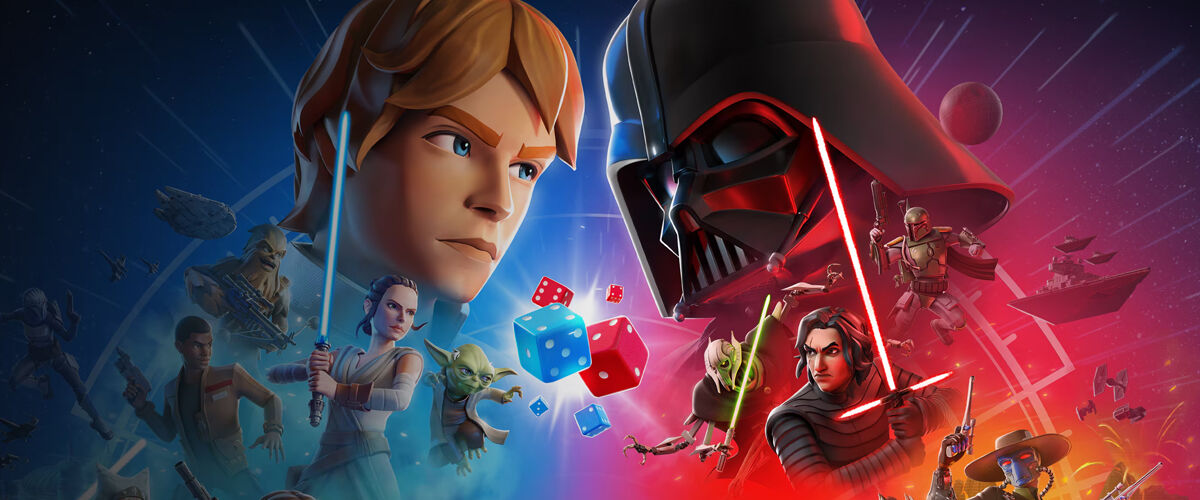
Monopoly is easily one of the most recognisable and popular family board games of all time, so what happens when it enters a galaxy far, far away? It’s not the first time in physical format, but the last time it happened in a video game was 29 years ago, when the Special Edition theatrical re-releases of the Original Trilogy made their debut, so Ubisoft has taken the liberty to revisit that combination on modern game systems with Monopoly: Star Wars Heroes vs Villains, but something must have glitched the hyperdrive engines because the Force is not strong on this one.
While the original board game, officially released in 1935 but created almost 30 years earlier, has evolved and been changed in the last 100 years, the one thing it has going for it has been its ability to change the rules of the game, with hundreds and potentially thousands of different editions and variations over the years, spanning region-specific changes to its in-game properties, updates to game pieces, properties and card contents, versions that tweak its ruleset like Monopoly Cheaters Edition, themed crossovers with iconic pop culture IPs like Pokémon and Super Mario, to spin-offs, partnerships and even card game versions.
It’s no surprise then that the board game has entered the digital space too, adapting to an age where entertainment is consumed via devices instead of in person. Still, without having a physical board and pieces to interact with, or dice to throw and players to interact with, turning a board game into a video game inadvertently loses the tactile experience of the real thing, meaning digital versions need to introduce fresh elements to shake things up.
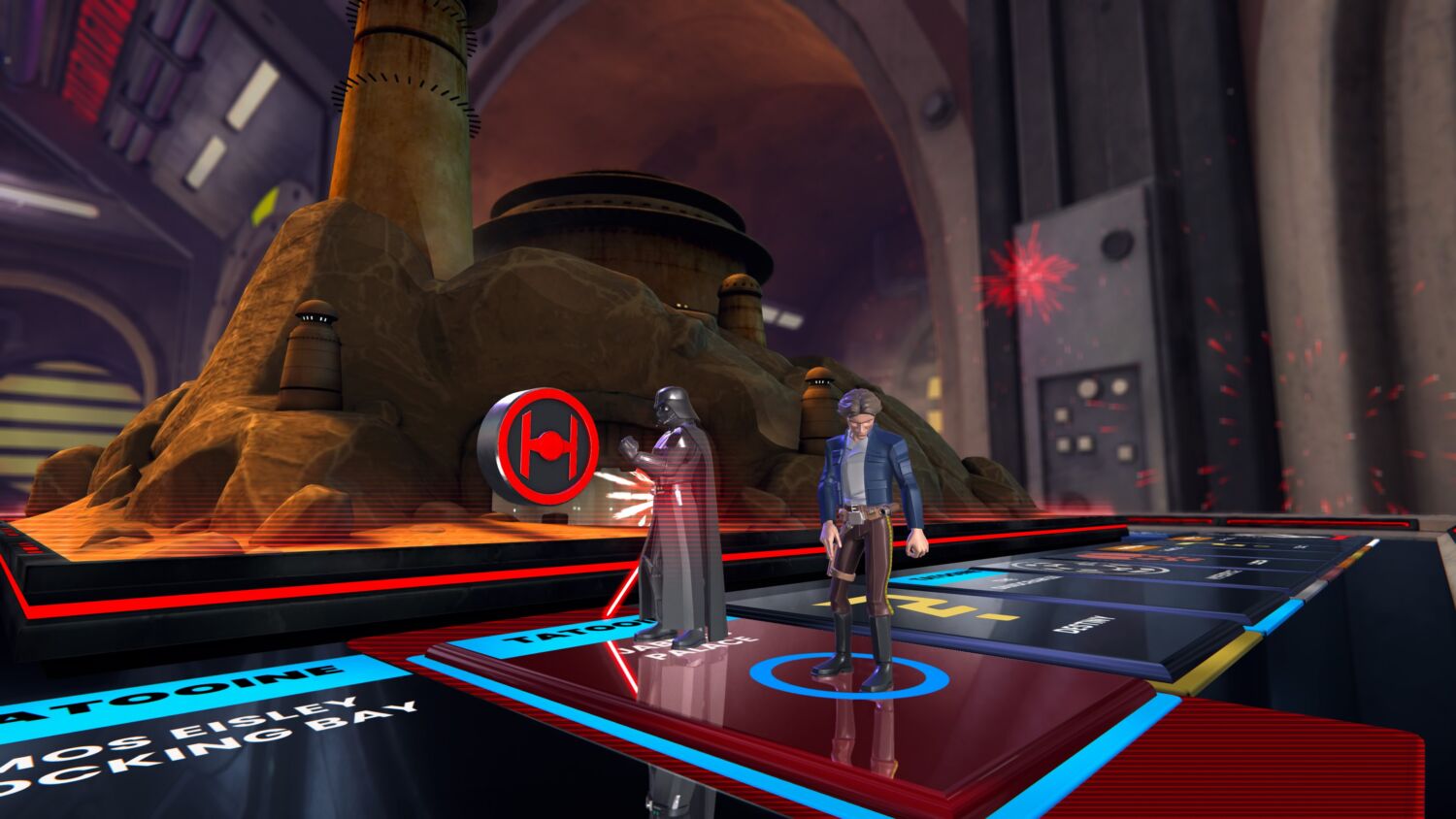
So the latest version from the French video game publisher, who has had prior experience bringing Monopoly to the digital realm with past attempts including 2021’s Monopoly Madness and 2024’s New Monopoly, seems like an exciting addition except that even the weakest of padawans cannot lift up this game with their Jedi skills.
The moment you fire up the game, and as the Star Wars visual appears, the music plays, and it’s nothing remotely familiar because the game runs the most generic and uninspired music that is in no way linked to George Lucas’ creation, as if it were a mockbuster – a cheap film designed to trick audiences with knock-off titles and similar cover art.
But then the computer graphics roll and you see an X-Wing, Darth Vader, Luke Skywalker, Han Solo, Bo Katan and more grace the screen – that’s right, the game includes additional Star Wars characters from the animated and live-action shows, incorporating a wider number of characters from beyond the films and you want to give it a chance, but this is also not the Monopoly you might remember.
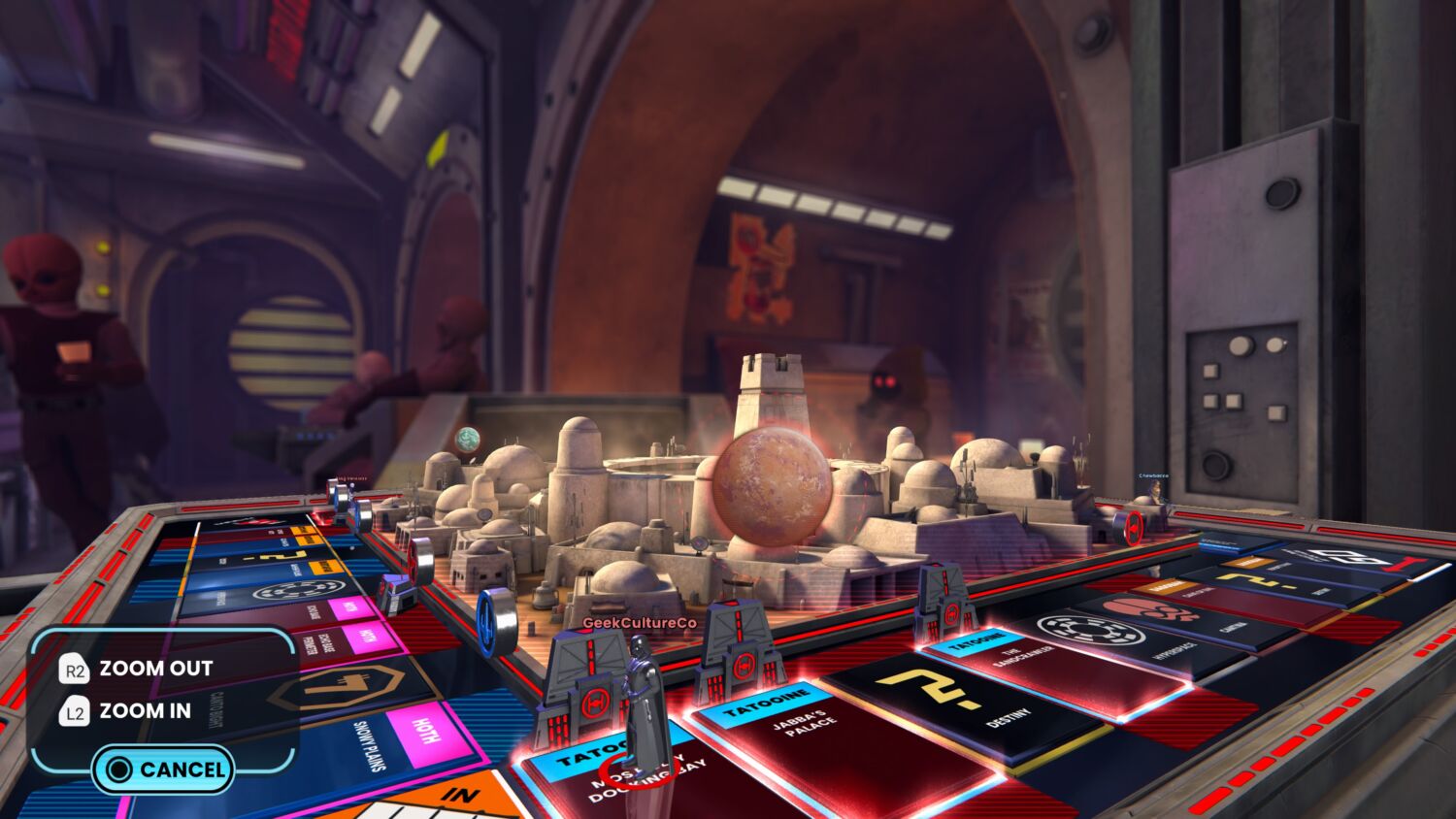
Perhaps the biggest change of all lies in the game’s overall structure, as Monopoly: Star Wars Heroes vs Villains transforms the usual Monopoly free-for-all playstyle into a team-based one, pitting teams of two or three players against each other as iconic characters from the Empire or the Republic, with the inclusion of lesser-known figures like Dedra Meero or Aurra Sing, but not the likes of Lando Calrissian, R2-D2 or Poe Dameron.
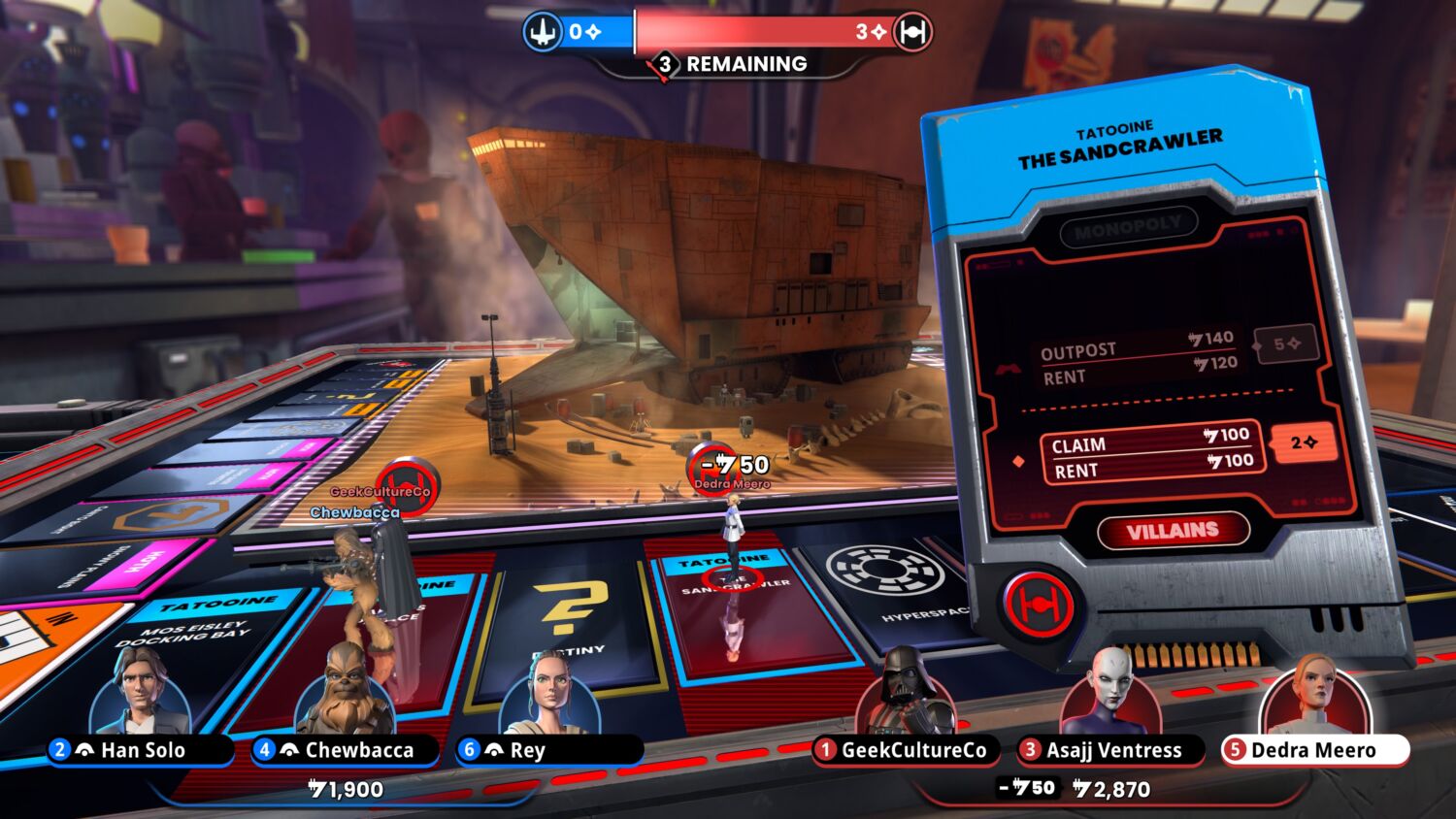
Once the teams are chosen and the game begins, players will recognise the familiar square board, now filled with familiar locations from the hit franchise, from Jabba’s Palace on Tatooine to Echo Base on Hoth, as each player takes turns to roll the digital dice and advance forward, buying properties laid out throughout the board.
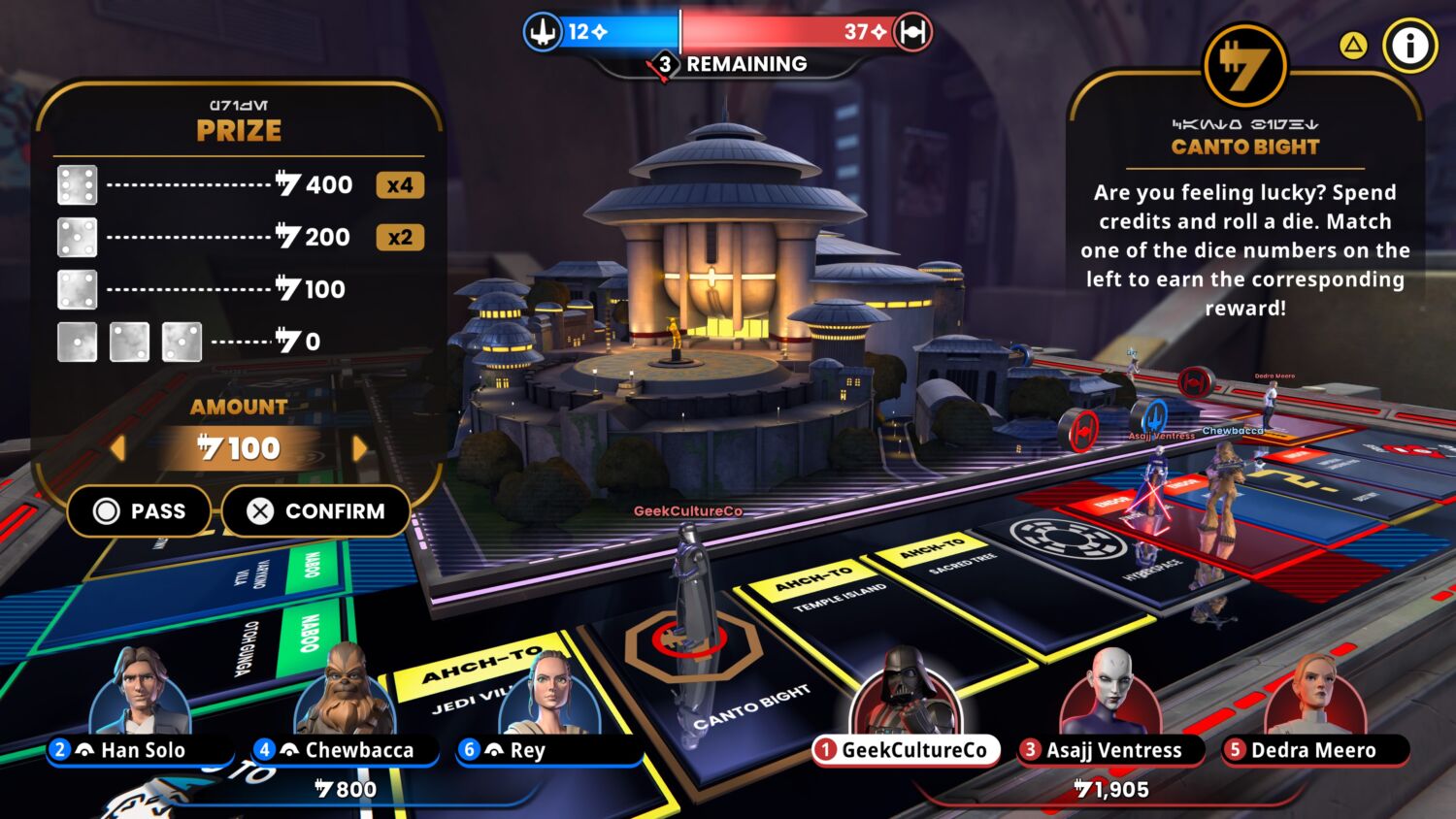
Pretty soon, deviations from the original game start to reveal themselves, starting with the inclusion of unique special cards mixed in with the properties. Apart from the Destiny spot, which functions just like the original’s “Chance” and “Community Chest”, and allows the player to draw a card with a random special effect, the game also features three unique ones – The Cantina, where players can buy one ability from a random set, the Canto Bight casino, where they can earn extra cash with a dice roll mini-game, and Hyperspace, which lets them teleport to specific locations on the board.
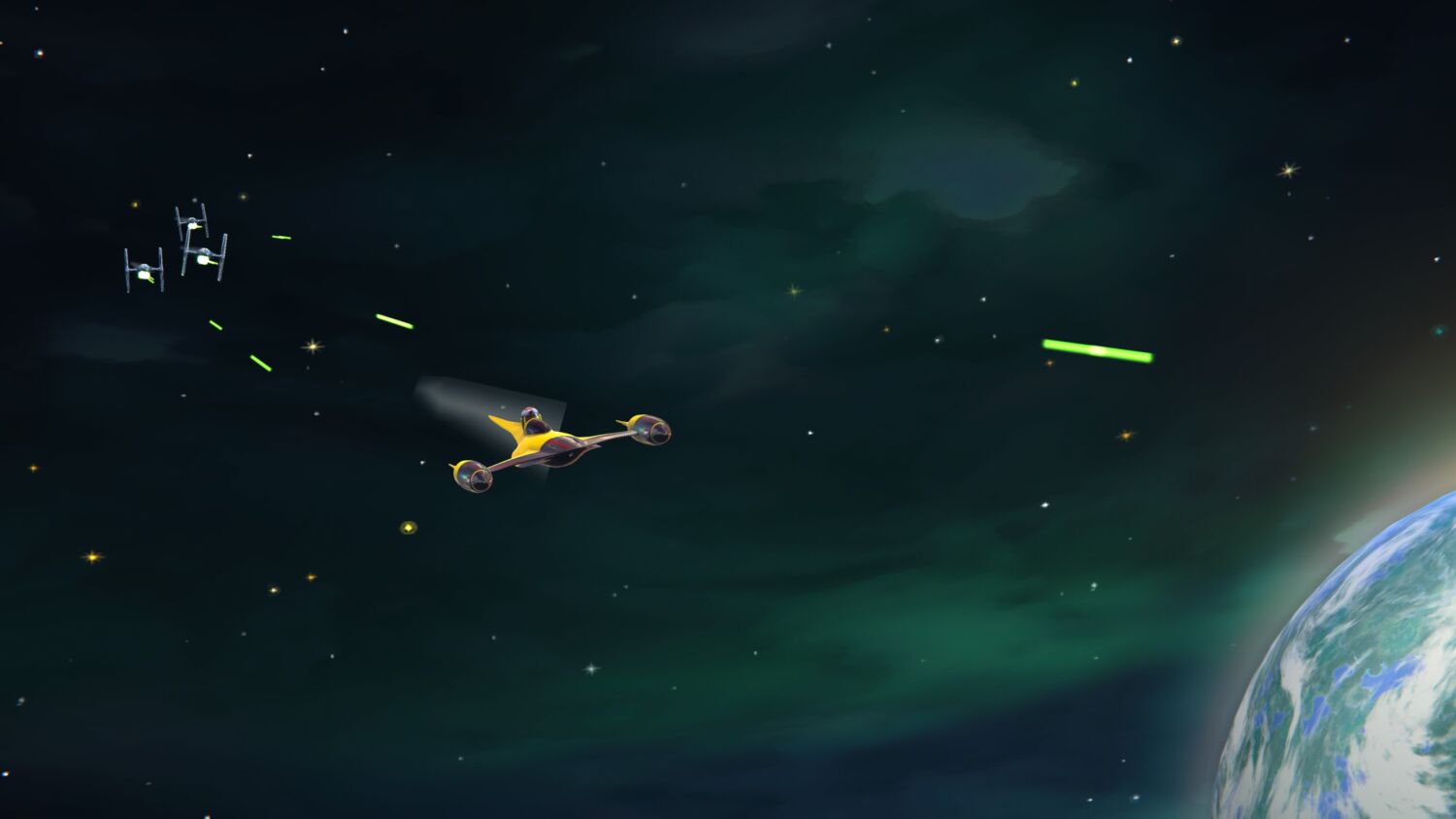
As the game progresses, so do the changes, as it also introduces an element of combat to the game, so to speak, as players can now engage in “battles” against each other. If you land on a tile owned by the opposing team with an opposing player already on it, or vice versa, the game transitions into a “Starfighter Battle” phase.
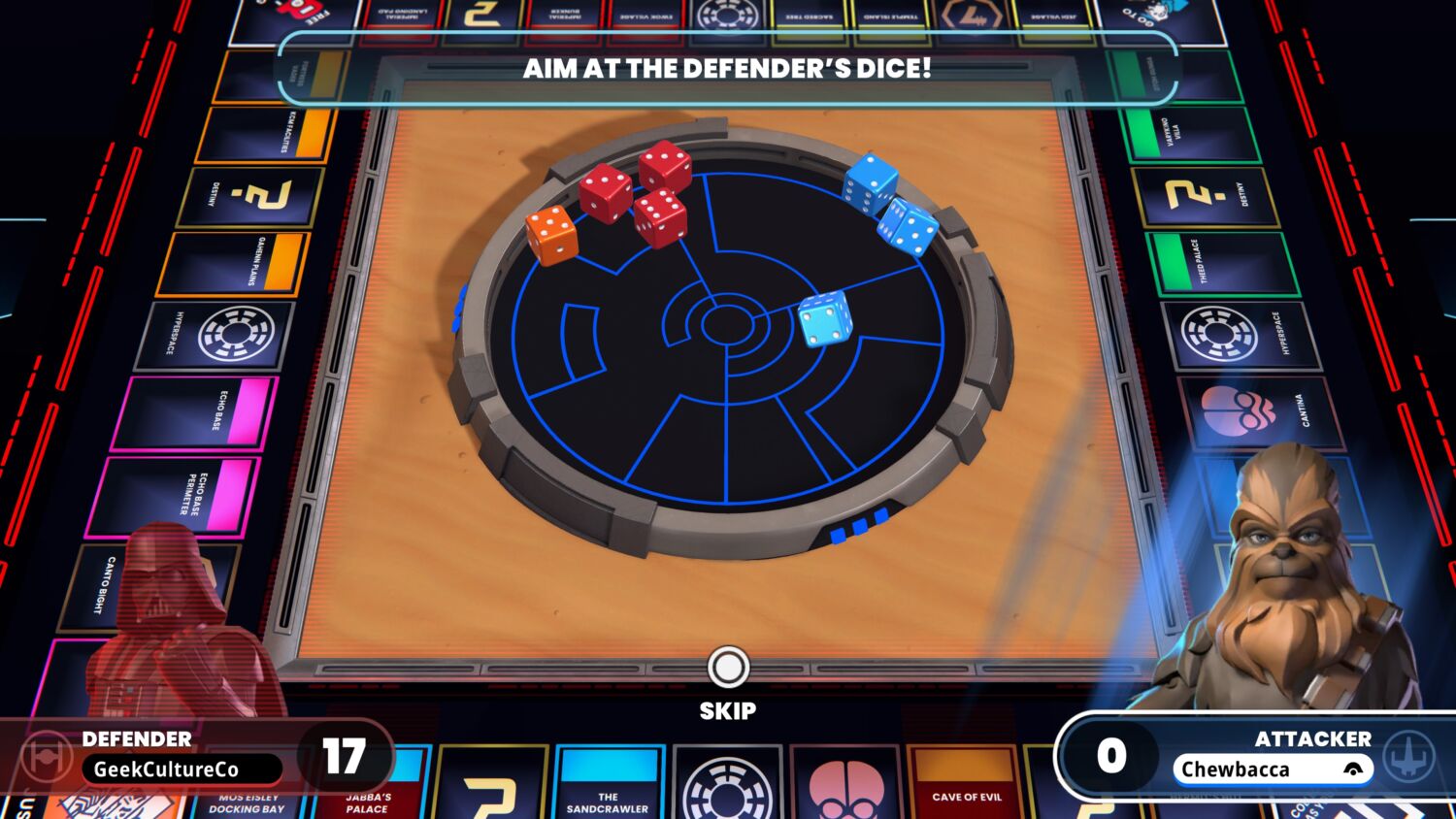
The “action” takes place in the large empty space in the middle of the board, in an “arena” where battles occur upon a series of dice throws, with the defender (the owner of the property) first throwing three dice, followed by the attacking player. And the winner is decided by the side with the highest total dice value. This mini-game doesn’t operate purely on luck, though, as both sides can choose the direction and impact of the thrown dice, which allows the attacker an opportunity to make contact with the defender’s dice and change their value.
Of course, this can work to and against an attacker’s favour, as changing a defender’s dice value might inadvertently increase it further, so players need to be smart about where they aim, and only risk changing values when faced with a six, for example. If an attacker wins, they automatically gain complete control of the defender’s property, or pay a hefty sum to the defender upon defeat.
Each character also possesses a unique ability that can change the nature of the game, and these abilities are a reflection of each character. Yoda, for instance, has an additional die during a combat roll, reflecting his superior fighting skills that make him a challenge to defeat.
Darth Vader and Luke Skywalker can summon a companion to land on a nearby tile and activate it to buy properties and draw cards, while Mace Windu and Assajj Ventress allow their allies to throw one extra die during combat, and Obi-Wan Kenobi and Kylo Ren allow the reroll of dice if the team fails during GO Events. Some abilities are unique to a scenario, or can only be triggered after a set number of turns, but knowing when and how to use them can alter the nature of buying properties, combat and GO Events.
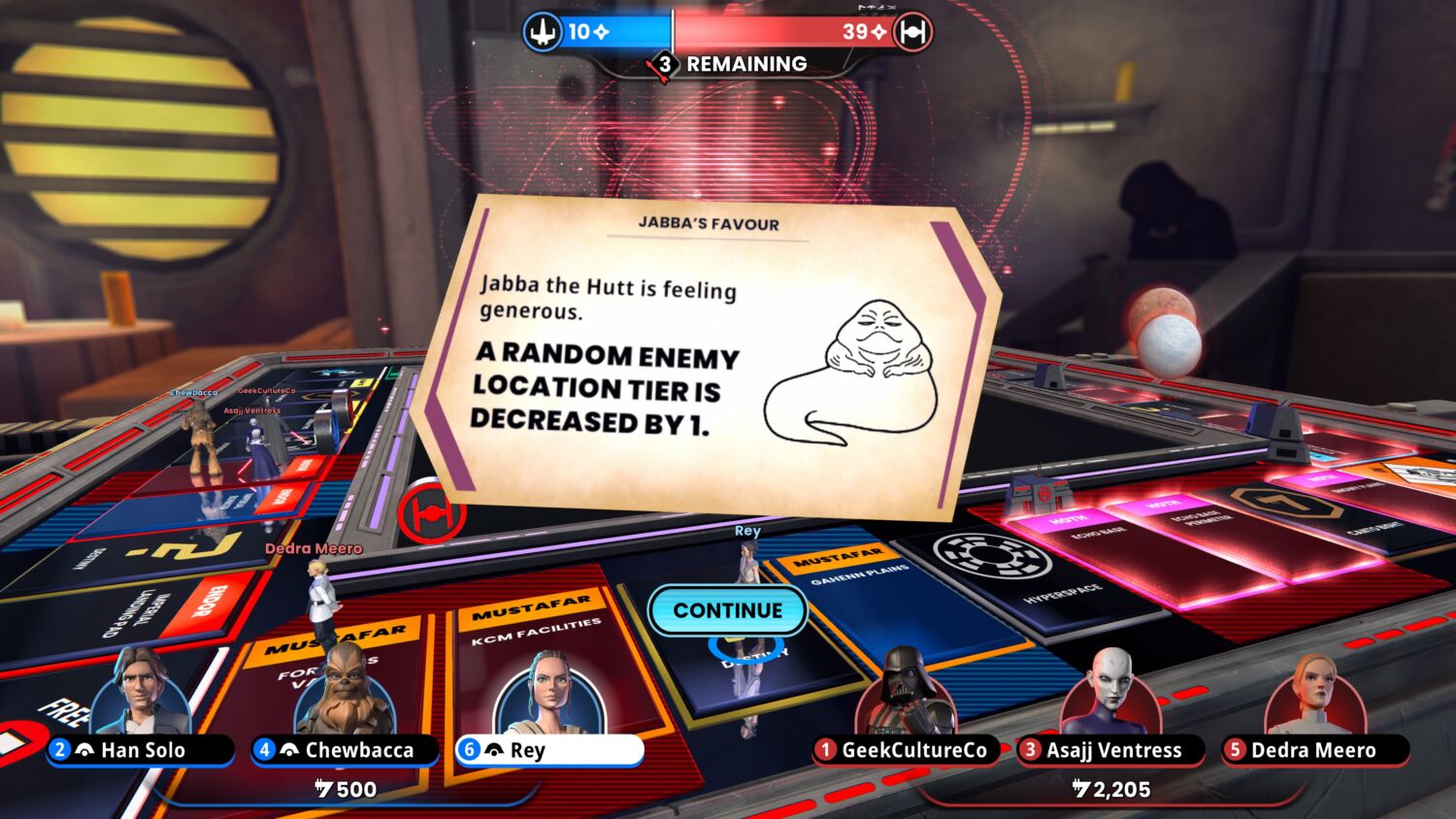
On the topic of properties, this is another aspect where Monopoly: Star Wars Heroes vs Villains deviates slightly from the original board game to match a streamlined video game form. Much like the original, buying all three properties of the same colour (or planet, as it’s known in this game) leads to a Planet Monopoly, which allows a player to then build and upgrade bases (the equivalent of houses and hotels in the original), up to three tiers.
How bases operate is also different from the original board game, too, as here, the opposing team is able to destroy said bases when they land on the property tile, reducing the tiers one by one until they are eventually able to take over the ownership of the property. So if you land on a location owned by your opponent, but they have not increased the tier, you can claim ownership just like that.
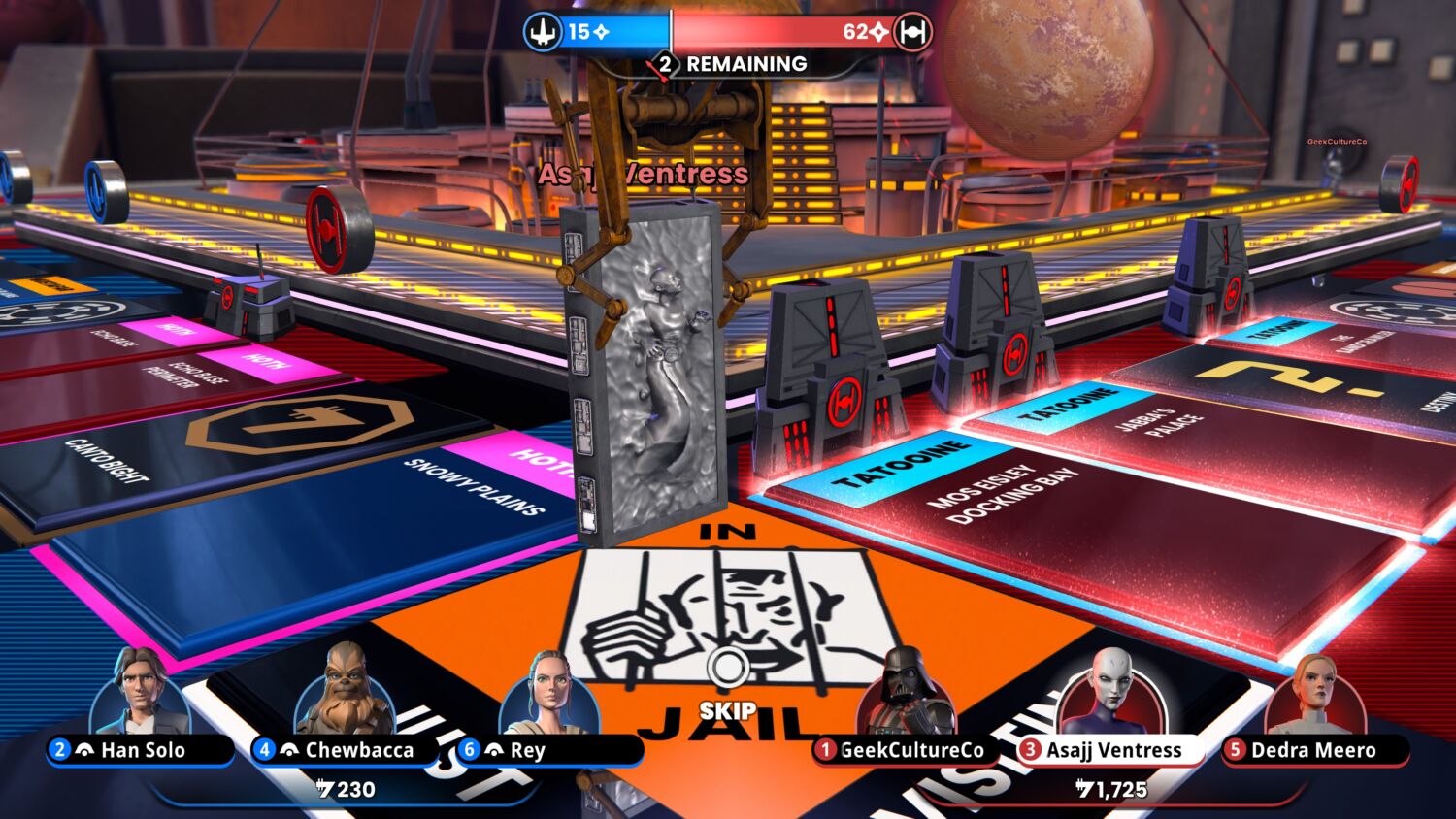
Further in the game, it offers players the chance to break an opponent’s monopoly, as they will just need to destroy the base upgrades and claim a property on an opponent’s set to prevent them from further buying base upgrades.
Unlike normal Monopoly, where the goal is to either own all properties on the map or bankrupt opponents to be the last one standing, winners in Star Wars Heroes vs Villains are determined by Influence Points and GO Events. Every successful action in the game, such as buying properties, bases, and successfully attacking an opponent, increases a team’s total Influence Points, with the team with the highest points at the end of the game emerging victorious.
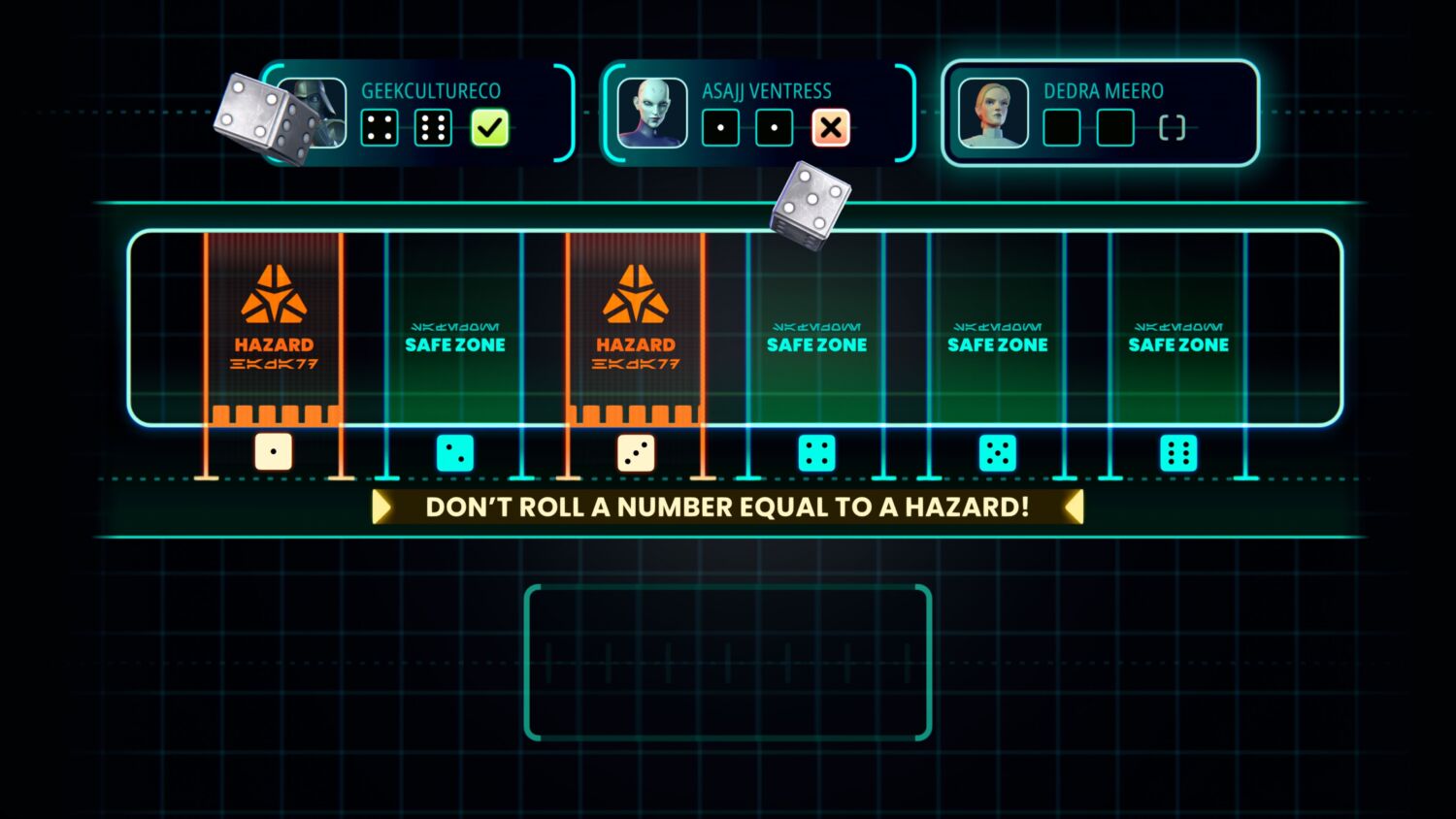
The end of the game also comes after a predetermined set number of GO Events are triggered, with players choosing the total number of events needed at the start to be completed before the game ends. Every time any character passes GO, they not only collect credits just like the original game, but also trigger a random GO Event. These come in the form of team-based mini-games that operate on dice throws.
Themed after pivotal moments in the Star Wars franchise, such as the Death Star trench run in 1977’s Star Wars: Episode IV – A New Hope, these minigames are chance-based and played by the entire team of the player who passes GO. The challenges include rolling a dice to match one of four randomised numbers, and all it takes is for one player to succeed to win.
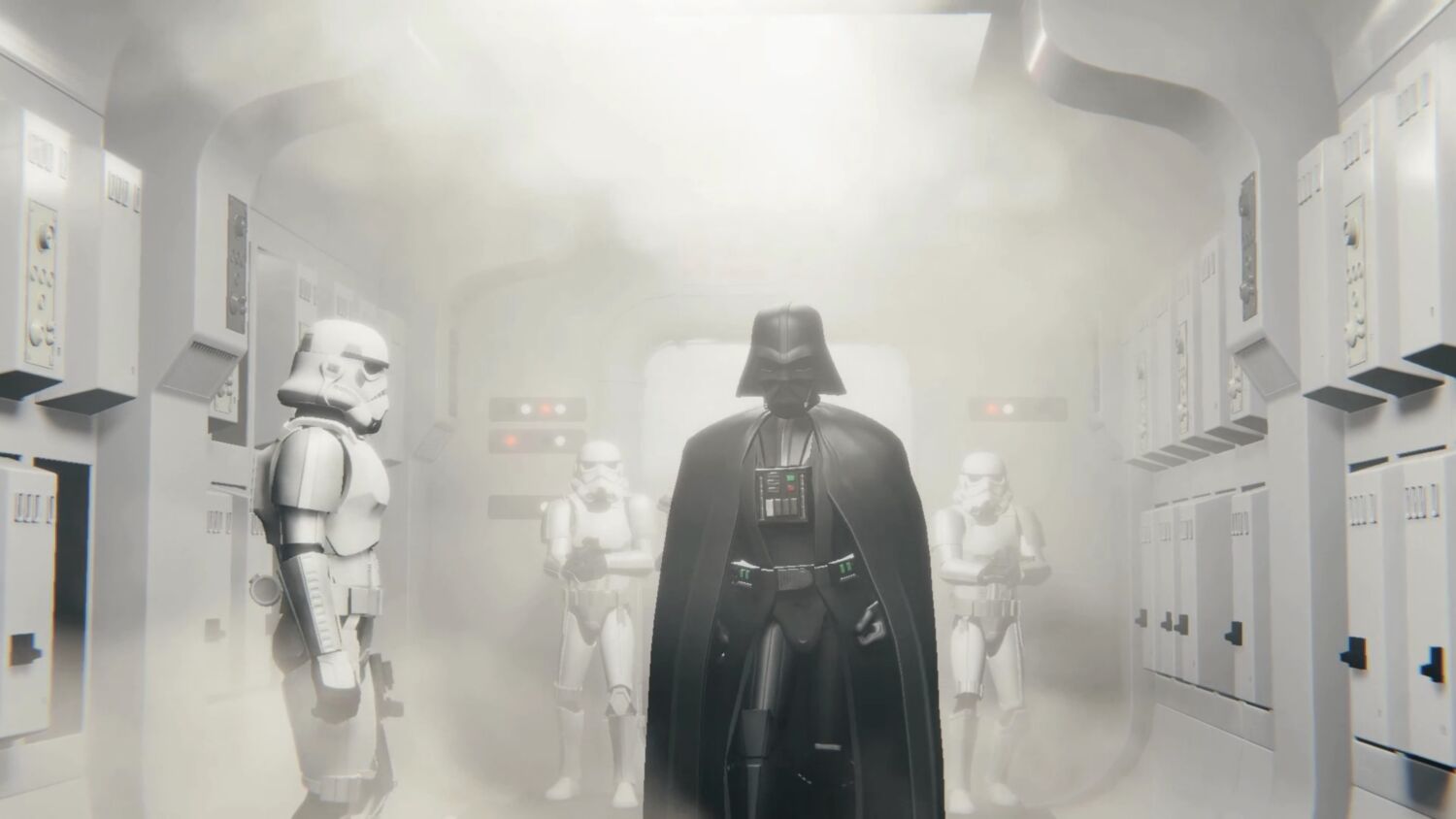
Each player, excluding anyone who is currently in jail, will take turns to roll the dice and try to hit the target number, with the challenge getting more difficult with every throw (the four randomised numbers, for example, will reduce by one with every attempt). Even if a team manages to win the challenge with their first throw, the remaining players can still attempt a dice throw after, with every successful throw gaining extra influence points. At the end of a successful GO event, the team earns not just a large amount of points, but also an additional effect, such as the ability to buy a base on any owned property in a monopoly for free.
Taking all these new additions into account, Star Wars Heroes vs Villains offers a new Monopoly experience suited for quick matches, but leaves out a lot of the Star Wars ones, where random chance means Han Solo can win a fight against any Sith Lord.
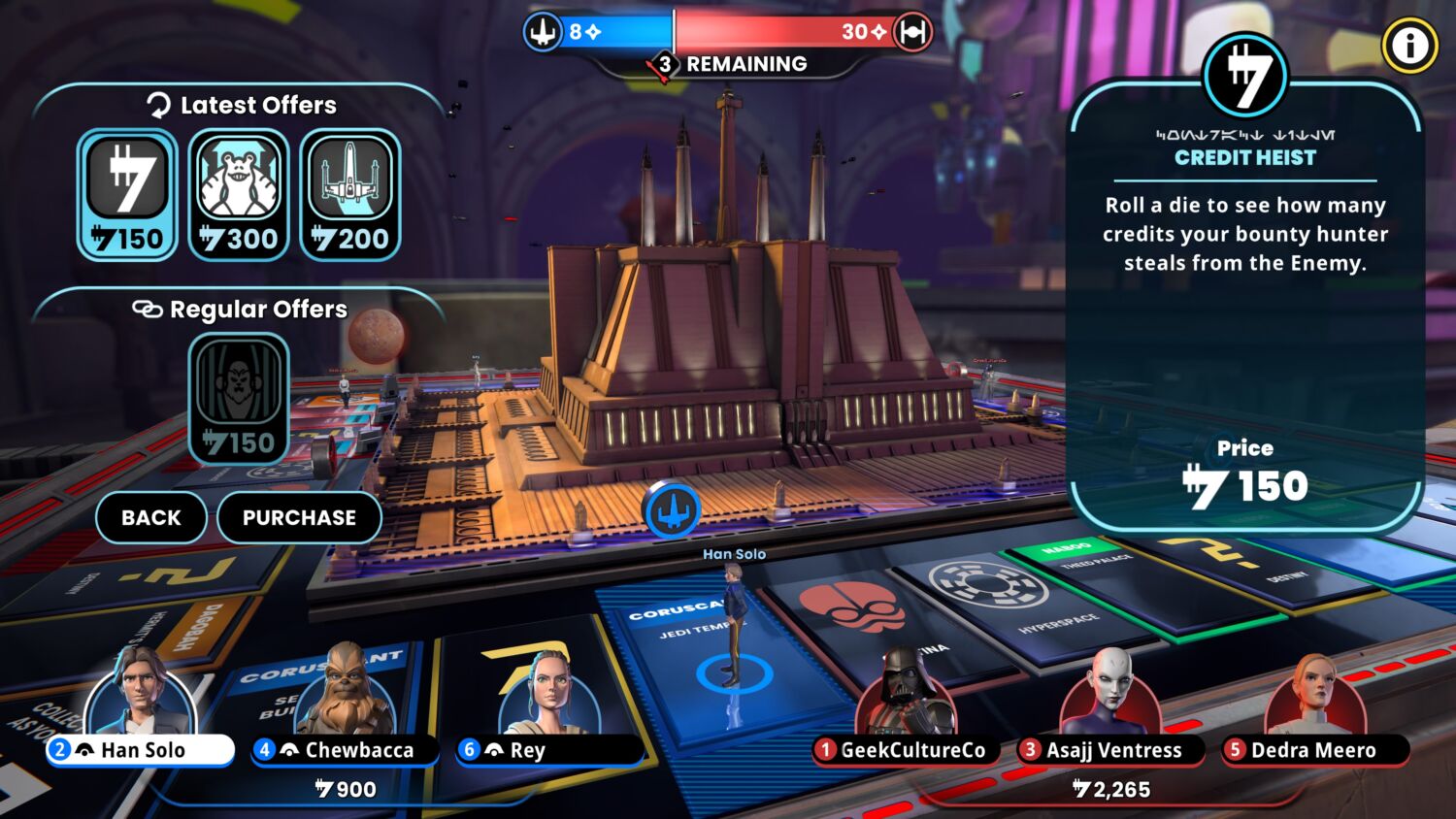
The issue here lies in balance, or in this case, perceived balance. As every dice roll plays out digitally, there will be times when it feels like the game is “rigged” and working against you. Of course, this is all down to luck, but it’s hard not to feel this way after three dice rolls in a row land all members of the team in jail, while the opponent instantly succeeds their GO Events on the first roll. This is much more noticeable when playing against the AI, as the game offers three difficulty modes, and at the highest one, it can truly feel like the odds are completely stacked against you.
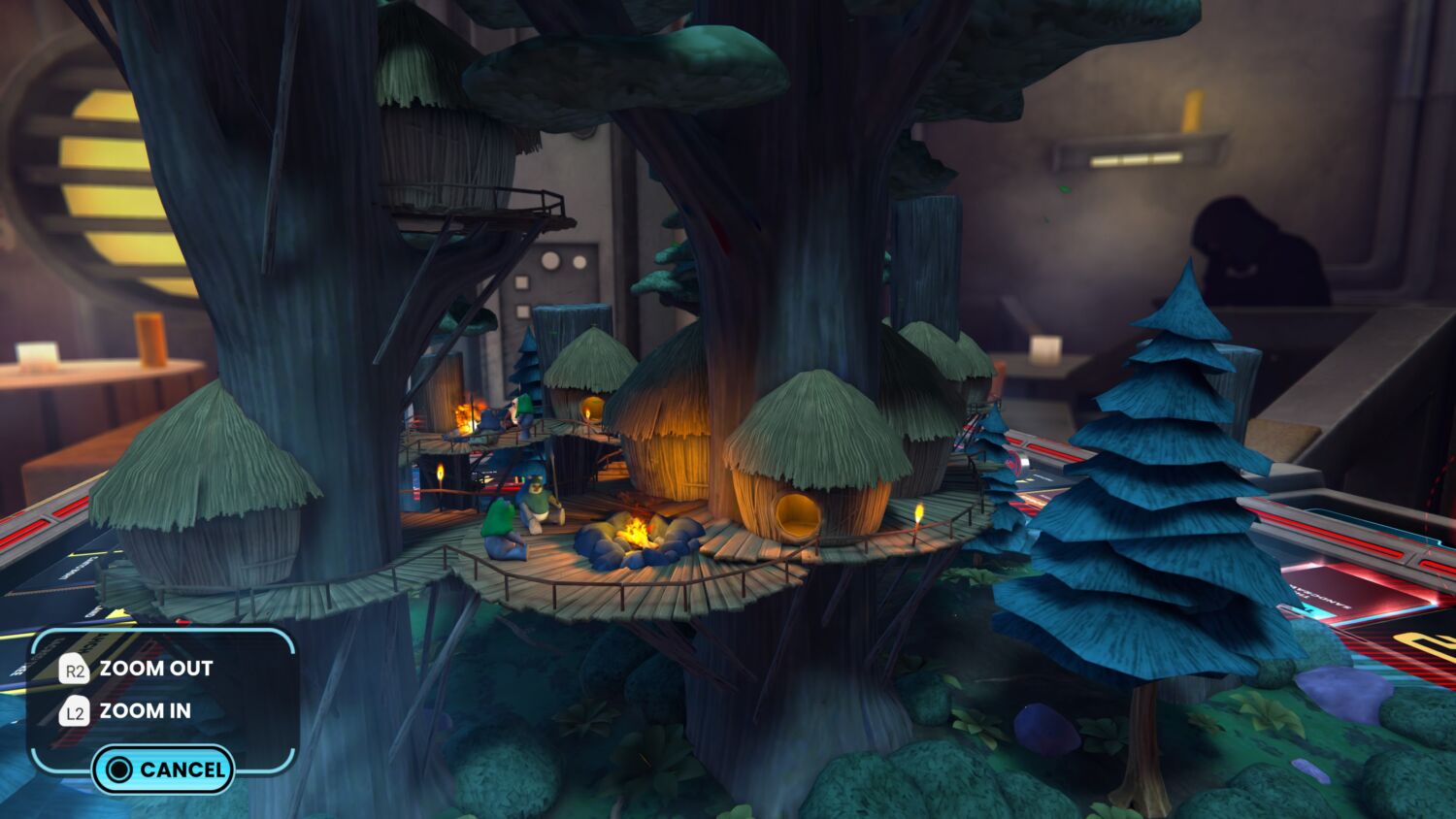
Familiar visuals, such as space battles, look exciting at first, but after several fights, the cut scenes look repetitive. And while each property is presented via a holographic diorama in the middle of the board when a player lands on it, the small visual treat loses its glamour rather quickly after multiple games. The fan service may be out in full force (pun intended) during GO Events, but what’s the point of seeing the Death Star blow up, or toppling an AT-AT during the battle of Hoth, when no element of John Williams’ powerful score is present?
Bringing a physical board game to the digital realm of video games is not always an easy task, and the mish-mash elements in Monopoly: Star Wars Heroes vs Villains do not blend well, especially for Star Wars fans. As a party game, the replay value isn’t there either and serves more as a novelty than a journey into a galaxy far, far away.
GEEK REVIEW SCORE
Summary
Monopoly: Star Wars Heroes vs Villains makes limited use of the hit franchise and while changes to the classic game are appreciated for casual fans, it hits the target as only a Stormtrooper can.
Overall
5/10-
Gameplay - 5/10
5/10
-
Presentation - 5/10
5/10
-
Value - 6/10
6/10
-
Geek Satisfaction - 4/10
4/10

Hsals needs more space in his house, and more money in his bank account to pay for all the toys, collectibles and other geek related items that companies are churning out. Free-time? Girlfriend? Who’s got time for those?

 Kevin Low