
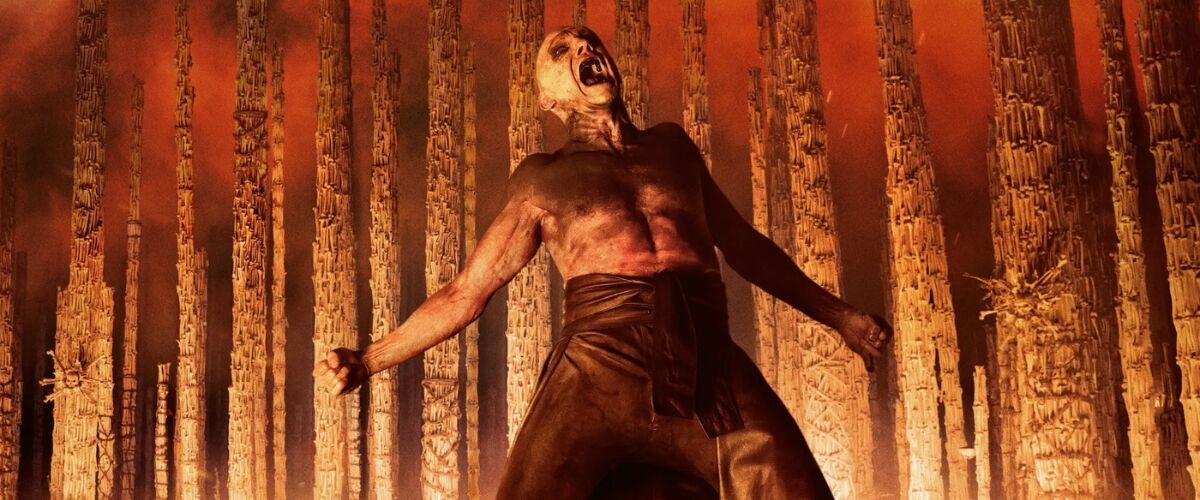
Middle entries in a trilogy are a balancing act, mostly because they inherit the momentum of a successful first chapter while carrying the burden of deepening its world, all without the catharsis of a true ending which sometimes causes them to spin their wheels, but ultimately stuck in narrative limbo. But when done well, à la Star Wars: The Empire Strikes Back (1980) and The Dark Knight (2008), they transcend expectations and define the series. 28 Years Later: The Bone Temple, thankfully, positions itself in that rare company.
Though filmed back-to-back with its franchise revival predecessor 28 Years Later (2025) and picking up almost immediately where it left off, 28 Years Later: The Bone Temple plays like its own creature entirely. Where Danny Boyle’s (127 Hours) return leaned into sweeping tension and large-scale suspense, director Nia DaCosta’s (Candyman) entry tightens the lens, making the apocalypse here feel more feral, more personal. The infected are as relentless as ever, but it’s the people who feel especially dangerous this time around. DaCosta has always favoured characters pushed to their extremes and here, she uses the smouldering ashes of post-collapse society to draw out raw, often ugly truths about survival, shame, and memory.

DaCosta, who first made waves with the indie thriller Little Woods (2018) and later with the polarising Candyman sequel (2021) and 2023’s The Marvels, was never an obvious pick. Yet her 2025 film Hedda – a provocative, thunderous take on the Hedda Gabler play – showed the full reach of her creative voice. It helps that DaCosta reunites with Icelandic composer Hildur Guðnadóttir (Tár, Joker), who scored her incendiary Hedda with a palette of whispers, moans, and unnerving silence. Her work on 28 Years Later: The Bone Temple is no less confrontational: an audio hallucination that veers between ecclesiastical stillness and guttural dread.
The previous film reintroduced Boyle’s world through the eyes of a fractured family, spotlighting Spike (Alfie Williams, His Dark Materials) and his strained parents Isla (Jodie Comer, Killing Eve) and Jamie (Aaron Taylor-Johnson, Bullet Train). The sequel leaves the domestic ache behind and zooms in on the film’s more baroque figures: Dr. Ian Kelson (Ralph Fiennes, Conclave) and Jimmy Crystal (Jack O’Connell, Sinners), whose Satanic televangelist energy detonated the prior film’s final act. O’Connell returns as the preacher’s son turned apocalyptic cult leader, leading a gang of tracksuited, bleach-wigged followers called “Jimmies” through the blighted countryside.

Recruited into Jimmy’s crew after being saved from a horde, Spike is folded into their deranged ritualism with a mix of confusion and horror. Unlike in 28 Years Later, Spike here functions more as a passive participant, a kind of living conscience trapped among devils. His initiation into the “Jimmies” is bloody and brutal, but it’s only the beginning. What follows is an unflinching descent into the group’s twisted doctrine of “charity”, a euphemism for torture, broadcast and justified in Jimmy’s fire-and-brimstone theatrics.
That descent leads to the film’s most upsetting stretch – a prolonged home invasion that discards the infected entirely in favour of pitting humans against each other. It’s a sequence that forces you to sit in the discomfort without any catharsis and cutaway as every act of violence is presented plainly without stylisation, and DaCosta resists the horror genre’s usual trick of giving the audience an emotional escape hatch. It’s a punishing section to watch, but also one that clarifies 28 Years Later: The Bone Temple’s moral centre – the infected were never the true horror.
O’Connell cements that idea with a performance that’s both magnetic and nauseating as Jimmy, walking the line between prophet and lunatic. That O’Connell manages to dominate the screen in three back-to-back horror titles: Sinners, 28 Years Later, and now The Bone Temple within a single year is a rare kind of hot streak. It may not be a huge leap from his Remmick in Sinners (another role that weaponised charisma into something jagged and dangerous), but O’Connell plays Jimmy with added spontaneity, giving the character a live-wire unpredictability, and you never know if Jimmy will hug someone or crucify them.

He shares a strange, jittering chemistry with Fiennes’ returning Dr. Kelson, whose story unfolds in an entirely different emotional register. Kelson hasn’t changed much since 28 Years Later, still quietly building a grotesque monument to the dead out of actual bones. After saying goodbye to Spike in the last film, he finds himself drawn into an unexpected companionship with Samson (Chi Lewis-Parry, Gladiator II), the towering, rage-infected “Alpha” with a big dong who once hunted him. What begins as a wary proximity turns into something that flirts with real connection, even tenderness, albeit through a gory, post-apocalyptic lens. Their friendship plays out with patience and quiet grace, allowing Lewis-Parry to convey an evolving intelligence through body language, breath control, and beautifully restrained physicality.
Fiennes, meanwhile, continues to thread a needle few actors can. When the film lets him be funny, he’s riotous, dry, deadpan. When he’s sad, he’s quietly gutting. DaCosta trusts Fiennes to walk that emotional tightrope without a safety net, and the result is oddly moving. By the time the third act descends into full mythopoetic horror, Kelson feels a lot like the last philosopher clinging to meaning inside an Iron Maiden album cover. Fiennes dancing to “The Number of the Beast” amid fire and chaos wasn’t on my 2026 bingo card, but it does land – grand, strange, and just restrained enough to avoid tipping into parody.

That balance between camp and carnage, poetry and pulp is where 28 Years Later: The Bone Temple makes its home. It’s a sequel, yes, but unlike 28 Weeks Later (2007) or even 28 Days Later, it assumes you’ve done your homework with very little hand-holding and no narrated recap. You need to have walked through the moral wreckage of 28 Years Later to make sense of where this new chapter begins, and where it’s choosing not to go… at least, not yet. For all its visceral tension and philosophical digressions, it withholds worldbuilding in favour of internal disintegration. What happened to the rest of Europe after the quarantine? What’s the state of the global response? Those questions, raised with such eerie clarity in the last film, are left untouched here. The world has moved on, we’re told but never shown in this contained sequel.
The upcoming third and final entry will no doubt carry the burden of answers but for now, 28 Years Later: The Bone Temple is content being the fevered middle act – the unravelling between infection and resolution, between the fall and whatever comes after. It’s a risky position for a film to occupy (middle chapters so often sag under the pressure of setup), but if writer Alex Garland and his team can stick the landing with the trilogy’s final instalment, this entry will be reappraised as a necessary breath before the plunge.
GEEK REVIEW SCORE
Summary
Rage-fueled zombies remain a threat in 28 Years Later: The Bone Temple, but belief, charisma, and human cruelty prove far deadlier. Whatever comes in part three has its work cut out.
Overall
7.5/10-
Story - 7/10
7/10
-
Direction - 7.5/10
7.5/10
-
Characterisation - 8/10
8/10
-
Geek Satisfaction - 7.5/10
7.5/10

Natalie is a big fan of anything related to movies, TV shows, and anime — you name it. When she’s not reading or being a dedicated cinephile, she’s probably playing gacha and tabletop games, or daydreaming of Caleb from Love and Deepspace.

 Si Jia

 Kevin Low